Healthy Cauliflower Gratin With a Cauliflower Cream Sauce, About 170 Calories a Serving
Healthy Cauliflower Gratin With a Cauliflower Cream Sauce, About 170 Calories a Serving
In this article:
- The Sauce Builds Itself From the Cauliflower
- Bubbly Edges, Tender Florets, a Crust That Crackles
- Gratin Math: 170 Against a 320 Calorie Dauphinois
- Ingredients for Healthy Cauliflower Gratin
- Steaming, Blending and Baking the Cauliflower Gratin
- Ten Quiet Minutes That Prevent a Watery Gratin
- Assembled on Christmas Eve, Baked on the Day
- Cheese Swaps and a Dairy Light Variation
- The Casserole Nobody Believes Is the Light One
- Questions Cooks Ask About Healthy Cauliflower Gratin
Healthy cauliflower gratin is the casserole I bring out at Christmas when the table expects something bubbling, golden and unapologetically creamy, and I want that dish to ask very little of the people eating it. It spoons like a gratin should. It simply weighs about half as much.
The trick is structural, not cosmetic. A third of the steamed cauliflower is blended straight into the milk sauce, so the sauce gains body from the vegetable itself instead of from cream, and a small amount of strong cheese can then do all the flavor work.
Each serving lands at about 170 calories, against roughly 320 for a classic potato dauphinois of the same size. The dish assembles the day before, bakes in twenty five minutes, and shares its oven happily with the rest of the Christmas menu.
The Sauce Builds Itself From the Cauliflower
Healthy cauliflower gratin stands or falls on its sauce, and the usual light version fails in a predictable way: thin milk, a little flour, and a sauce that tastes like an apology. Blending part of the cauliflower into that sauce changes its physics entirely.
Steamed florets blended with hot milk turn silk smooth and naturally thick, the way a potato would thicken a soup. Folded back through the remaining florets, the sauce clings in a continuous coat instead of pooling at the bottom of the dish.
The cheese is chosen for strength, not volume. Gruyere brings the deep, nutty flavor a gratin lives on, Parmesan adds salt and savor, and together they total one cup for eight servings, grated fine so they melt into every spoonful instead of sitting in pockets.
Greek yogurt goes in last, off the heat, for a quiet tang that reads as richness. It must never boil, or it splits and turns the sauce grainy; stirred in at the end, it stays smooth and nobody at the table will name it.
The same vegetable does similar work elsewhere on this site. Our healthy cauliflower mash leans on cauliflower for body in a lighter direction, while this gratin takes the same idea into the oven and under a crust.
Bubbly Edges, Tender Florets, a Crust That Crackles
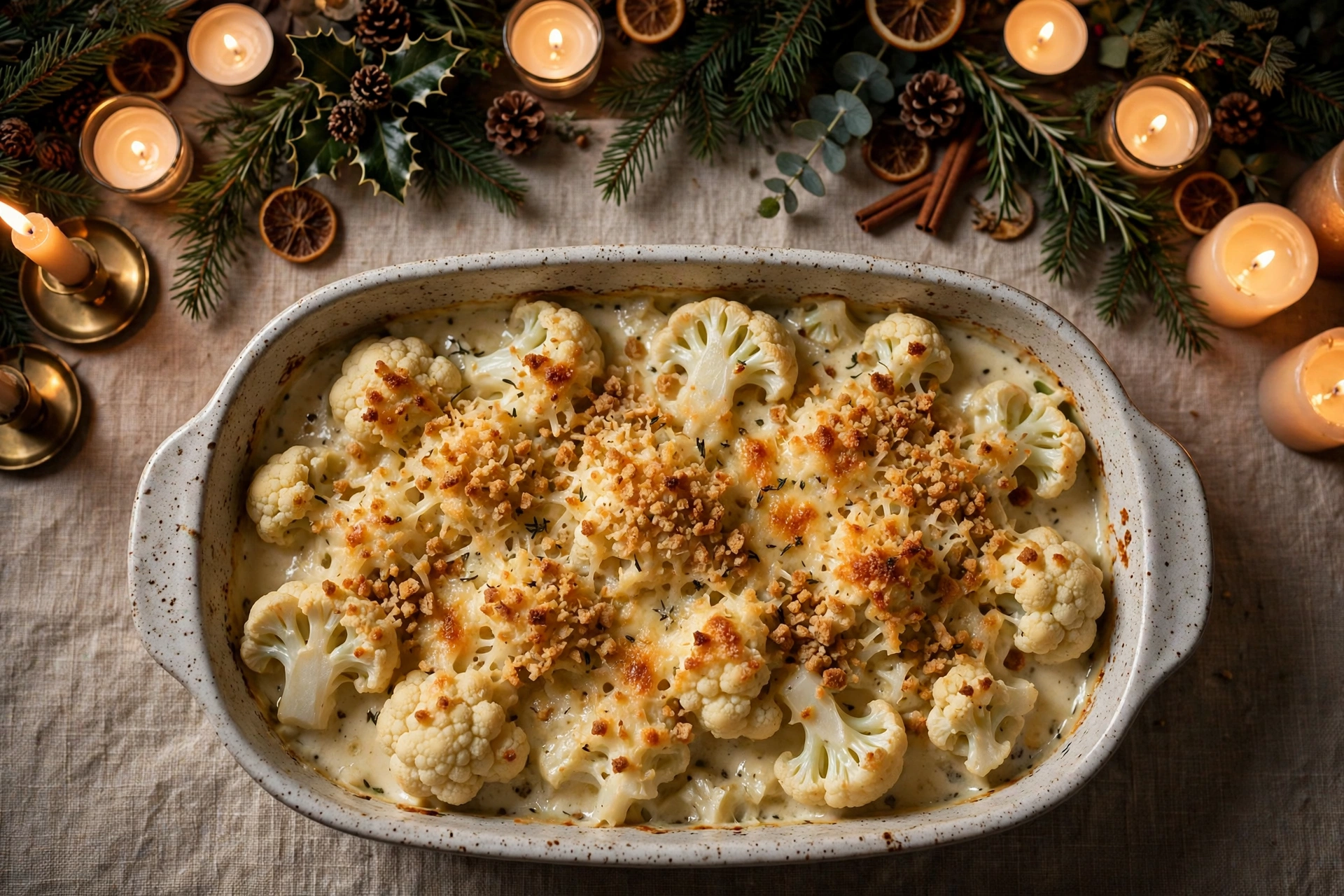
A gratin announces itself at the edges first. The sauce should bubble lazily around the rim of the dish, thick enough that the bubbles hold their shape for a second before they break, and the center should shiver slightly when the dish is nudged, then set as it rests.
The florets keep their identity here. Five minutes of steaming leaves them tender at the stem with a little resistance left in the crown, and the bake finishes them without collapse. A spoon should meet distinct florets in sauce, never a uniform mash.
The crust is deliberately thin and loud. Whole wheat crumbs tossed with olive oil and thyme toast into a crisp, freckled layer that crackles under the spoon, giving the creamy interior the one contrast it needs. A thick blanket of cheese on top would only go leathery as it cools.
Cauliflower carries more than texture to the dish. It brings vitamin C, vitamin K and fiber in real quantity, as the USDA FoodData Central listing shows, which is part of why this casserole can hold a Christmas plate without crowding out everything else.
Gratin Math: 170 Against a 320 Calorie Dauphinois
The classic dauphinois builds its sauce from cream and its body from potatoes, and a modest serving reaches about 320 calories before the cheese on top is counted generously. It is a wonderful dish. It is also a second main course hiding in a side dish.
This healthy cauliflower gratin changes the three expensive ingredients at once. Cauliflower replaces the potato, low fat milk and the blended florets replace the cream, and strong cheese in a measured cup replaces handfuls of mild cheese. The result is about 170 calories a serving, with 9 grams of protein and 3 grams of fiber.
The comparison matters because the place on the plate is the same. Guests spoon this gratin exactly where the dauphinois would have gone, beside the turkey or the roast, which is why our healthy scalloped potatoes exist for the tables that want the potato version lightened instead of replaced.
Nothing in the lighter build asks for specialty products. The flour is ordinary, the milk is the carton already in the refrigerator, and the yogurt is a quarter cup. The savings come from structure, and structure costs nothing at the store.
Ingredients for Healthy Cauliflower Gratin
Two and a half pounds of cauliflower fill a two quart dish for eight servings. Cut the florets bite size and fairly even, because the steaming time and the final texture both depend on pieces that finish together.
- 2 1/2 pounds cauliflower, cut into bite size florets, about 9 cups
- 2 cups low fat milk, 1 percent
- 3 tablespoons whole wheat flour, or all purpose flour
- 1 teaspoon olive oil, plus 2 teaspoons for the crumbs
- 1 garlic clove, grated
- 1/2 teaspoon Dijon mustard
- 1/4 teaspoon ground nutmeg
- 3/4 teaspoon fine sea salt
- 1/4 teaspoon black pepper
- 3/4 cup finely grated Gruyere cheese, about 3 ounces
- 1/4 cup finely grated Parmesan cheese
- 1/4 cup plain nonfat Greek yogurt, at room temperature
- 1/2 cup whole wheat panko, or fresh whole grain breadcrumbs
- 1 teaspoon fresh thyme leaves, plus extra for serving
Steaming, Blending and Baking the Cauliflower Gratin
The work divides into three calm stages: steam, sauce, bake. The steaming and the draining are the steps cooks rush, and the steps that decide whether the gratin comes out creamy or watery, so give them their minutes.
- Heat the oven to 400 degrees F. Lightly oil a 2 quart baking dish.
- Steam the cauliflower florets for 5 minutes, until a knife meets the stem with slight resistance. They finish in the oven, so stop while they still hold their shape.
- Spread the florets on a towel lined tray and let them drain and steam dry for 10 minutes.
- Set aside about 2 cups of the steamed florets. Warm the milk in a saucepan until it steams at the edges.
- Blend the reserved florets with 1 cup of the hot milk until completely smooth, with no visible flecks.
- Wipe out the saucepan and add the teaspoon of olive oil and the flour. Cook, whisking, for 1 minute, then slowly whisk in the remaining milk, followed by the blended cauliflower mixture.
- Simmer the sauce for 3 to 4 minutes, whisking often, until it thickly coats the back of a spoon.
- Take the pan off the heat. Stir in the garlic, mustard, nutmeg, salt and pepper, then the Gruyere and Parmesan, until melted. Stir in the Greek yogurt last.
- Fold the remaining florets through the sauce and transfer everything to the baking dish, leveling the top gently.
- Mix the crumbs with the 2 teaspoons of olive oil and the thyme and scatter them evenly over the top.
- Bake for 20 to 25 minutes, until the edges bubble and the crumbs are deep golden. Rest for 10 minutes before serving, with extra thyme over the top.

Ten Quiet Minutes That Prevent a Watery Gratin
Cauliflower is mostly water, and a gratin has nowhere for that water to go. Every watery cauliflower gratin I have ever met was made by florets that went into the sauce still steaming wet from the pot, diluting it a spoonful at a time as they baked.
The fix is patience in one specific place. Spread the steamed florets on a towel lined tray in a single layer and walk away for ten minutes. The surface moisture evaporates, the tray towel catches the rest, and the florets go into the sauce dry enough to drink it in instead of watering it down.
The sauce protects itself from the other side. It should simmer until it thickly coats a spoon before the cheese goes in, closer to a soft custard than to a pourable cream. A sauce that starts thin and meets a wet vegetable has no chance; a sauce that starts thick can absorb the little moisture the bake releases.
If a finished gratin ever does weep at the table, serve it with a slotted spoon and without apology, then note the two corrections for next time: longer drain, thicker sauce. The flavors forgive quickly, and the leftovers, reheated uncovered, usually set up firmer than the first serving.
Assembled on Christmas Eve, Baked on the Day
This gratin was built for a shared oven and a busy day. Assemble it fully on Christmas Eve, sauce, florets and all, cover the dish and refrigerate it, but keep the oiled crumbs in a separate small container so they stay dry.
On the day, the dish goes into the oven cold, with the crumbs scattered over at the last moment, and needs thirty minutes instead of twenty five. It bakes comfortably at the temperature most Christmas mains want, anywhere between 375 and 400 degrees F, with five minutes added at the lower setting.
Place it on the plate where the heavy gratin used to sit. Beside our healthy herb roasted turkey breast, it gives the Christmas plate its creamy element while the bird stays the centerpiece, and the two dishes share both oven timing and serving spoons without competing.
The ten minute rest is part of the recipe, not a courtesy. A gratin served straight from the oven slumps and runs; rested, the sauce settles around the florets and the portions hold their edges on the plate, which is the difference between a casserole and a side dish.
Cheese Swaps and a Dairy Light Variation
The cheese rule is simple: strong and finely grated beats mild and abundant. An aged white cheddar swaps for the Gruyere at the same weight, and a fully Parmesan version, one cup total, tastes sharper and saltier, so drop the added salt to half a teaspoon and taste before it goes in the dish.
For a dairy light variation, replace the milk with an unsweetened oat milk and the yogurt with a plain plant based yogurt of similar thickness. The blended cauliflower still gives the sauce its body, which is exactly why this recipe adapts where a cream based gratin would fall apart.
The crumbs accept variations gracefully. Fresh whole grain breadcrumbs toast softer and more rustic than panko, and a spoonful of finely chopped walnuts mixed into the crumbs adds a Christmas note and a second crunch for tables that like it.
Vegetable swaps stay close to home. Half cauliflower and half broccoli holds the method and turns the dish green and white for the holiday table, and our healthy broccoli casserole covers the fully broccoli route for families who want both dishes in the same week.
The Casserole Nobody Believes Is the Light One
Healthy cauliflower gratin does its best work in silence: it arrives bubbling, spoons like a classic, and lets someone mention the calories only if they want to. The cauliflower in the sauce is the whole secret, and it stays a secret at the table.
Assemble it the day before, guard the ten minute drain, and Christmas dinner gains its creamy casserole at about 170 calories a serving, with the oven, and the cook, still calm.
Questions Cooks Ask About Healthy Cauliflower Gratin
Why did my cauliflower gratin come out watery?
Almost always the florets went into the sauce wet, or the sauce went in thin. Drain the steamed cauliflower on a towel for a full ten minutes, and simmer the sauce until it thickly coats a spoon before the cheese is added. Both fixes together end the problem.
Can I assemble the gratin the day before Christmas?
Yes, and it improves the day. Assemble everything except the crumbs, cover and refrigerate for up to twenty four hours, then scatter the oiled crumbs over just before baking. Add about five minutes to the bake, since the dish starts cold.
Can I use frozen cauliflower florets?
You can, with a longer drain. Steam them from frozen for four minutes, then give them fifteen minutes on the towel instead of ten, pressing very gently once. Frozen florets release more water than fresh, and the extra draining is what keeps the sauce thick.
What cheese works if I have no Gruyere?
Aged white cheddar is the closest swap at the same weight, and Comte or Emmental also work. Keep the total at one cup including the Parmesan, and grate it fine: finely grated strong cheese covers more sauce than coarse shreds of a milder one.
How long do leftovers keep, and how do I reheat them?
Leftovers keep for three days in the refrigerator. Reheat a portion uncovered at 350 degrees F for fifteen to twenty minutes, which dries the surface and brings the crumbs back to crispness. A microwave portion tastes fine but softens the top, so the oven is worth it for the full dish.

Healthy Cauliflower Gratin
Cauliflower florets steamed for five minutes and drained for ten, a third of them blended into a low fat milk sauce with strong Gruyere and Parmesan in a measured cup, Greek yogurt stirred in off the heat, and a whole wheat crumb top toasted with olive oil and thyme. About 170 calories a serving against roughly 320 for a classic potato dauphinois, made for the Christmas table.
- Total Time: 55 minutes
- Yield: 8 servings 1x
Ingredients
- 2 1/2 pounds cauliflower, cut into bite size florets, about 9 cups
- 2 cups low fat milk, 1 percent
- 3 tablespoons whole wheat flour, or all purpose flour
- 1 teaspoon olive oil, plus 2 teaspoons for the crumbs
- 1 garlic clove, grated
- 1/2 teaspoon Dijon mustard
- 1/4 teaspoon ground nutmeg
- 3/4 teaspoon fine sea salt
- 1/4 teaspoon black pepper
- 3/4 cup finely grated Gruyere cheese, about 3 ounces
- 1/4 cup finely grated Parmesan cheese
- 1/4 cup plain nonfat Greek yogurt, at room temperature
- 1/2 cup whole wheat panko, or fresh whole grain breadcrumbs
- 1 teaspoon fresh thyme leaves, plus extra for serving
Instructions
- Heat the oven to 400 degrees F. Lightly oil a 2 quart baking dish.
- Steam the cauliflower florets for 5 minutes, until a knife meets the stem with slight resistance.
- Spread the florets on a towel lined tray and let them drain and steam dry for 10 minutes.
- Set aside about 2 cups of the steamed florets. Warm the milk in a saucepan until it steams at the edges.
- Blend the reserved florets with 1 cup of the hot milk until completely smooth, with no visible flecks.
- Wipe out the saucepan and add the teaspoon of olive oil and the flour. Cook, whisking, for 1 minute, then slowly whisk in the remaining milk, followed by the blended cauliflower mixture.
- Simmer the sauce for 3 to 4 minutes, whisking often, until it thickly coats the back of a spoon.
- Take the pan off the heat. Stir in the garlic, mustard, nutmeg, salt and pepper, then the Gruyere and Parmesan, until melted. Stir in the Greek yogurt last.
- Fold the remaining florets through the sauce and transfer everything to the baking dish, leveling the top gently.
- Mix the crumbs with the 2 teaspoons of olive oil and the thyme and scatter them evenly over the top.
- Bake for 20 to 25 minutes, until the edges bubble and the crumbs are deep golden. Rest for 10 minutes before serving, with extra thyme over the top.
- Prep Time: 20 minutes
- Cook Time: 35 minutes
Nutrition
- Serving Size: 1 cup
- Calories: 170
- Sugar: 6
- Sodium: 290
- Fat: 9
- Saturated Fat: 4
- Unsaturated Fat: 5
- Trans Fat: 0
- Carbohydrates: 14
- Fiber: 3
- Protein: 9
- Cholesterol: 20