
Healthy Herb Roasted Turkey Breast: Juicy, Golden and Light
In this article:
## What Makes This Healthy Herb Roasted Turkey Breast Special
Healthy herb roasted turkey breast solves the eternal Thanksgiving dilemma: how to serve a juicy, golden centerpiece without the butter overload and without roasting a twenty pound bird. This recipe skips the butter entirely and skips the wine too, building flavor instead from olive oil, fresh herbs, lemon and savory chicken broth.
The result is a turkey breast with shatteringly crisp, herb-flecked skin and meat so moist it barely needs gravy. Every slice carries the seasoning all the way through, not just on the surface.
The technique borrows the best ideas from restaurant kitchens and leaves the fussy ones behind. Loosening the skin and rubbing the herb paste directly onto the meat seasons from the inside out, so every slice tastes like rosemary and sage, not just the skin.
A shallow bath of broth in the roasting pan creates gentle steam that protects the breast during its long roast. An instant read thermometer takes all the guesswork out of doneness, which is the real secret to turkey that never dries out.
Healthy herb roasted turkey breast starts with a dry brine the night before, and that single step changes everything. Salt draws moisture to the surface, then the meat reabsorbs it along with the seasoning, which means juicier slices and deeply seasoned flavor all the way through.
The next day you simply rub on the herb paste and roast. No basting marathons, no cheesecloth, no stress. This is Thanksgiving cooking for people who would rather enjoy the holiday than babysit the oven.
## Flavor Notes and Texture Contrast
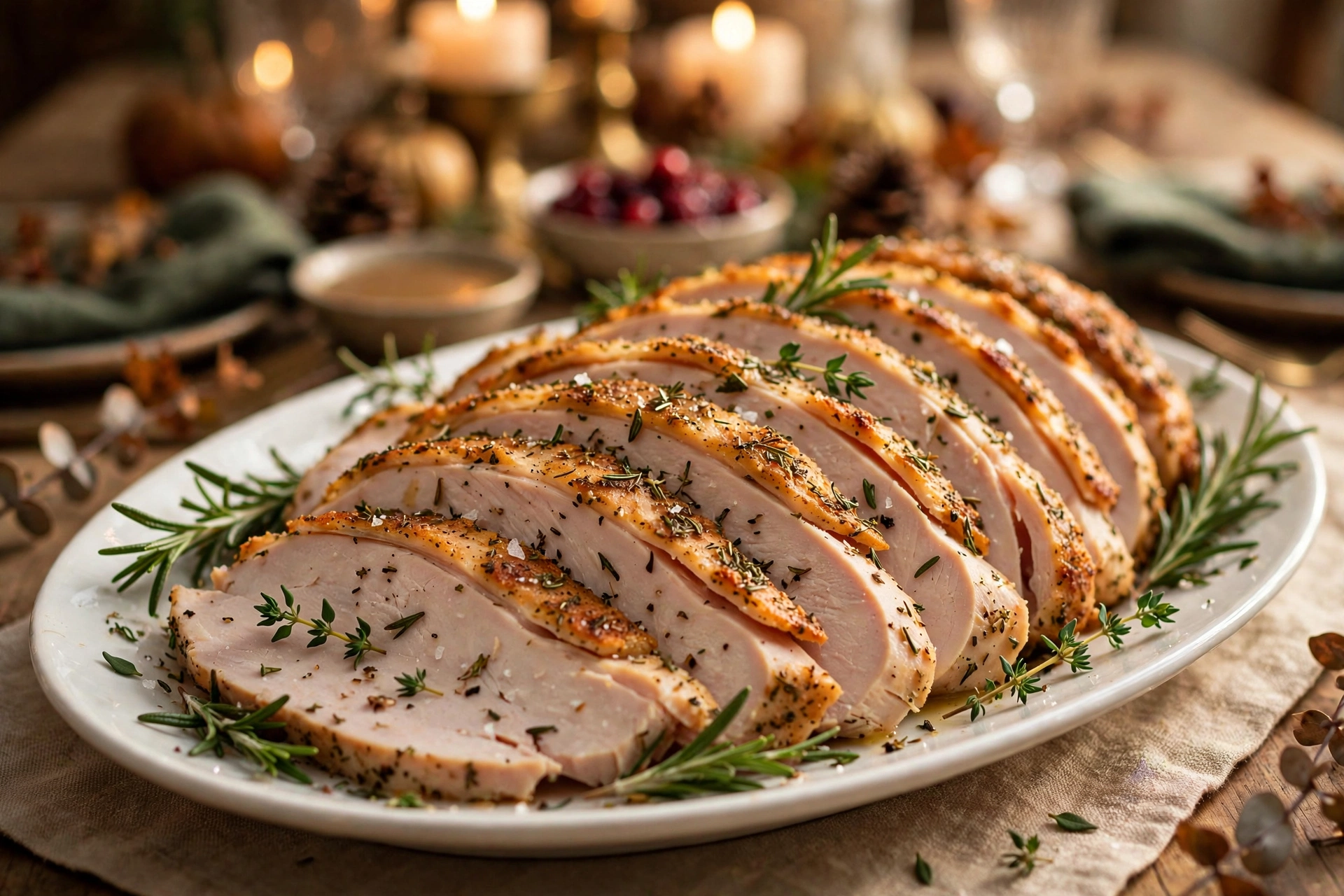
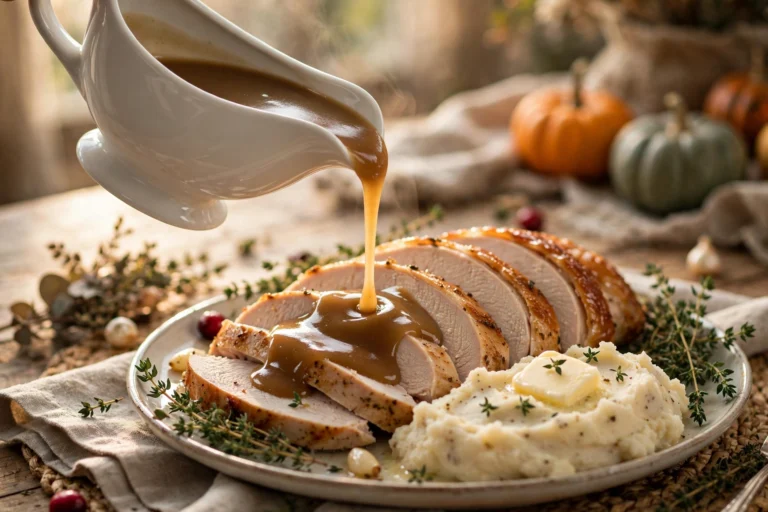
The first thing you notice is the skin: deeply golden, lacquered with herbs, crackling lightly under the knife. Rosemary brings piney intensity, sage adds earthy warmth, and thyme contributes a gentle floral note that ties them together. Fresh parsley, stirred in at the end, keeps the paste bright instead of muddy.
Under the skin, the meat tells a different story. The breast stays pale and succulent, each slice glistening with natural juices. Lemon juice in the herb paste does quiet work here, its acidity tenderizing the outer layer of meat while adding a freshness that cuts through the richness. You taste herbs first, then clean turkey flavor, then a faint citrus finish that makes you reach for another slice.
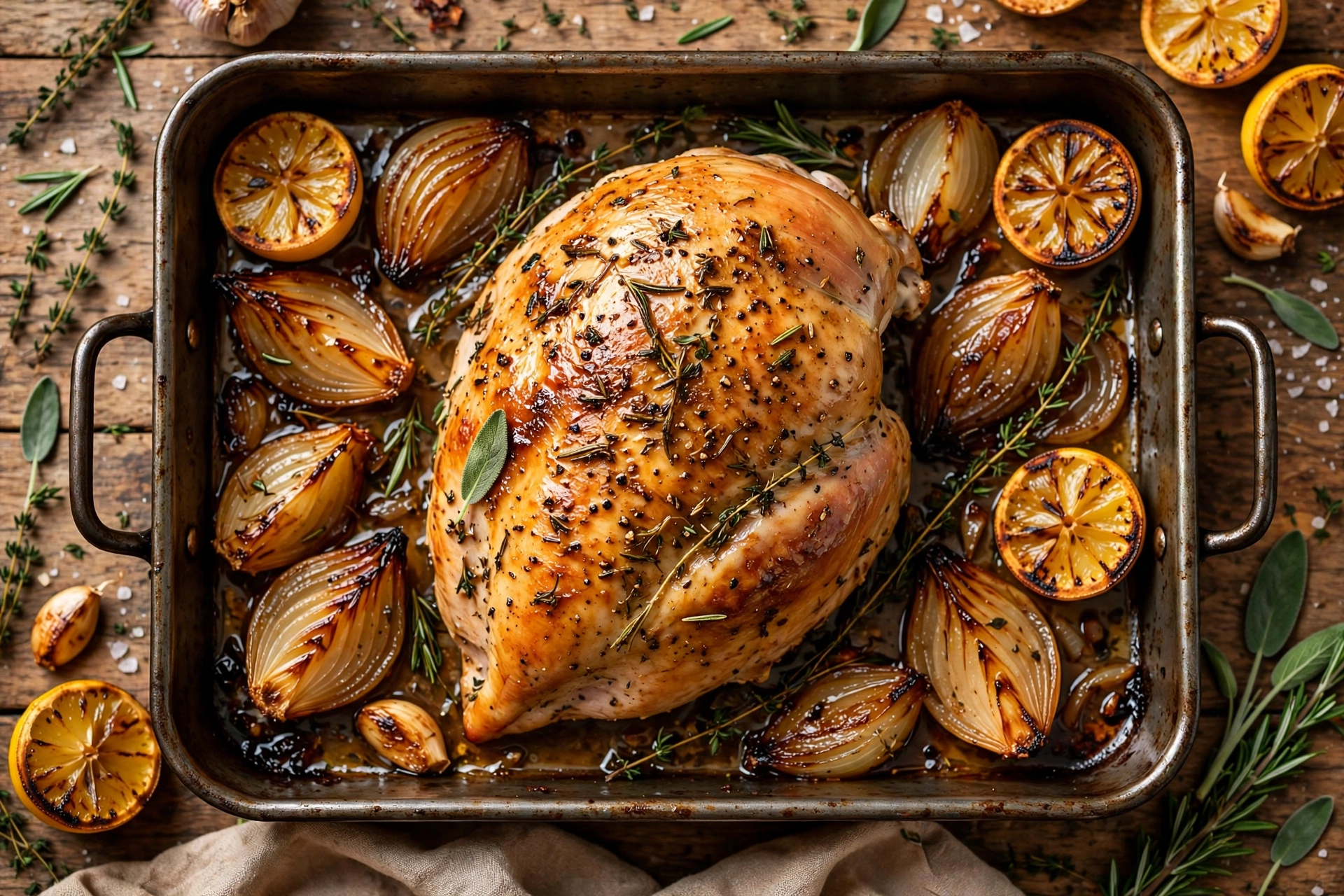
The pan juices deserve their own paragraph. Onion wedges and lemon halves roast in the broth below the bird, caramelizing at the edges and perfuming the drippings. Spooned over sliced turkey, these juices taste like a light gravy already, no roux required. For a proper gravy, they reduce in minutes into something silky.
Texture contrast comes from the method, not from breading or frying. Crisp skin against tender meat is the whole pleasure of roast turkey, and this recipe maximizes it. Patting the breast completely dry before the herb paste goes on is what guarantees that crackle. Any surface moisture would steam the skin instead of crisping it.
Served warm from the oven after its rest, the turkey eats like the best part of the holiday bird, which, honestly, it is. Dark meat lovers may convert. The breast is the leanest, mildest cut, and treated this way it needs no apology and no heavy sauce to make it interesting.
## Why It Fits Your Schedule
A whole turkey hijacks your oven for five hours and your sanity for longer. A single breast roasts in under two hours and feeds eight generously, which changes the entire shape of Thanksgiving Day. You can sleep in, enjoy coffee, and still have the centerpiece resting on the counter by mid afternoon.
The hands-on time is genuinely short. Twenty minutes of prep the day before for the dry brine, then twenty minutes on roasting day to make the paste and get the bird in the oven. Everything between is passive roasting time you can spend on sides, or on doing absolutely nothing, which is also a valid holiday plan.
The timeline flexes around your menu. Need the oven for healthy cornbread stuffing at 400°F? Roast the turkey first in the morning, then crank the heat for sides while the breast rests under foil. Rested turkey holds its temperature for a full hour, giving you a generous window to finish everything else.
Smaller gatherings benefit most. Cooking for four to eight people no longer means drowning in leftovers or, worse, buying a massive bird for the look of it. A five to six pound breast is the right scale for an intimate Thanksgiving, and the recipe halves or doubles without any tricky math. It is also perfect for Friendsgiving, where oven space is always the bottleneck.
If you are building the full table, this turkey loves our classic sides. Serve it alongside healthy mashed potatoes and healthy green bean casserole for a complete lighter feast. The pan juices tie the whole plate together better than any store bought gravy.
## Diet Conscious Twists
Turkey breast is one of the leanest proteins you can put on a holiday table. A three ounce serving delivers about 26 grams of protein with minimal fat, which makes it a natural fit for high protein and weight conscious eating. This recipe keeps it that way by using olive oil instead of butter and broth instead of cream based bastes.
The herb paste is naturally gluten free, dairy free and keto friendly as written. There is no flour, no sugar and no hidden starch anywhere in the ingredient list. Guests with celiac disease or dairy sensitivities can eat confidently, which is a genuine gift at a holiday meal full of off-limits dishes.
Watching sodium? Use a low sodium chicken broth and keep the kosher salt at the lower end, tasting the paste before it goes on the bird. Most of the perceived saltiness comes from the dry brine step, so a lighter hand there goes a long way. The lemon and herbs carry plenty of flavor on their own.
For a Whole30 compliant version, check that your chicken broth has no added sugar, which most store bought low sodium broths already satisfy. Everything else in the recipe complies as written. Serve with roasted vegetables and cranberry sauce for a fully compliant holiday plate.
## Ingredients
– 1 bone-in turkey breast, 5 to 6 pounds, patted very dry
– 2 teaspoons kosher salt, plus more for the dry brine (1 teaspoon per pound)
– 3 tablespoons extra virgin olive oil
– 4 cloves garlic, minced
– 1 tablespoon fresh rosemary leaves, finely chopped
– 1 tablespoon fresh sage leaves, finely chopped
– 2 teaspoons fresh thyme leaves
– 2 tablespoons fresh flat-leaf parsley, chopped
– 1 teaspoon freshly ground black pepper
– 2 tablespoons fresh lemon juice (about 1 lemon)
– 1 cup low-sodium chicken broth
– 1 yellow onion, cut into thick wedges
– 1 lemon, halved
## Step by Step Instructions
1. Dry brine the night before: rub the turkey breast all over with 1 teaspoon of kosher salt per pound of meat. Place on a rack set over a rimmed baking sheet, uncovered, and refrigerate 12 to 24 hours. The skin will look dry and taut in the morning. That is exactly what you want.
2. Take the turkey out of the refrigerator 45 minutes before roasting to take the chill off. Preheat the oven to 325°F (165°C) with a rack in the lower third position.
3. Pat the turkey breast completely dry with paper towels, inside and out. Moisture is the enemy of crisp skin, so be thorough.
4. Make the herb paste: in a small bowl, stir together the olive oil, minced garlic, rosemary, sage, thyme, parsley, the remaining 2 teaspoons kosher salt, black pepper and lemon juice until it forms a thick, fragrant paste.
5. Gently loosen the skin over the breast with your fingers, working carefully so it does not tear. Spread half of the herb paste directly onto the meat under the skin, pushing it into an even layer. Rub the remaining paste all over the outside of the skin.
6. Scatter the onion wedges and lemon halves in a roasting pan and pour in the chicken broth. Set a rack in the pan and place the turkey breast skin side up on the rack, making sure it does not sit directly in the liquid.
7. Roast for 1 hour 45 minutes to 2 hours, until an instant read thermometer inserted into the thickest part of the breast (without touching bone) reads 160°F. If the skin browns too quickly, tent it loosely with foil for the remaining time.
8. The temperature will climb to 165°F as the turkey rests, which is the safe temperature recommended by the USDA for poultry. Pulling at 160°F uses carryover cooking to reach safety without overshooting into dryness.
9. Transfer the breast to a cutting board and tent loosely with foil. Rest for a full 20 minutes so the juices redistribute through the meat. Do not skip this rest, as slicing early spills the juices onto the board instead of keeping them in the slices.
10. While the turkey rests, strain the pan juices into a small saucepan. Simmer for 5 minutes until slightly reduced, then spoon over the sliced turkey as a light, natural gravy.
## Secrets for Foolproof Success
Buy bone-in, skin-on, always. Boneless breasts cook faster but dry out with far less forgiveness, and the bone insulates the meat while adding flavor to the pan juices. A whole bone-in breast, which is both breast halves joined at the keel bone, feeds eight and roasts more evenly than two split halves.
Trust the thermometer, not the clock. Ovens lie, birds vary, and twenty minutes per pound is only a rough guide. Insert the probe horizontally into the thickest part of the breast from the side, keeping the tip away from bone, which reads hotter than meat. Check in two spots to be sure.
Pull at 160°F, not 165°F. Carryover cooking during the rest will coast the internal temperature up those final five degrees. This single habit is the difference between juicy and chalky turkey breast, and it is the most common mistake home cooks make on Thanksgiving.
Dry the skin obsessively. Paper towels, both sides, right before the herb paste goes on. The dry brine step the night before already helped, but a final thorough pat-down is what delivers shattering crisp skin. Wet skin steams, dry skin crackles.
Do not baste. Opening the oven every thirty minutes drops the temperature and extends the cooking time, which dries the meat. The broth in the pan provides all the moisture the oven environment needs. Leave the door closed and let the thermometer be your eyes.
Let it rest the full twenty minutes. The internal juices are roiling when the bird comes out, and slicing immediately floods the cutting board. Tent loosely with foil so the skin stays crisp while the meat relaxes. Use this window to warm your sides or set the table.
## Variations to Try Next Time
Add smoke without a smoker by stirring 1 teaspoon of smoked paprika into the herb paste. The turkey takes on a gentle campfire depth that is wonderful with mashed potatoes. Everything else in the recipe stays exactly the same.
Go citrus forward for a brighter profile. Double the lemon juice, add the zest of two lemons to the paste, and tuck extra lemon halves around the bird in the pan. The roasted lemon caramelizes into something sweet and complex that spooned over the slices tastes like sunshine.
Make it Italian inspired with a different herb mix. Swap the sage and thyme for 2 tablespoons of chopped fresh oregano and 1 tablespoon of chopped fresh basil, keeping the rosemary. The flavor turns Mediterranean and pairs beautifully with roasted vegetables.
Turn the pan juices into a proper light gravy. After straining, whisk 1 tablespoon of cornstarch into 2 tablespoons of cold water, stir it into the simmering juices, and cook for 2 minutes until it coats a spoon. No butter, no flour, no lumps, and it tastes like it took all afternoon.
Use the leftovers deliberately. Thick slices become the best turkey sandwiches on toasted sourdough with cranberry sauce. Diced turkey folds into soups, grain bowls and quesadillas for a week of easy lunches. Simmer the breast bone with vegetables for a rich stock that beats anything from a carton.
## Keeping It Fresh: Storage Guide
Refrigerate leftover turkey within two hours of roasting. Slice the breast off the bone first, as meat stored on the bone dries faster, then pack the slices in airtight containers with a spoonful of pan juices poured over. Properly stored, it keeps for 4 days in the refrigerator.
For the juiciest reheats, warm slices gently instead of blasting them. Place them in a baking dish with a splash of broth, cover tightly with foil, and warm at 300°F for 15 minutes. The microwave works in a pinch: cover the slices with a damp paper towel and heat at 50 percent power in short bursts.
Freeze for longer keeping. Wrap portions tightly in plastic wrap, then slide them into freezer bags with the air pressed out. Frozen turkey breast keeps its quality for up to 3 months. Thaw overnight in the refrigerator, never on the counter, then reheat as above.
This healthy herb roasted turkey breast is a dream for Thanksgiving make-ahead planning. Dry brine on Tuesday, roast on Wednesday, refrigerate the sliced breast, and reheat gently on Thursday while the sides finish. Nobody will guess it was cooked a day early, and your holiday itself becomes genuinely relaxing.
Save the bone and any pan drippings you did not serve. The roasted bone makes an exceptional stock: cover with water, add an onion, carrot and celery stalk, and simmer for 3 hours. Freeze the stock in portions for soups all winter. It is the kind of frugality that tastes like luxury.
## Conclusion
Healthy herb roasted turkey breast gives you the Thanksgiving centerpiece without the all-day commitment or the butter hangover. Crisp herb-crusted skin, juicy slices, pan juices that double as gravy, and a method forgiving enough for a first-time turkey roaster. Put the thermometer in, trust the rest, and enjoy the part of the holiday that happens around the table instead of in front of the oven.
Healthy Herb Roasted Turkey Breast FAQ
Should I buy bone-in or boneless turkey breast?
Bone-in, every time. The bone insulates the meat so it cooks more gently, adds flavor to the pan juices, and gives you a much wider margin before the meat dries out. Boneless breasts cook about 25 percent faster but go from perfect to chalky in minutes, so they demand constant thermometer watching.
Why pull the turkey at 160°F instead of 165°F?
Because of carryover cooking. The internal temperature climbs another 5 degrees during the 20 minute rest as residual heat moves toward the center. Pulling at 160°F lands you exactly at the USDA safe temperature of 165°F without overshooting. Pulling at 165°F means serving 170°F turkey, which is noticeably drier.
How long can the dry brine go before roasting?
Twelve to 24 hours is ideal. Less than 8 hours and the salt does not fully penetrate. Beyond 36 hours the texture can turn slightly hammy as the salt cures the outer meat. If your schedule slips, rinse the brine off, pat dry, and proceed, the turkey will still be well seasoned.
Can I make gravy if there are barely any drippings?
Yes. The cup of broth in the pan guarantees flavorful liquid even from a lean breast. Strain it, simmer to reduce by a third, and thicken with a cornstarch slurry if you like it heavier. One tablespoon of cornstarch whisked into cold water, stirred into simmering juices for 2 minutes, makes a silky light gravy.
How do I reheat sliced turkey breast without drying it out?
Low and slow with moisture. Arrange slices in a baking dish, add a few spoonfuls of broth or pan juices, cover tightly with foil, and warm at 300°F for about 15 minutes. The covered steam environment reheats the meat gently. Never reheat turkey uncovered at high heat, which is how leftovers turn to cardboard.
Healthy Herb Roasted Turkey Breast
Juicy herb roasted turkey breast with rosemary, sage, lemon and olive oil, roasted over onions and broth. No butter, no wine, with a full Thanksgiving make-ahead timeline.
- Total Time: 2 hours 15 minutes
- Yield: 8 servings 1x
Ingredients
- 1 bone-in turkey breast, 5 to 6 pounds
- 1 teaspoon kosher salt per pound, for the dry brine, plus 2 teaspoons more
- 3 tablespoons extra virgin olive oil
- 4 cloves garlic, minced
- 1 tablespoon fresh rosemary leaves, finely chopped
- 1 tablespoon fresh sage leaves, finely chopped
- 2 teaspoons fresh thyme leaves
- 2 tablespoons fresh flat-leaf parsley, chopped
- 1 teaspoon freshly ground black pepper
- 2 tablespoons fresh lemon juice
- 1 cup low-sodium chicken broth
- 1 yellow onion, cut into thick wedges
- 1 lemon, halved
Instructions
- The night before, rub the turkey all over with 1 teaspoon kosher salt per pound. Refrigerate uncovered on a rack for 12 to 24 hours.
- Remove the turkey from the refrigerator 45 minutes before roasting. Heat the oven to 325°F (165°C).
- Pat the turkey completely dry with paper towels.
- Stir the olive oil, garlic, rosemary, sage, thyme, parsley, remaining salt, pepper and lemon juice into a thick paste.
- Loosen the skin and spread half the paste on the meat underneath; rub the rest over the skin.
- Scatter the onion and lemon in a roasting pan, add the broth, set a rack inside and place the turkey skin side up on the rack.
- Roast 1 hour 45 minutes to 2 hours, until a thermometer in the thickest part reads 160°F. Tent with foil if browning too fast.
- Transfer to a cutting board, tent loosely with foil and rest 20 minutes (the temperature will reach 165°F).
- Strain the pan juices into a saucepan and simmer 5 minutes to reduce slightly.
- Slice the turkey against the grain and serve with the warm pan juices.
- Prep Time: 20 minutes
- Cook Time: 1 hour 45 minutes

2 Comments
Comments are closed.