Healthy Broccoli Casserole at About 185 Calories a Serving
In this article:
- Why This Healthy Broccoli Casserole Holds Its Own Beside the Turkey
- The Dry Roast That Keeps the Sauce Silky
- The Honest Math: About 185 Calories Against Roughly 370
- Ingredients for Healthy Broccoli Casserole
- Roasting, Saucing and Baking the Casserole, Step by Step
- Sauce Gone Grainy? Three Quiet Fixes
- Cauliflower, Gruyere and a Ritz-Style Crumb: Variations
- Assemble Wednesday, Bake While the Turkey Rests
- The Green Dish the Table Actually Finishes
- Questions Home Cooks Ask About Healthy Broccoli Casserole
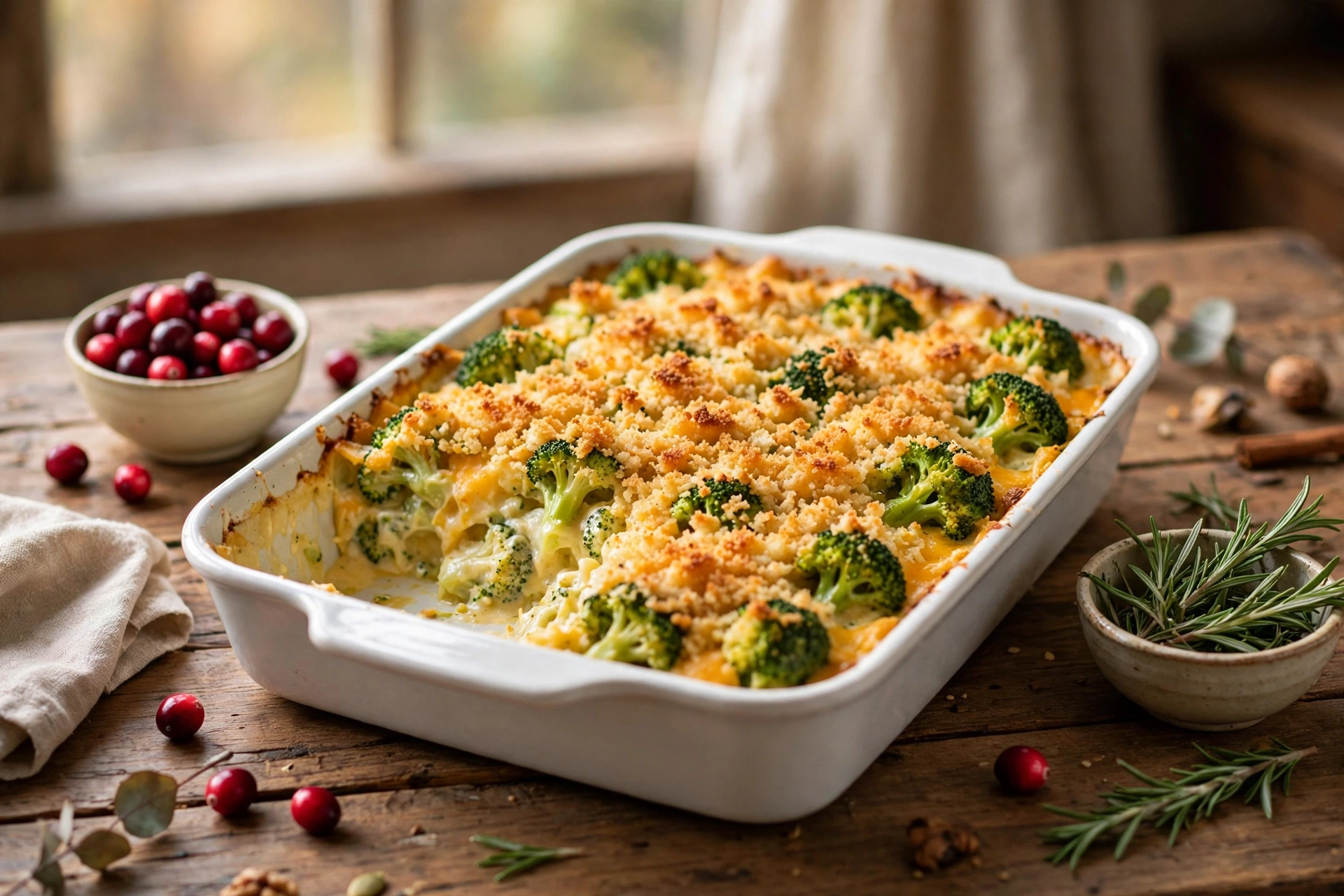
Healthy broccoli casserole is the dish I bring when the Thanksgiving table needs one green thing that people eat with genuine pleasure instead of politeness. Bright florets, a real cheddar sauce made on the stove, and a crisp panko cap: nothing about it reads as the light option.
The florets roast first, dry and hot, so their edges caramelize and their color stays vivid. The sauce is a proper roux and milk sauce, loosened with Greek yogurt off the heat, sharp with good cheddar and a whisper of nutmeg.
The honest number is about 185 calories a serving, against roughly 370 for the classic build with its full fat cheese, buttered cracker crumbs and canned soup base. The savings come from technique, not from removing anything people actually love about this dish.
Why This Healthy Broccoli Casserole Holds Its Own Beside the Turkey
Healthy broccoli casserole works because broccoli can carry a cheese sauce without disappearing into it. The florets keep their shape and a gentle bite, so every spoonful has structure instead of the soft uniformity of the canned soup version.
Sharp cheddar is the second decision. A smaller amount of a cheese with real presence tastes cheesier than a larger amount of a mild one, which is how the sauce stays vivid while the fat stays where it belongs.
Greek yogurt does the quiet work of the old sour cream and soup combination. Stirred in off the heat, it gives the sauce tang and body, and it keeps the finish bright instead of heavy on a plate that already holds gravy.
The panko cap matters more than it looks. A crisp, golden layer over a creamy base is the contrast people remember from the classic, and it survives here intact, toasted in olive oil instead of drowned in butter.
Portion logic helps too. This casserole sits in smaller, richer tasting spoonfuls next to the big trays, and one serving genuinely satisfies, because the flavor is concentrated rather than diluted.
There is also a color argument, and it is not trivial. A Thanksgiving plate runs gold, brown and beige from one end to the other, and a dish of vivid green florets under a bronzed cap is the thing eyes land on first. It photographs like a promise and eats like one too.
The Dry Roast That Keeps the Sauce Silky
Most broccoli casseroles fail in the first ten minutes. Raw or briefly blanched florets go into the sauce still holding their water, and that water seeps out during baking until the sauce turns thin and the bottom of the dish pools.
Roasting the florets dry solves it at the source. Ten minutes in a hot oven, spread out with a little olive oil and salt, drives off surface moisture and leaves the tips just bronzed, so the broccoli enters the sauce seasoned and concentrated.
Cut the florets into pieces of a similar size, with a flat side where you can manage it. Flat surfaces roast better, and even sizes mean the small pieces do not scorch while the large ones are still firm.
Salt the broccoli before it roasts, not after. Early salt seasons the vegetable itself; late salt only seasons the sauce around it, and the difference is easy to taste in the finished bite.
While the tray is in the oven, the sauce comes together on the stove in the same window. Thanksgiving cooking rewards this kind of overlap, and this recipe is timed so the two parts meet warm.
Let the roasted broccoli sit for two minutes before folding it into the sauce. A short rest lets the last steam escape instead of loosening the sauce, a small habit borrowed from the way good gratins are built.
The Honest Math: About 185 Calories Against Roughly 370
Here is where the calories actually go. The broccoli itself is almost free, roughly 35 calories a serving. The cheddar, used at one measured cup plus a Parmesan finish, carries the largest share and earns it in flavor.
Compare that with the classic build, where canned soup, two or more cups of full fat cheese and a sleeve of buttered crackers push a serving toward 370 calories, much of it saturated fat that greases the plate before the turkey even arrives.
The USDA entries in FoodData Central for broccoli and plain Greek yogurt show why this swap works so well. The yogurt brings protein and tang for a fraction of the fat in the soup and sour cream it replaces.
For the cook keeping score, the protein lands near 12 grams a serving and the fiber near 4 grams. That is a side dish that holds its corner of the plate, which matters on a day when most of the table is starch.
None of the savings come from a substitute product. There is no canned soup swapped for a lighter canned soup, no cheese flavored anything. It is the same dish, built with a roasting tray, a saucepan and a scale of judgment about where fat earns its place and where it was only habit.
Ingredients for Healthy Broccoli Casserole
- 2 pounds broccoli florets, about 8 cups, cut into bite size pieces
- 1 tablespoon olive oil, plus 1 teaspoon more for the panko
- 1 tablespoon unsalted butter
- 1 small yellow onion, finely diced
- 2 garlic cloves, minced
- 3 tablespoons white whole wheat flour
- 1 1/2 cups 1 percent milk
- 3/4 cup plain nonfat Greek yogurt, at room temperature
- 1 cup shredded reduced fat sharp cheddar, divided
- 1/4 cup finely grated Parmesan
- 1 teaspoon Dijon mustard
- 1/4 teaspoon ground nutmeg
- 3/4 teaspoon fine sea salt, divided
- 1/2 teaspoon black pepper
- 1/2 cup whole wheat panko breadcrumbs
Roasting, Saucing and Baking the Casserole, Step by Step
- Heat the oven to 425°F. Spread the broccoli on a large rimmed sheet pan, toss with the tablespoon of olive oil and 1/4 teaspoon of the salt, and arrange it in one layer with room to breathe.
- Roast for 10 minutes, until the florets are bright green with bronzed tips and feel just tender at the stem. Set aside and lower the oven to 375°F.
- Meanwhile, melt the butter in a large saucepan over medium heat. Cook the onion for 4 to 5 minutes, until soft and sweet at the edges, then stir in the garlic for 30 seconds.
- Sprinkle the flour over the onion and cook, stirring, for 1 minute. It should smell faintly toasty and look like wet sand.
- Pour in the milk a splash at a time, whisking after each addition so the sauce stays smooth. Simmer gently for 3 to 4 minutes, until it coats the back of a spoon.
- Take the pan off the heat. Whisk in the Greek yogurt until fully blended, then stir in 3/4 cup of the cheddar, the mustard, nutmeg, remaining 1/2 teaspoon salt and the pepper. Let the cheese melt into the sauce.
- Fold the roasted broccoli through the sauce until every floret is coated. Tip everything into a 2 quart baking dish and level the top.
- Toss the panko with the teaspoon of olive oil and a pinch of salt. Scatter it over the casserole with the remaining 1/4 cup cheddar and all the Parmesan.
- Bake at 375°F for 18 to 22 minutes, until the edges bubble and the top is deep golden. Rest 5 minutes before serving so the sauce settles.
Sauce Gone Grainy? Three Quiet Fixes
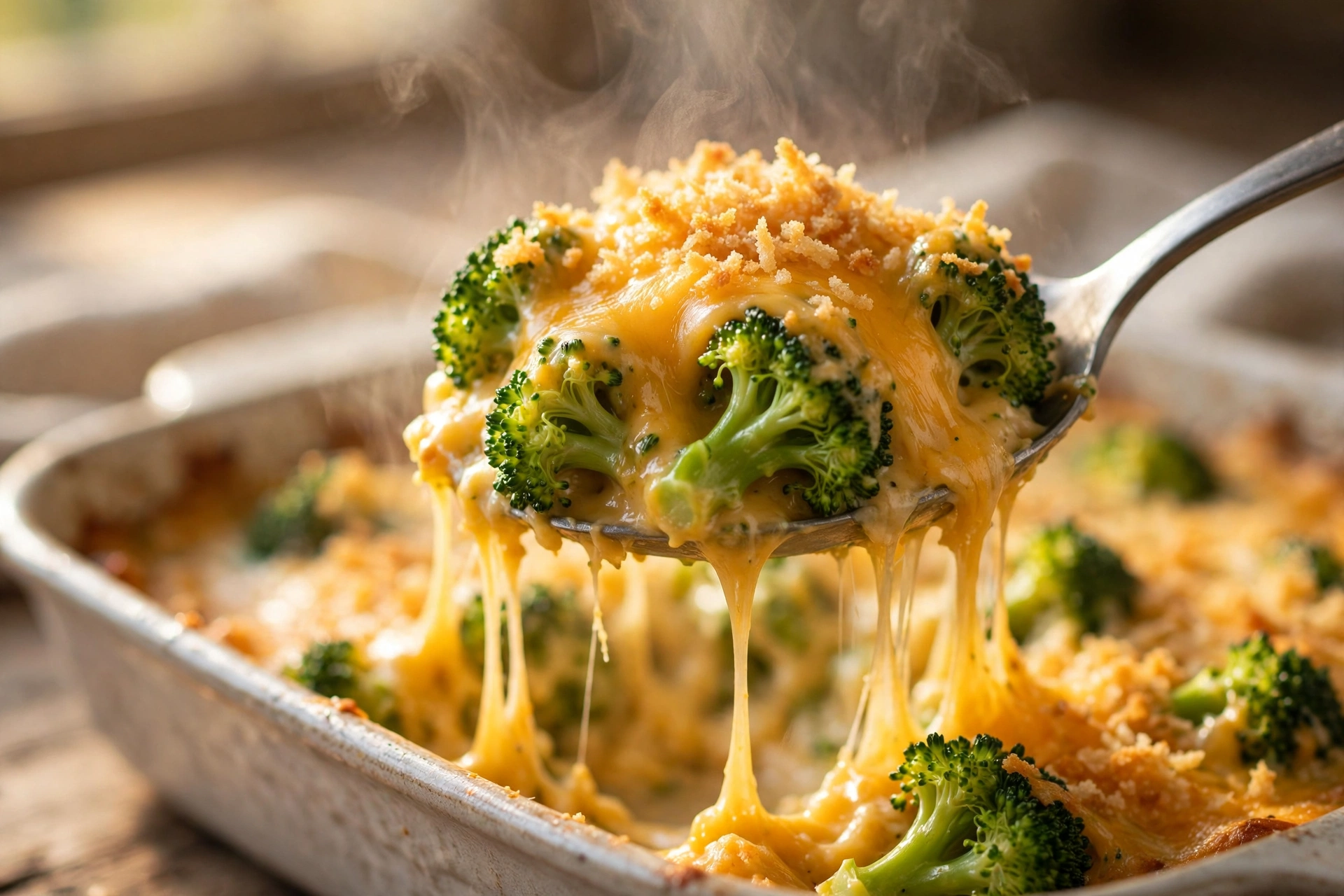
Yogurt is the one ingredient here with a temperament. If it goes into a boiling sauce, it can split into fine grains. The fix is timing: the pan comes off the heat, the sauce cools for thirty seconds, and only then does the yogurt whisk in.
A sauce that still looks thin usually needs patience, not more flour. The roux keeps thickening as the sauce simmers and again as the casserole rests after baking. Give it the full simmer and the full rest before judging it.
A pale top is a placement problem. Move the dish to the upper third of the oven for the last five minutes, where the heat browns the panko and cheese. If it still lags, ninety seconds under a hot broiler, watched closely, finishes it.
Cauliflower, Gruyere and a Ritz-Style Crumb: Variations
Half broccoli and half cauliflower is the easiest variation and the one kids tend to accept fastest. Roast the cauliflower on the same tray, a few minutes longer if the pieces are thick, and keep everything else the same.
Gruyere in place of the cheddar shifts the dish toward a gratin: nuttier, a little sweeter, lovely next to ham at Christmas. Keep the quantity identical so the calorie count stays honest.
For a cracker style crumb without the butter load, crush six whole grain crackers into the panko and add a pinch of smoked paprika. The cap reads richer than it is, which is the entire strategy of this recipe in miniature.
A handful of sauteed mushrooms folded in with the broccoli suits a January weeknight version, when the casserole can share the table with a bowl of healthy butternut squash soup and call itself dinner.
Assemble Wednesday, Bake While the Turkey Rests
Thanksgiving Day oven space is a negotiation, and this casserole is built to stay out of it. Roast the broccoli and make the sauce on Wednesday, fold them together in the dish, cover and refrigerate unbaked.
On Thursday, let the dish sit on the counter for 20 minutes while the turkey finishes. Add the panko topping just before baking so it stays crisp, then bake at 375°F for 25 to 28 minutes, until bubbling at the edges.
The casserole also holds gracefully. Baked and kept warm, it waits 30 minutes without harm, which lets it slide next to slices of healthy herb roasted turkey breast whenever the carving actually happens.
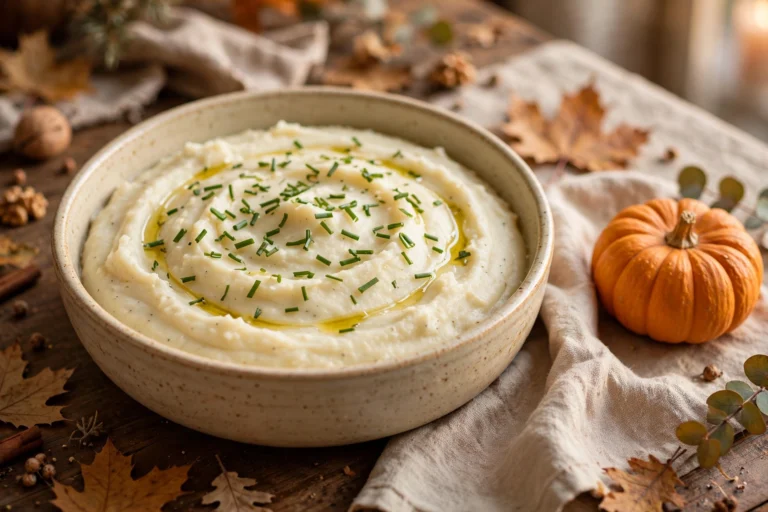
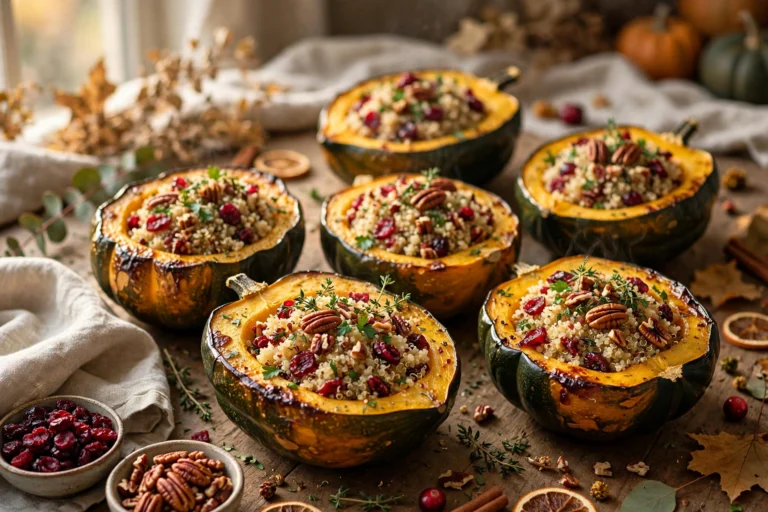
On the table it keeps good company: a spoonful of healthy corn casserole on one side, the caramelized halves of healthy stuffed acorn squash on the other, and a smooth scoop of healthy cauliflower mash underneath the gravy.
Leftovers keep four days in the refrigerator. Reheat single servings in a small skillet with a splash of milk, which brings the sauce back to silk better than the microwave does.
The Green Dish the Table Actually Finishes
Healthy broccoli casserole earns its place because it respects the original. The cheese is real, the top is crisp, the broccoli tastes like broccoli, and the lightness shows up only afterward, in how people feel at the pie course.
The Harvard T.H. Chan School of Public Health makes a similar point about holiday plates built around vegetables with real structure in its Nutrition Source guides. This dish is that advice under a golden panko cap.
Make the full dish even for a small table. It reheats with dignity, the sauce stays kind, and Friday lunch next to leftover turkey is where this casserole quietly wins the week.
Questions Home Cooks Ask About Healthy Broccoli Casserole
Can I use frozen broccoli instead of fresh in this casserole?
Yes, with one adjustment. Thaw the florets fully and pat them very dry, then give them the full 10 minute dry roast, plus 2 extra minutes if they still look wet. Frozen broccoli holds more water, and the roast is what protects your sauce.
Why did my yogurt sauce curdle, and can I save it?
It curdled because the yogurt met boiling sauce. Whisk the pan off the heat for a full minute next time, and temper the yogurt with a spoonful of warm sauce first. A split sauce can usually be rescued by whisking in a tablespoon of cold milk, slowly, off the heat.
How far ahead can I assemble this casserole before Thanksgiving?
Assemble it up to 24 hours ahead, sauce and broccoli together, covered in the refrigerator. Keep the panko topping in a separate container and add it just before baking so it stays crisp, then add 5 to 7 minutes to the bake time.
What cheese can replace reduced fat cheddar without losing the sharp flavor?
An aged full fat sharp cheddar, used at 3/4 cup instead of a full cup, lands in nearly the same place for calories and tastes even stronger. Gruyere and aged Gouda also work at the same reduced quantity. Mild cheeses are the ones to avoid; you end up using more to taste them.
Does this casserole freeze well after baking?
The sauce freezes acceptably for up to a month, but the panko cap softens and the broccoli loses its bite. For a freezer plan, freeze the sauced broccoli without the topping, thaw overnight in the refrigerator, then add fresh panko and bake as written.