Healthy Roasted Sweet Potatoes, Caramel Edged and Creamy at About 160 Calories a Serving
Healthy Roasted Sweet Potatoes, Caramel Edged and Creamy at About 160 Calories a Serving
In this article:
- Caramel Edges Are a Spacing Problem, Not a Sugar Problem
- Dry Cubes, Hot Oven: the Two Moves Behind the Crisp
- The Sweet Potato Math: About 160 Against About 290
- Ingredients for Healthy Roasted Sweet Potatoes
- Cut, Dry, Toss, Roast: the Pan in Four Moves
- On the Thanksgiving Table: Roasted Last, Served First
- Steamed, Stuck or Scorched: the Three Roasting Failures, Solved
- Smoky Heat, Garlic Herb, or the Weeknight Shortcut
- Four Days in the Fridge, a Month in the Freezer
- The Side That Earns the Empty Pan
- Questions Cooks Ask About Healthy Roasted Sweet Potatoes
Healthy roasted sweet potatoes should taste like the best part of the casserole, the caramelized edges, without the marshmallow blanket and the puddle of butter. This version roasts plain cubes at high heat and finishes them with a spoonful of maple, and the flavor lands exactly there.
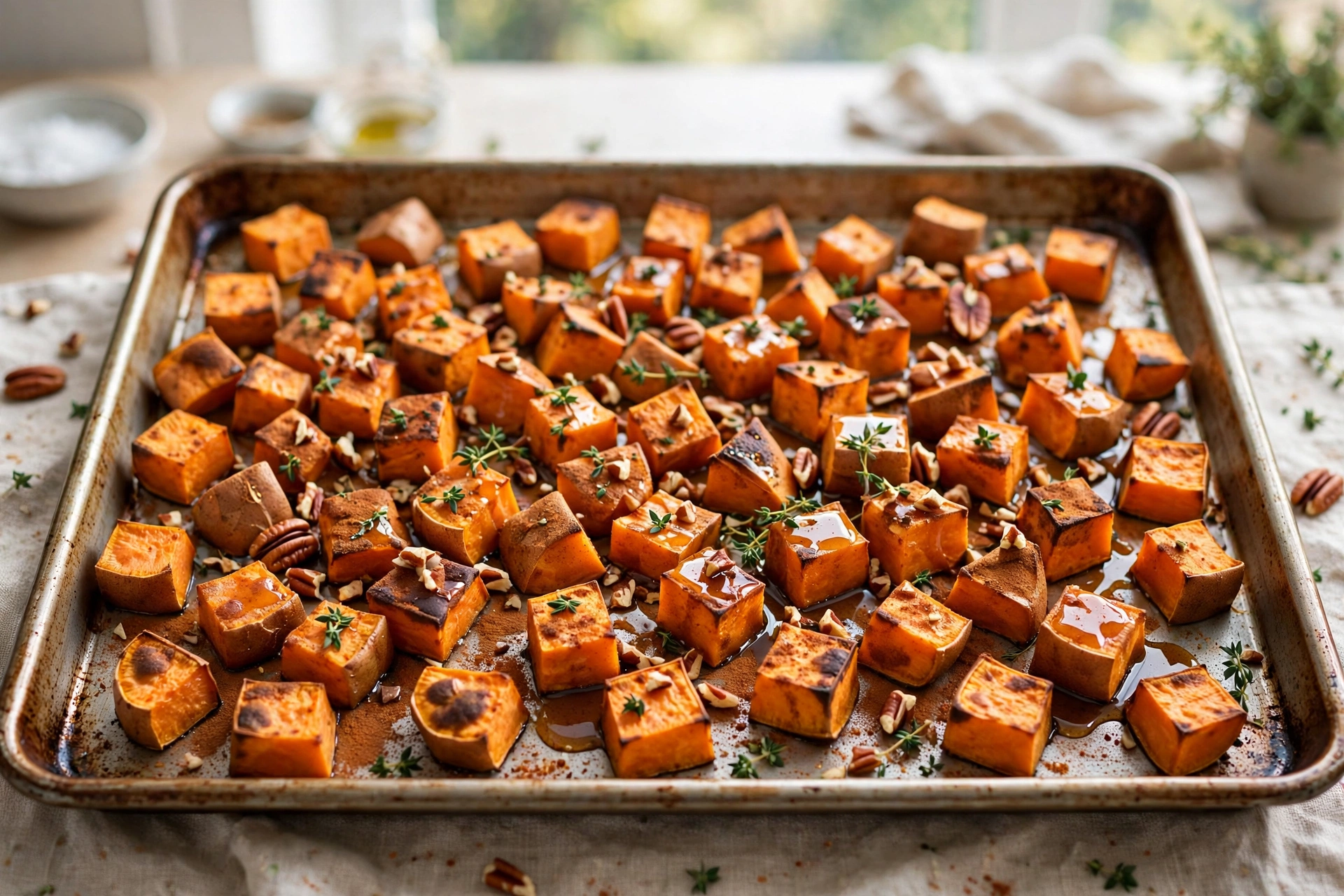
The edges come out dark gold and crisp, almost candied where they touched the pan. The centers stay creamy and soft, the contrast that makes a simple roasted vegetable feel like a holiday dish.
Nothing about the method is fussy. The cubes are dried well, spread out with room to breathe, and left alone in a hot oven until the pan does the work.
At about 160 calories a serving, against roughly 290 for the classic casserole, this is the sweet potato dish that lets the rest of the Thanksgiving plate stay generous. It is also the one that disappears first.
Caramel Edges Are a Spacing Problem, Not a Sugar Problem
Healthy roasted sweet potatoes turn caramel sweet in the oven for one plain reason: the vegetable arrives with its own sugar. A sweet potato carries enough natural sugar that high heat and dry surfaces will brown it deeply, no coating required.
What stops the browning is steam. Cubes cut from a fresh sweet potato weep moisture as they heat, and if that moisture has nowhere to go, the cubes simmer in it and stay pale and soft.
Crowding is where most pans fail. Cubes heaped on one sheet touch each other on every side, and every touching side steams instead of roasts. The same cubes, spread with a finger of space between them, brown on five sides.
Sugar added at the start works against the edges, not for them. Granulated sugar and honey scorch at roasting temperatures long before the centers turn creamy, so sweetening first produces dark spots that taste burnt, not caramelized.
This recipe therefore keeps the pan savory while it roasts: cinnamon, smoked paprika, garlic, salt, and olive oil. The spices bloom in the heat and give the cubes a depth that reads as richness.
The maple syrup goes on after the pan leaves the oven, one tablespoon over the whole batch. On hot cubes it thins, glazes, and shines, and because it never meets the full heat, it keeps its round maple flavor instead of burning.
Dry Cubes, Hot Oven: the Two Moves Behind the Crisp
The first move happens at the cutting board. Cubes of three quarters of an inch roast at the same rate, so the smallest pieces are not scorched when the largest turn tender.
The second move is the one almost nobody does: dry the cubes. Spread them on a clean towel or paper towels for ten minutes, then pat the tops. Surface water is the enemy of browning, and a dry cube starts roasting the second it lands on the pan.
Peeling is a texture choice with a real cost and a real gain. The skin holds fiber, but it also shields the flesh from the pan. For the deepest caramel edges at a holiday table, peel; for a weeknight pan, scrub and leave the skin on.
Choose the right potato at the store, too. Orange fleshed varieties sold as garnet or jewel are the roasting kind: moist, sweet, and quick to caramelize. Pale fleshed and white sweet potatoes roast drier and starchier, closer to a regular potato, and purple varieties turn dense; both are fine eating, but neither gives this pan its creamy center.
The oven runs at 425 degrees F, and it should be fully hot before the pan goes in. Cubes that enter a climbing oven steam in their own juice while the temperature rises, and they never fully recover their edges.
One flip, halfway, is the whole intervention. The cubes need a full twenty minutes of stillness to build their first crust; turned too early, they tear and stick, turned once at the right moment, they release cleanly and brown on a second side.
The load limit matters as much as the temperature: two pounds and a half of cubes, maximum, on a large rimmed sheet of 18 by 13 inches. More than that goes on a second pan, on the second rack, swapped halfway.
The Sweet Potato Math: About 160 Against About 290
The classic Thanksgiving sweet potato casserole is a dessert wearing a side dish costume: butter in the mash, brown sugar by the cup, and a marshmallow or streusel roof. A serving lands near 290 calories, with sugar in the high twenties.
These healthy roasted sweet potatoes land near 160 calories a serving, and the saving is structural. There is no topping, no mash of butter, and the only added sweetener is one tablespoon of maple syrup across eight servings.
The fat line tells the same story: about 6 grams, from two tablespoons of olive oil spread over the whole pan. The casserole carries two to three times that before its topping is even counted.
What the cubes keep is everything the vegetable does well. Sweet potatoes are one of the richest common sources of vitamin A, and a serving of these cubes covers well over the full daily need, along with about 4 grams of fiber.
The USDA vegetable guidance at MyPlate is to fill half the plate with fruits and vegetables, and a vivid, caramel edged side like this one is how that advice survives a holiday table built on gravy and rolls.
Sodium stays near 215 milligrams, seasoned to be eaten next to turkey and gravy rather than on its own. Nothing here is a diet substitute for the real dish; it is the real dish, roasted instead of buried.
Ingredients for Healthy Roasted Sweet Potatoes
The list is short and deliberate: one vegetable, one oil, four seasonings, and a single spoon of maple held back for the finish. Everything on it earns its place.
- 2 1/2 pounds sweet potatoes (about 4 medium), peeled and cut into 3/4 inch cubes
- 2 tablespoons olive oil
- 1 teaspoon ground cinnamon
- 1 teaspoon smoked paprika
- 1/2 teaspoon garlic powder
- 3/4 teaspoon fine sea salt
- 1/4 teaspoon black pepper
- 1 tablespoon pure maple syrup, for finishing after roasting
- 1/4 cup chopped pecans, toasted (optional)
- 1 teaspoon fresh thyme leaves (optional)
Cut, Dry, Toss, Roast: the Pan in Four Moves
The work is front loaded into the cutting and the drying. Once the pan is in the oven, the recipe asks for one flip and nothing else.
- Heat the oven to 425 degrees F. Set out a large rimmed sheet pan, 18 by 13 inches; if your pan is smaller, plan on two pans rather than a deeper layer.
- Peel the sweet potatoes and cut them into cubes of about 3/4 inch, as even as you can manage. Spread the cubes on a clean towel for 10 minutes, then pat them dry on top.
- Move the dry cubes to a large bowl. Add the olive oil, cinnamon, smoked paprika, garlic powder, salt, and pepper, and toss with your hands until every cube is glossy and evenly spiced.
- Spread the cubes on the sheet pan in a single layer with space between them. Any cube touching a neighbor on all sides needs a nudge; the pan should look full but never piled.
- Roast undisturbed for 20 minutes. The bottoms should be deep golden and the cubes should release from the pan with a thin spatula rather than tearing.
- Flip the cubes in sections and return the pan to the oven. Roast 12 to 15 minutes more, until the edges are dark gold at the corners and a knife slides into the largest cube without resistance.
- Slide the pan onto a rack and drizzle the maple syrup over the hot cubes at once. Toss gently for 30 seconds; the syrup will thin on the heat and glaze every side.
- Scatter the toasted pecans and thyme over the pan if you are using them, and serve hot, straight from the sheet or piled into a warm bowl.
On the Thanksgiving Table: Roasted Last, Served First
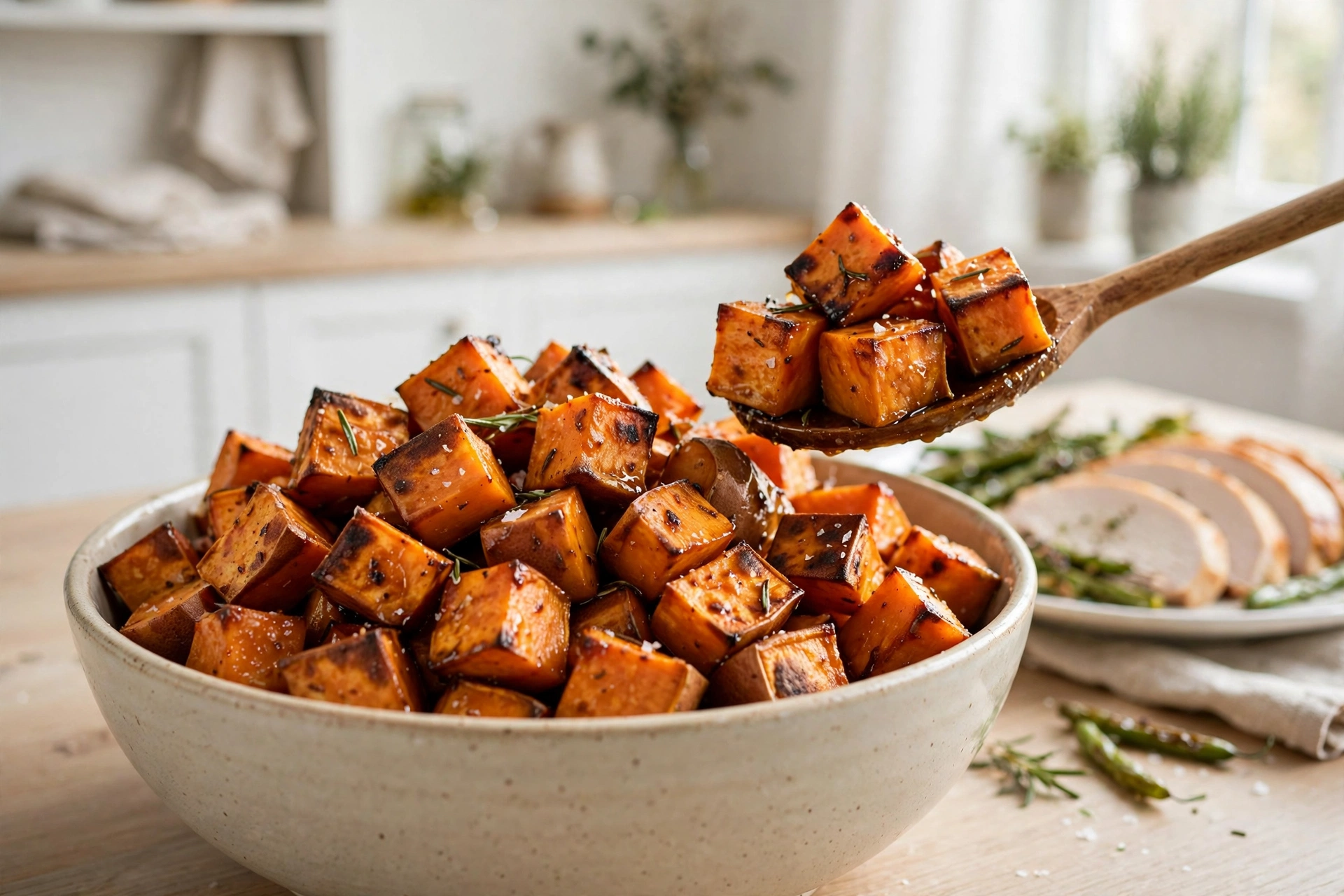
Healthy roasted sweet potatoes fit the Thanksgiving oven schedule better than the casserole they replace. Thirty five minutes at high heat is all they ask, and they are happiest roasted while the turkey rests and the gravy comes together.
The order runs like this. The turkey comes out and gets tented. The oven, already hot, takes the pan of cubes. By the time the bird is carved and the gravy is whisked, the sweet potatoes are glazed and ready.
Set them beside our healthy herb roasted turkey breast and let a spoonful of our healthy turkey gravy find its way over the cubes; the caramel edges hold up under the sauce instead of dissolving the way a mash does.
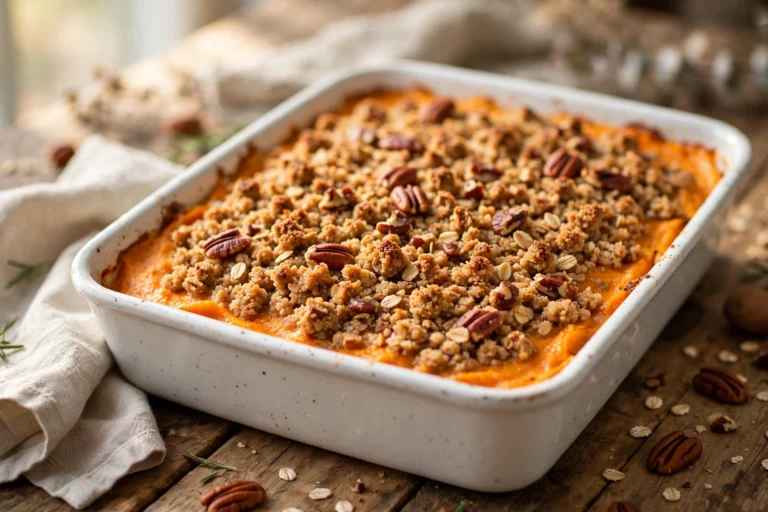
For the traditionalists at the table, our healthy sweet potato casserole keeps the familiar form in a lighter build, and the two dishes side by side settle the argument without a word. A wedge of yesterday’s healthy cornbread completes the corner of the plate.
If the oven is spoken for until the last minute, roast the cubes an hour ahead and hold them, loosely covered, in the turned off oven. Five minutes at 425 degrees F before serving brings the edges back to life.
For a crowd of twelve or more, the recipe scales by the pan, not by the pile: two pans of two and a half pounds each, on two racks, swapped top to bottom at the flip. A single overloaded pan is the one version of this recipe that does not work.
Steamed, Stuck or Scorched: the Three Roasting Failures, Solved
Steamed, pale cubes are the failure everyone knows. The causes are only ever two: the cubes went in wet, or the pan was crowded past its limit. Dry them, and cap the load at two and a half pounds per large pan.
Cubes that stick and tear were flipped too soon. The first crust needs its full twenty minutes; a cube that has browned properly releases with a gentle push, while a pale one welds itself to the metal.
Scorched corners with firm centers mean uneven cubes or sugar in the pan too early. Cut evenly, keep the maple for the finish, and remember that the smallest cube sets the clock for the whole pan.
Edges that brown but taste flat usually point at the seasoning, not the roasting. Salt measured for the full batch, and spices that have sat open for a year, are the two quiet culprits; smoked paprika should smell smoky the moment the jar opens.
If the finished cubes are a touch soft for your taste, give them three extra minutes after the maple goes on, watching closely. The glaze sets, the edges firm, and the pan crosses from roasted to nearly candied.
Smoky Heat, Garlic Herb, or the Weeknight Shortcut
For a smoky heat version, add half a teaspoon of chipotle powder to the spice mix and finish with lime zest instead of maple. The cubes lean toward the enchilada end of the table and pair naturally with black beans and rice.
A garlic herb version drops the cinnamon, doubles the garlic powder, and finishes with a tablespoon of chopped parsley and a squeeze of lemon. It is the pan to serve next to roast chicken on an ordinary Sunday.
The pecan finish in the recipe is optional and costed honestly: a quarter cup of toasted pecans adds about 20 calories a serving and the crunch the casserole topping used to provide. Add them at the table so they stay crisp.
For a weeknight shortcut, cut the cubes smaller, at half an inch, and roast at 450 degrees F for about 20 minutes. The edges char a little more and the centers stay just creamy enough, and nobody needs the occasion explained.
Four Days in the Fridge, a Month in the Freezer
Roasted cubes keep four days in the refrigerator, sealed once fully cool. They lose their crisp edges in the cold, which is a texture problem with a known cure, not a quality problem.
Reheat them in a single layer at 425 degrees F for 8 to 10 minutes, or in a dry skillet over medium heat. The microwave returns them soft and steaming in a minute, which is fine for a lunch bowl and wrong for a dinner side.
The cubes also freeze well, a fact the casserole never manages. Spread the cooled cubes on a tray, freeze them solid, then bag them for a month; reheat from frozen at 425 degrees F for about 15 minutes.
Holiday timing follows the usual rule: FoodSafety.gov advises refrigerating Thanksgiving leftovers within two hours and finishing them within three to four days, so the pan should not sit out for an evening of grazing.
Leftovers have planned second lives here: folded into a grain bowl with greens and a soft egg, blended into a soup with the last of the stock, or scattered over a salad where their sweetness does the work of a dressing.
The Side That Earns the Empty Pan
Healthy roasted sweet potatoes ask for three small disciplines: even cubes, a dry surface, and room on the pan. In exchange they deliver the caramel, the creaminess, and the color that the Thanksgiving table expects from this vegetable.
At about 160 calories a serving, with the maple kept to a single shining spoonful, they are proof that the lighter dish and the favorite dish can be the same pan. Expect to scrape the last cubes from the sheet before it reaches the sink.
Questions Cooks Ask About Healthy Roasted Sweet Potatoes
Why did my roasted sweet potato cubes come out soft instead of crisp?
Almost always moisture or crowding. Cubes cut from a fresh sweet potato weep as they heat, so dry them on a towel for 10 minutes before oiling, and cap the pan at 2 1/2 pounds of cubes on a large sheet. A single layer with space between the cubes lets the steam escape instead of simmering them.
Should I peel the sweet potatoes before roasting the cubes?
For this recipe, yes: peeled cubes caramelize on every face and give the deepest edges. Leaving the skin on is a fair trade on a weeknight, since the skin adds fiber, but shielded faces brown less and the texture turns chewier. Either way, cut the cubes at 3/4 inch so they roast evenly.
Can I roast the cubes ahead for Thanksgiving and reheat them?
Yes. Roast them up to an hour ahead and hold them loosely covered in the turned off oven, then give them 5 minutes at 425 degrees F before serving. Fully made ahead, they keep 4 days in the refrigerator and reheat in a single layer at 425 degrees F for 8 to 10 minutes.
Why does the maple syrup go on after roasting instead of before?
Because maple syrup scorches at 425 degrees F long before the centers turn creamy, and burnt syrup tastes bitter rather than caramelized. Drizzled over the hot cubes at the end, one tablespoon thins on their heat and glazes the whole pan, so the flavor stays round and every cube shines.
What size cube roasts best, and how long does the pan take?
Three quarters of an inch is the sweet spot: small enough to turn creamy inside, large enough to build dark edges without drying. At 425 degrees F the pan takes about 20 minutes undisturbed, then 12 to 15 minutes after the flip. Half inch cubes finish nearer 20 minutes total at 450 degrees F.