
Healthy Mushroom Herb Stuffing, Savory, Golden and Light at About 185 Calories a Cup
Healthy Mushroom Herb Stuffing, Savory, Golden and Light at About 185 Calories a Cup
In this article:
- Two Mushrooms, One Job: Depth Without the Butter Bath
- Dry Bread First: the Texture Rule That Never Changes
- The Stuffing Math: 185 Against 350
- Ingredients for Healthy Mushroom Herb Stuffing
- Sear, Soak, Bake: the Order That Builds the Crust
- The Night Before and the Day Of: a Calm Plan
- Too Wet, Too Dry, Too Pale: the Three Fixes
- Gluten Free Bread, Extra Herbs and Two Pan Sizes
- The Side Dish Nobody Has to Recover From
- Questions Cooks Ask About Mushroom Herb Stuffing
Stuffing is the dish Thanksgiving cooks argue about, and the one nobody skips. It is also, in its classic form, a quiet calorie trap: cubes of white bread soaked in butter, enriched with rich pan drippings, baked until the richness does all the talking.
This healthy mushroom herb stuffing keeps the parts people actually love. The top still turns crisp and golden, the center stays moist and soft, and the flavor runs deep and savory. What changes is the engine: two kinds of mushrooms, browned hard, do the work that rendered fat used to do.
The numbers land where a lighter table needs them. One generous cup comes in at about 185 calories, against roughly 350 for the classic butter rich stuffing, with four grams of fiber from whole grain bread. Nobody at the table will feel they were handed the compromise dish.
The method is calm and mostly hands off. Dry the bread, sear the mushrooms, sweat the vegetables, then let the oven finish. Most of the work can happen the day before, which matters more than any single ingredient on a crowded holiday.
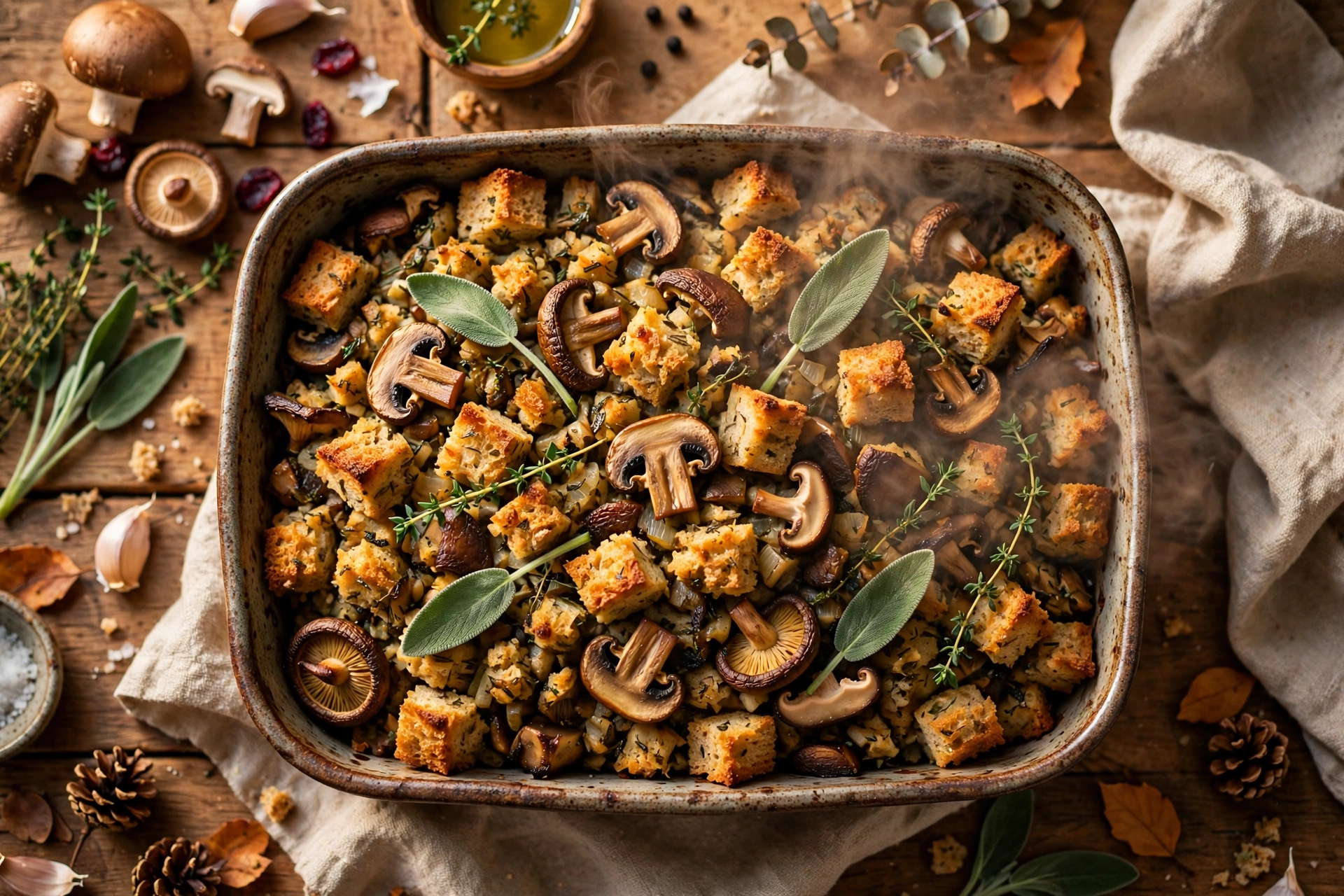
Two Mushrooms, One Job: Depth Without the Butter Bath
A single mushroom can make a stuffing taste earthy. Two mushrooms, treated properly, make it taste complete. Cremini bring the familiar, meaty base note, the one that reads as savory before you can name it. Shiitake add a darker, almost smoky layer that lingers the way pan drippings do.
The browning matters more than the variety. Mushrooms are mostly water, and that water has to leave before flavor concentrates. Spread them in a wide pan, in a single layer, and let them sit undisturbed until the first side takes real color. Crowded mushrooms steam, pale and soft, and the stuffing inherits that softness.
Work in two batches if your pan asks for it. Three tablespoons of olive oil, split across the batches, is enough because the mushrooms release their own moisture first and then fry in what remains. The pan drippings, scraped up with the vegetables, carry more flavor than a stick of butter poured over the top.
Slice the mushrooms thick, a quarter inch or better. Thin slices vanish into the bread and you lose the contrast: a tender, almost meaty bite against the soft crumb. Thick slices stay distinct, and the finished dish eats like a main course that happens to be served on the side.
Dry Bread First: the Texture Rule That Never Changes
Every stuffing failure begins with wet bread. Fresh cubes collapse the moment broth touches them, and the bake turns into a dense, gummy slab. Dry cubes behave differently: they drink the broth slowly, hold their edges, and give the finished dish its two textures, crisp top and custardy middle.
Whole grain bread brings a second advantage. Its crumb is sturdier than white sandwich bread, so the cubes survive tossing and baking without dissolving. It also brings the fiber, four grams a serving here, and a faint nuttiness that sits naturally beside mushrooms and sage.
Drying takes twenty minutes in a low oven, spread on two sheet pans, or a day on the counter in a loose bowl. The cubes should feel dry on the surface and slightly firm at the center. Bone dry is too far: a cube with no give at all will stay chewy in patches no matter how much broth you add.
Cut size is part of the rule. Three quarter inch cubes give you crust and interior in every bite. Smaller cubes pack down and bake up tight; larger ones leave dry pockets that the broth cannot reach. When in doubt, tear the bread instead of cutting it, and the rough edges will crisp even better.
The Stuffing Math: 185 Against 350
The classic plate of stuffing earns its roughly 350 calories honestly: butter by the stick, drippings by the ladle, white bread that absorbs all of it. Nothing about that construction is a mistake. It is simply built for richness first, and the numbers follow.
This healthy mushroom herb stuffing rebuilds the same dish on different supports. Olive oil replaces the butter bath, three tablespoons across ten servings. Mushrooms replace the drippings, contributing savoriness at a fraction of the fat. Whole grain bread replaces white, and the broth is low sodium so the salt stays in the cook’s hands, measured at one and a quarter teaspoons.
The result, about 185 calories a cup, is not a diet portion pretending to be stuffing. It is a full cup, the size anyone would scoop at the table, with seven grams of protein and the kind of fiber that keeps the rest of the meal from sitting heavy. If you build a full lighter menu around it, our healthy herb roasted turkey breast and healthy turkey gravy keep the same promise from plate to sauce.
One honest note on the comparison: calorie counts for the classic version vary by recipe, and a restrained cook can land lower than 350. The point is not the exact gap. The point is that this version was designed, ingredient by ingredient, to sit near half, without shrinking the serving or sanding off the flavor.
Ingredients for Healthy Mushroom Herb Stuffing
- 10 cups whole grain bread cubes, cut 3/4 inch, dried (about 1 pound loaf)
- 3 tablespoons olive oil, divided
- 1 pound cremini mushrooms, sliced 1/4 inch thick
- 8 ounces shiitake mushrooms, stems removed, caps sliced
- 1 large yellow onion, finely diced
- 3 celery ribs, finely diced
- 2 medium carrots, finely diced
- 4 garlic cloves, minced
- 2 tablespoons chopped fresh sage
- 1 tablespoon fresh thyme leaves
- 1 teaspoon chopped fresh rosemary
- 1/2 cup chopped fresh parsley, divided
- 2 1/2 cups low sodium vegetable broth, warmed
- 2 large eggs, lightly beaten
- 1 1/4 teaspoons fine sea salt
- 3/4 teaspoon black pepper
Read the list once for the logic. The vegetables are cut small so they disappear into the crumb and season every bite, while the mushrooms are cut large so they stay present. The herbs are fresh because dried sage and thyme read dusty in a dish with this little fat to round them out.
The eggs are the quiet binder. Two eggs across ten servings add almost nothing to the calorie count, yet they set the center into a soft custard instead of a loose crumble. If your table avoids eggs entirely, the variation section below covers the swap and what changes.
Sear, Soak, Bake: the Order That Builds the Crust
- Heat the oven to 300 degrees F. Spread the bread cubes on two sheet pans and dry for 18 to 20 minutes, until the surfaces feel firm and dry. Raise the oven temperature to 375 degrees F and lightly oil a 9 by 13 inch baking dish.
- Warm 1 tablespoon of the olive oil in a large wide skillet over medium high heat. Add the cremini in a single layer and cook undisturbed for 3 minutes, then stir and cook 2 minutes more, until deeply browned. Transfer to a large mixing bowl.
- Repeat with the shiitake and the second tablespoon of oil. Add them to the bowl with the cremini, scraping every browned bit from the pan as you go.
- Lower the heat to medium and add the last tablespoon of oil. Cook the onion, celery and carrots with a pinch of the salt for 7 to 8 minutes, until soft and sweet at the edges. Stir in the garlic, sage, thyme and rosemary and cook 1 minute, until fragrant.
- Add the vegetable mixture to the bowl. Add the bread cubes and half the parsley, then toss everything together with your hands until the bread and vegetables are evenly mixed.
- Whisk the beaten eggs into the warm broth with the remaining salt and the pepper. Pour over the bread mixture in two additions, tossing gently after each, until the cubes look evenly moist with no dry centers and no puddle at the bottom of the bowl. Rest 10 minutes.
- Turn the mixture into the prepared dish and press it down lightly, keeping the top rough. Cover tightly with foil and bake for 30 minutes.
- Remove the foil and bake 18 to 20 minutes more, until the top is crisp and deeply golden and the center registers 165 degrees F on a thermometer. Rest 10 minutes, scatter the remaining parsley, and serve warm.
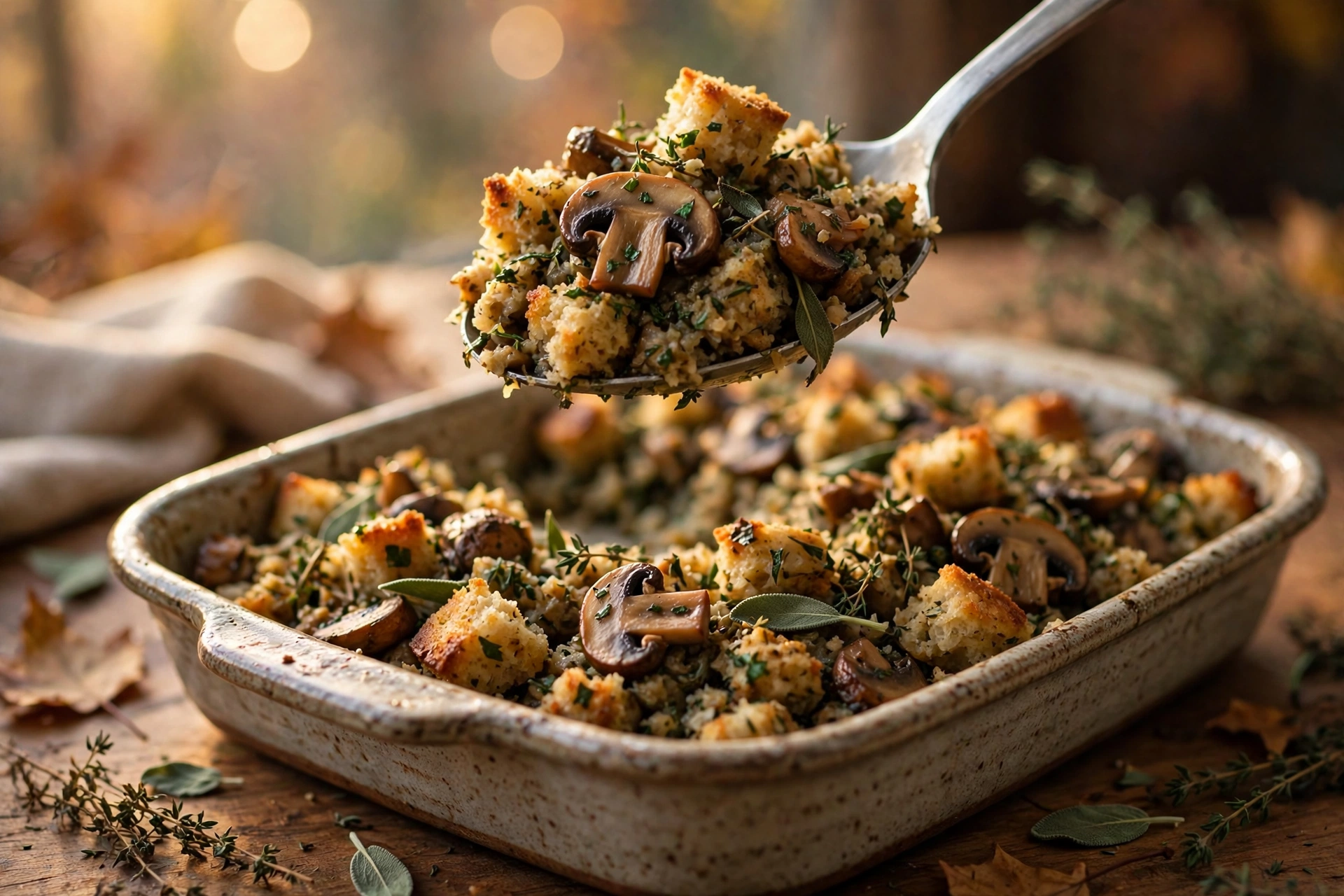
Two details in that sequence protect the texture. Warm broth absorbs faster and more evenly than cold, so the cubes hydrate instead of floating. The ten minute rest before baking is where the dish decides its final structure: skip it, and the oven dries the surface before the center has taken up its share.
On temperature, follow the same guidance you would for any egg bound casserole. The center should reach 165 degrees F, the safe minimum the federal food safety temperature chart lists for casseroles, which is also the point where the eggs set softly rather than firm.
The Night Before and the Day Of: a Calm Plan
Thanksgiving oven space is the scarcest resource in the kitchen, so this dish was designed to wait politely. The bread can be cubed and dried two days ahead and held in a sealed bag. The mushrooms and vegetables can be cooked the day before and refrigerated together, which deepens their flavor overnight.
Assemble the full dish the night before, up to the foil covered stage, and refrigerate it in its baking dish. On the day, let it stand at room temperature for thirty minutes while the turkey rests, then bake as written, adding five minutes to the covered stage. The crust still crisps, because the foil comes off for the final stretch regardless.
If the bird is your main event, this stuffing also holds gracefully after baking. Keep it covered in a low oven, 200 degrees F, for up to forty five minutes, and splash a quarter cup of warm broth over the top before serving if the surface has dried. It reheats the next day at 350 degrees F for fifteen minutes, covered for ten of them.
Planning companions helps the whole table land together. Our healthy quinoa stuffing suits the gluten free end of the table, and the healthy cornbread stuffing covers the cooks who insist on a Southern note. Three stuffings sounds like excess until you watch them all disappear.
Too Wet, Too Dry, Too Pale: the Three Fixes
A soggy center almost always traces back to bread that was not dry enough or broth added all at once. The rescue, if you catch it before baking, is simple: fold in an extra cup of dried cubes and rest ten minutes more. Caught after baking, return the dish uncovered for ten extra minutes and let evaporation do the work.
A dry, crumbly result means the bread drank more than expected, which denser whole grain loaves often do. Drizzle a quarter cup of warm broth over the top, cover, and rest ten minutes before serving. Next time, hold back a quarter cup of the broth mixture and judge by feel: the cubes should feel moist throughout, never dripping.
A pale top is a heat and timing problem, not an ingredient problem. The foil traps steam, and steam prevents browning, so a dish that stays covered too long stays blond. Give it the full uncovered stretch, move the rack up one level, and if your oven runs cool, finish with three minutes under the broiler while you watch it closely.
Underseasoning is the fourth, quieter failure, and low fat cooking invites it. Mushrooms and bread both absorb salt. Taste the vegetable mixture before it meets the bread; it should taste slightly too seasoned on its own. After baking, a final pinch of flaky salt and the fresh parsley wake up a dish that reads flat.
Gluten Free Bread, Extra Herbs and Two Pan Sizes
For a gluten free table, swap in a sturdy gluten free loaf, dried a few minutes longer than the whole grain version, since gluten free crumb softens faster. The method, the broth quantity and the bake all stay the same, and the mushrooms carry the dish so confidently that nobody identifies the substitution.
Egg free is equally manageable. Replace the two eggs with a quarter cup of extra broth whisked with one tablespoon of ground flaxseed, rested five minutes before adding. The center sets a little looser and scoops more like a classic dressing, which many families honestly prefer.
Herb direction can travel. Keep the sage, it is the signature, then trade the rosemary for marjoram for a softer profile, or add a teaspoon of finely grated lemon zest to the broth for brightness against a rich menu. A cup of diced apple folded in with the vegetables leans the dish toward the sweet savory register of our quinoa stuffing.
Pan size flexes without drama. A deep 3 quart casserole adds five minutes to the covered bake. Individual ramekins, filled three quarters full, bake in about twenty five minutes total and give every guest a crisped edge of their own, a small luxury that costs nothing but dishes.
The Side Dish Nobody Has to Recover From
This healthy mushroom herb stuffing asks for no apologies and makes none. It arrives golden, steaming and properly savory, and it lets everyone at the table take a full scoop without doing quiet arithmetic about the rest of the plate.
Make it once for Thanksgiving and you will find reasons to repeat it: beside roast chicken in January, under a fried egg for a weekend lunch, or as the base of the best leftovers bowl of the year. The mushrooms, it turns out, were never a substitute. They were the point.
Questions Cooks Ask About Mushroom Herb Stuffing
Round out the same menu with our healthy green bean casserole: its mushroom sauce is made from scratch too, so the two dishes share the same honest, vegetable-first spirit.
Can I bake this stuffing inside the turkey instead of in a dish?
Food safety guidance is firm on this: bake stuffing separately in a dish. A stuffed bird cooks unevenly, and the center of the stuffing may not reach 165 degrees F before the meat overcooks. Baked apart, this dish reaches temperature evenly and still crisps on top.
Which broth works better here, vegetable or chicken?
Low sodium vegetable broth keeps the dish vegetarian and lets the mushrooms lead. Low sodium chicken broth adds a rounder, more traditional background note. Either works at the same quantity; just keep the low sodium part, since the recipe seasons deliberately with measured salt.
My whole grain bread is very dense. Should I change the broth amount?
Dense loaves drink more. Mix the stuffing with the full amount, rest it ten minutes, then squeeze one cube: if the center still feels dry, drizzle in up to a quarter cup more warm broth. The mixture should look evenly moist with no puddle in the bowl.
Can I freeze mushroom herb stuffing, baked or unbaked?
Both work. Freeze the assembled unbaked dish, well wrapped, for up to one month and bake from thawed with ten extra covered minutes. Baked leftovers freeze in portions for up to two months and reheat, covered, at 350 degrees F until steaming.
What can replace the shiitake mushrooms if my store is out?
Use all cremini and add half a teaspoon of smoked paprika to the vegetables to restore the darker note. Oyster mushrooms are the other good swap, torn rather than sliced, added in the second batch so their delicate edges brown without breaking down.

One Comment
Comments are closed.