Healthy Chocolate Mousse, Real Air and Honest Chocolate at About 230 Calories a Glass
Healthy Chocolate Mousse, Real Air and Honest Chocolate at About 230 Calories a Glass
In this article:
- The Base: Real Chocolate, a Yogurt Body
- The Mousse Math: 230 Against 430
- The Whites: Where the Air Actually Comes From
- Ingredients for Healthy Chocolate Mousse
- Melt, Whisk, Fold, Chill: Twenty Minutes and Patience
- On the Christmas Table: Made on the Twenty Third, Served on the Twenty Fifth
- Grainy, Runny or Dense: the Three Mousse Fixes
- With Peppermint, With Espresso, or Dairy Free
- The Small Glass Nobody Believes Is Light
- Questions Cooks Ask About Healthy Chocolate Mousse
Healthy chocolate mousse usually fails in one of two directions: a five minute blend that tastes like chocolate yogurt, or a rich pot of full fat yogurt and chocolate that is a classic mousse wearing a lighter name. This one takes the third road, the classic gesture done with lighter parts.
The base is nonfat Greek yogurt whisked with melted dark chocolate, cocoa, and maple syrup. The air, and this is the whole recipe, comes from real egg whites, whipped to glossy peaks and folded in the way mousse has always been made.
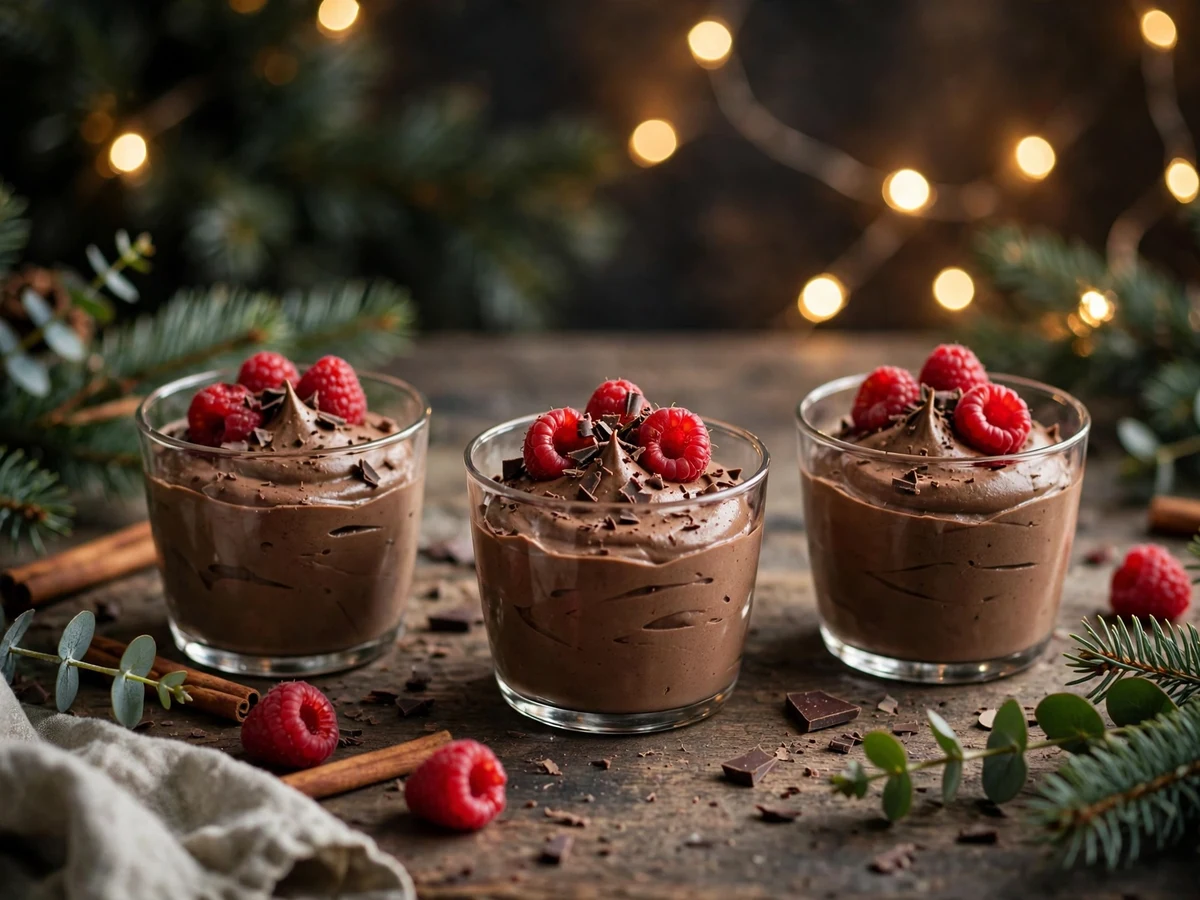
It sets like a mousse because it is one: spoonable, airy, with a clean chocolate finish and a gentle tang underneath. Served in small half cup glasses, each one lands at about 230 calories, against roughly 430 for the classic cream and butter version.
Nothing in the glass comes from a packet. There is no instant pudding mix, no whipped topping, no powdered sweetener. The sweetness is a quarter cup of maple syrup shared across six servings, and the chocolate is chocolate.
For Christmas it has one more virtue: it improves in the refrigerator. Made on the twenty third, it is at its best on the twenty fifth, which is exactly when the cook has no time to make dessert.
The Base: Real Chocolate, a Yogurt Body
Healthy chocolate mousse stands on its base, and the base here is built to taste like chocolate first. Five ounces of dark chocolate, melted, carry the flavor; two tablespoons of cocoa deepen it; the yogurt is the body, not the headline.
That order matters. Recipes that start from cocoa and yogurt alone taste thin and sharp, because cocoa without chocolate’s cocoa butter has no roundness. The melted chocolate supplies the richness, and it also helps the mousse set as it chills.
The yogurt must be at room temperature and the chocolate warm, not hot, when they meet. Cold yogurt seizes melted chocolate into tiny hard flecks, the single most common failure in every yogurt mousse on the internet, and it is entirely a temperature problem.
Maple syrup is measured, a quarter cup for the whole batch. Dark chocolate at 70 percent is already sweetened, and the mousse should taste deep rather than sweet; guests who want more sweetness get it from the raspberries on top.
The cinnamon and orange zest are optional but pointed: with them, the mousse belongs to December. Without them, it is a clean, year round chocolate dessert. Readers building a full lighter chocolate course often start the season with our healthy chocolate fudge for gifts, then keep this mousse for the table itself.
Whisk the base until it shines. A glossy base folds smoothly and sets evenly; a dull, streaky base means the chocolate was too cool, and ten seconds of patient whisking usually brings it back.
The Mousse Math: 230 Against 430
A classic chocolate mousse is a beautiful construction of cream, butter, chocolate, yolks, and sugar, and a modest serving of it lands around 430 calories. The cream alone, whipped and folded, accounts for nearly half of that number.
This glass lands at about 230 calories, and the savings are structural rather than cosmetic. The whipped cream becomes whipped egg white, which is air and protein with almost no calories at all. The butter disappears. The sugar becomes a measured quarter cup of maple syrup across six glasses.
What the glass keeps is worth naming: about 12 grams of protein per serving, from the Greek yogurt and the whites. According to USDA FoodData Central, nonfat Greek yogurt carries roughly 10 grams of protein in a half cup, which is why this dessert holds its own after a long dinner instead of evaporating like a sweet nothing.
The portion is honest about its size. Mousse is intense; a half cup glass, eaten slowly with raspberries, satisfies in a way a large bowl of a weaker dessert does not. The 230 describes the glass exactly as served, chocolate shavings and berries included as a rounding error of a few calories.
Nothing is labeled sugar free, because it is not. The claim is narrower and truer: real chocolate, real air, about half the calories of the classic, and a protein count no classic mousse can match.
The Whites: Where the Air Actually Comes From
Every shortcut version of this dessert skips the same step. Blending yogurt and chocolate gives a thick, tasty spoon dessert, but it is dense all the way down, because nothing in the bowl ever held air. A mousse is defined by the air, and the air has one classic source.
Beaten egg whites are a foam of tiny bubbles wrapped in protein. Folded into a heavy base, they lighten every spoonful and give the set mousse its delicate, almost crumbly break against the spoon. No blender, gelatin powder, or whipped topping reproduces that texture honestly.
Safety comes first, and it is simple: use pasteurized egg whites, sold in cartons, or pasteurized eggs in the shell. Raw shell egg whites do not belong in a dessert served to a table of guests, and the pasteurized ones whip beautifully, so there is no reason to take the risk.
Technique is three small disciplines. The whites whip best at room temperature. The bowl must be free of any grease, including a trace of yolk. And the folding happens in stages: a first third of the whites loosens the thick chocolate base, and the rest folds in gently, in two additions, with a spatula cutting down the center and turning the bowl.
Carton whites take a minute longer to foam than shell whites, which is normal. The cream of tartar steadies them, and once the foam turns white and billowy, the peaks follow quickly.
Firm, glossy peaks are the target, not stiff dry ones. Peaks that stand with a slight bend at the tip fold in smoothly; whites beaten to dryness break into clumps that no folding can hide, and the mousse sets with white flecks.
Ingredients for Healthy Chocolate Mousse
Eleven lines, one of them a serving garnish. The only ingredient that needs a deliberate purchase is the pasteurized egg whites; everything else is a pantry and refrigerator staple.
- 5 ounces dark chocolate (70 percent cacao), finely chopped
- 2 tablespoons unsweetened cocoa powder
- 1/4 cup pure maple syrup
- 2 cups plain nonfat Greek yogurt, at room temperature
- 1 teaspoon vanilla extract
- 1/4 teaspoon fine sea salt
- 1/2 teaspoon ground cinnamon (optional, for the Christmas version)
- Finely grated zest of 1 orange (optional)
- 3 large pasteurized egg whites, at room temperature
- 1/4 teaspoon cream of tartar
- Fresh raspberries and shaved dark chocolate, for serving
Melt, Whisk, Fold, Chill: Twenty Minutes and Patience
Twenty minutes of work, then the refrigerator does the rest. The only place to slow down is the folding: it takes two quiet minutes and decides the entire texture.
- Melt the chopped chocolate in a heatproof bowl set over a pan of barely simmering water, stirring until smooth, or in the microwave in 20 second bursts. Set aside 10 minutes, until warm to the touch but no longer hot.
- In a large bowl, whisk the Greek yogurt with the cocoa powder, maple syrup, vanilla, salt, and the cinnamon and orange zest if using, until glossy and even.
- Pour the melted chocolate into the yogurt mixture and whisk until fully combined and shiny. The base will be thick; that is correct at this stage.
- In a clean bowl, beat the egg whites with the cream of tartar to firm, glossy peaks, 2 to 3 minutes with an electric mixer. The peaks should stand up with a slight bend at the tip.
- Fold one third of the whites into the chocolate base with a spatula to loosen it, then fold in the remaining whites in two additions, cutting down the center and turning the bowl, until no white streaks remain.
- Divide among 6 small glasses, about 1/2 cup each. Cover and refrigerate at least 4 hours, or up to 2 days.
- Serve cold, topped with fresh raspberries and a little shaved dark chocolate.
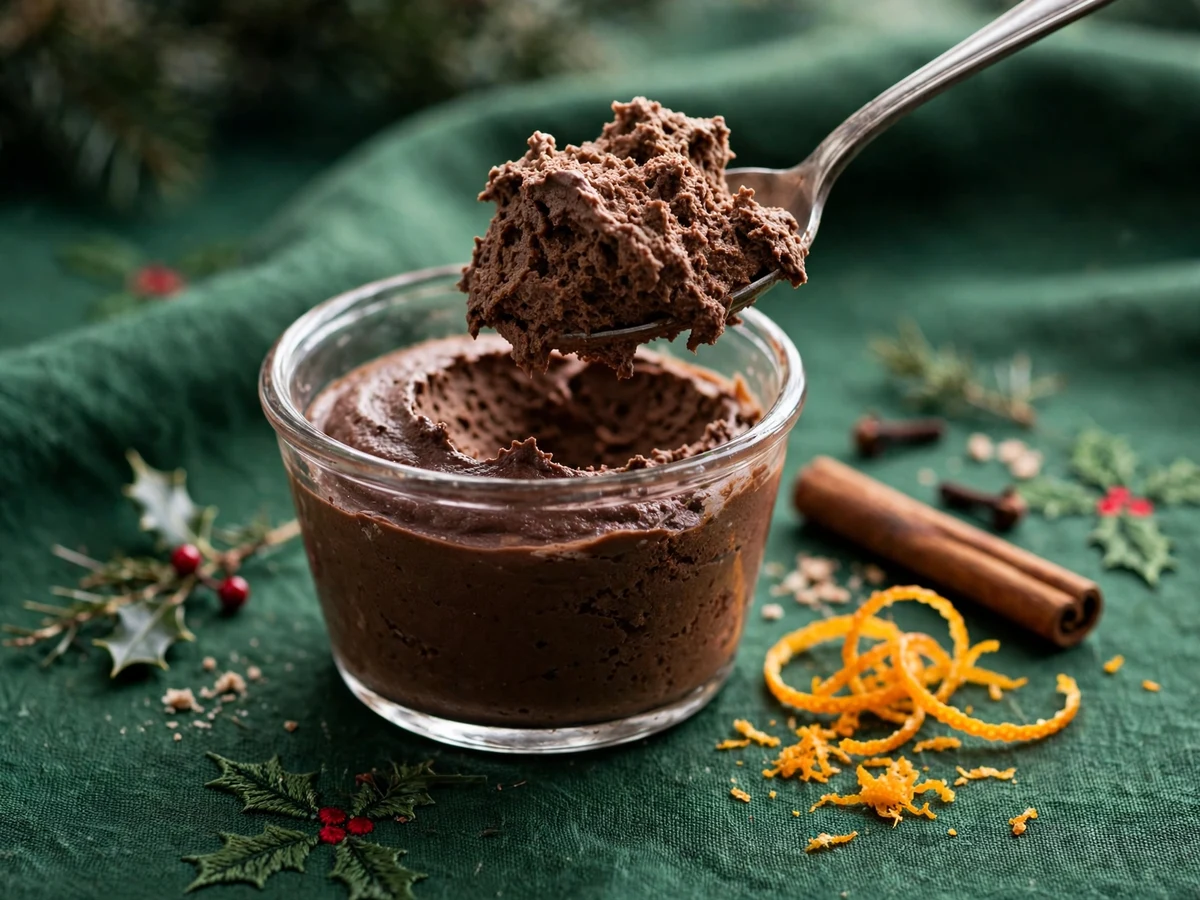
On the Christmas Table: Made on the Twenty Third, Served on the Twenty Fifth
Christmas dinner ends with a table that has already eaten well. The dessert that succeeds there is small, cold, intense, and ready without a minute of work on the day, and a half cup glass of dark mousse is exactly that shape.
Make the mousse on December twenty third, with the cinnamon and orange zest in the base. The two days of rest are not just convenience: the cocoa deepens, the orange settles into the chocolate, and the texture sets to its silkiest on the second day.
Serve the glasses straight from the refrigerator with raspberries and shaved chocolate added at the last minute. On a table that also carries our lighter healthy yule log, the mousse is the small, dark counterpoint to the log’s celebration slice, and guests routinely take one of each.
The glasses themselves do quiet decorative work. Small, clear, and dark against the table’s candles and greenery, they read as a course rather than an afterthought, which is how a lightened dessert earns its place without apology.
For a larger gathering, the recipe doubles cleanly in a bigger bowl, but fold the whites in two batches so the foam is never crushed by the weight of a double base. Portion into glasses before chilling, never after, so the surfaces stay smooth.
Leftovers, on the rare occasion there are any, keep their texture for a third day in the refrigerator. The glasses also travel well, lidded and cold, which makes this the dessert to send home with a guest who hosts you later in the season.
Grainy, Runny or Dense: the Three Mousse Fixes
A grainy mousse with tiny hard flecks means the chocolate seized: the yogurt was cold or the chocolate too hot when they met. It cannot be fully repaired after the whites are in, but before folding, a seized base often recovers with one tablespoon of warm milk whisked in slowly until the shine returns.
A runny mousse that never sets usually traces back to the whites. Peaks that were soft and droopy cannot hold a base up, and a base made with thin, watery yogurt gives the foam nothing to stand on. Use a thick Greek yogurt, and if the tub shows a layer of liquid, pour that liquid off before measuring.
A dense mousse is a folding problem, not an ingredient problem. Stirring instead of folding, or folding all the whites in at once into a stiff base, knocks the air out in seconds. Loosen the base with the first third of the whites, then fold the rest gently, and stop the moment the last white streak disappears.
A mousse that tastes sharply tangy was made with a very lean, very tart yogurt. The fix for next time is a spoonful more maple syrup and a pinch more salt, which reads as balance rather than sweetness. Serving it colder, straight from the refrigerator, also softens the tang noticeably.
With Peppermint, With Espresso, or Dairy Free
For a peppermint version built for December, replace the cinnamon with a quarter teaspoon of peppermint extract. A few of our healthy peppermint truffles on the same small plate turn two light desserts into one composed course.
For an espresso version, dissolve one teaspoon of instant espresso powder in the warm melted chocolate. The mousse does not taste of coffee; the chocolate simply reads darker and longer, which many adults prefer after a rich meal.
For a dairy free glass, use a thick plain coconut yogurt and add one extra tablespoon of cocoa to firm the set. The texture lands slightly softer and the coconut stays in the background, but the whites still do the real work of the mousse.
For a sweeter, milder glass aimed at children, use a 60 percent dark chocolate instead of 70 and add one extra tablespoon of maple syrup. The numbers rise to about 255 calories a glass, still far under the classic, and the flavor moves toward milk chocolate without changing the method at all.
The Small Glass Nobody Believes Is Light
Healthy chocolate mousse, made this way, asks for a bowl of melted chocolate, a bowl of whipped whites, and the patience to fold them together gently. What it returns is a dessert with real air in it: deep chocolate, a clean tang, a set that trembles slightly on the spoon.
Serve it in small glasses after the biggest meal of the year and watch it disappear without a single comment about calories. That silence is the point. The numbers are simply how it got there.
Questions Cooks Ask About Healthy Chocolate Mousse
Pair it with a mug of our healthy hot chocolate and the chocolate course is complete: deep cacao flavor in the glass and in the cup, both without the heavy cream.
Are the egg whites in healthy chocolate mousse safe to eat raw?
Use only pasteurized egg whites, sold in cartons, or pasteurized eggs in the shell; they are gently heat treated and safe to eat uncooked. Never serve raw whites from ordinary shell eggs to guests, especially children, older adults, or anyone pregnant.
Can I skip the egg whites and just blend yogurt and chocolate?
You can, and it tastes good, but it will be a dense chocolate yogurt cup, not a mousse: nothing in the bowl holds air. The whipped whites are the entire difference in texture, and they add almost no calories, about 17 per glass.
Why did my chocolate turn grainy when it hit the yogurt?
The chocolate seized, which happens when warm melted chocolate meets cold yogurt. Bring the yogurt to room temperature, let the melted chocolate cool 10 minutes, and whisk steadily. A tablespoon of warm milk whisked into a seized base often brings the shine back.
How far ahead can I make this mousse for Christmas?
Two days is the sweet spot. Made on December 23, covered and refrigerated, it is at its silkiest on December 25. Add the raspberries and shaved chocolate just before serving so the berries stay fresh and the shavings stay dry.
Can I use milk chocolate instead of dark chocolate in this mousse?
Yes, with two adjustments: choose the darkest milk chocolate you can find, and cut the maple syrup to 2 tablespoons, since milk chocolate is much sweeter. The set will be a little softer and the calories rise to about 255 a glass, still well under the classic.