
Healthy Spritz Cookies, Pressed, Buttery and Crisp at About 55 Calories Each
Healthy Spritz Cookies, Pressed, Buttery and Crisp at About 55 Calories Each
In this article:
- The Press Rewards the Right Dough
- Crisp Ridges, Melting Middle
- Spritz Math: 55 Calories Against 85
- Ingredients for Healthy Spritz Cookies
- Cream, Fill, Click: Pressing the Cookies
- When the Press Fights Back: Four Fixes
- One Dough, a Whole Tin of Shapes
- Building the Cookie Box Around Them
- Two Weeks in the Tin, Two Months in the Freezer
- Small Cookies, Long Season
- Questions Cooks Ask About Spritz Cookies
Healthy spritz cookies come out of the same tin my grandmother kept on her counter every December, the one nobody was allowed to open before the tree was up. Trees, wreaths and stars, ridged and pale gold, gone two at a time with coffee.
For years I assumed a lighter spritz was a contradiction. The cookie is butter, pressed thin; take the butter away and you take the cookie. What I had not tried was taking away only some of it, and letting flour do more of the work.
The version below keeps real butter, real sugar and the real press. It lands at about 55 calories a cookie against roughly 85 for the classic spritz of the same size, and the ridges still shatter the way they should.

The Press Rewards the Right Dough
These healthy spritz cookies succeed or fail on dough consistency, and the window is narrower than most cookie doughs allow. Too cold, and the press strains and extrudes ragged shapes. Too warm, and the dough slumps into puddles that lose their ridges in the oven.
The target is a dough like firm frosting: soft enough to pipe, structured enough to hold a sharp edge. Three choices get it there. The butter is beaten pale but never glossy, the flour goes in all at once and is mixed only until it disappears, and the dough is used promptly, without a long chill.
Half of the flour is white whole wheat, and this is a deliberate piece of engineering rather than a health gesture. Its finer grind and slightly higher absorption firm the dough just enough to press cleanly, while its mild flavor stays invisible under the vanilla and almond.
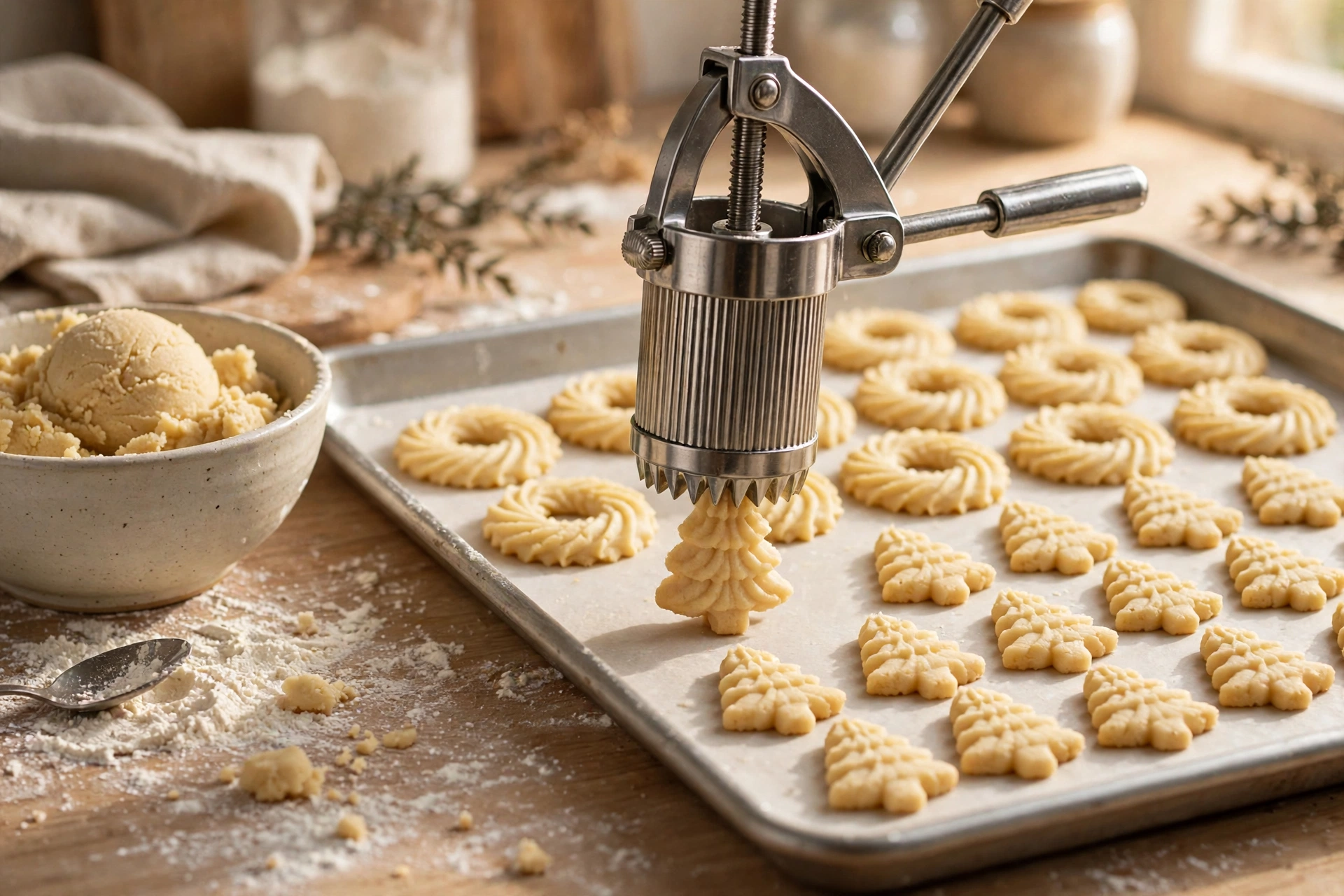
The sheet matters as much as the dough. Spritz cling to bare, cool metal as they leave the press; that grip is what releases them from the disk. A greased or parchment lined sheet defeats the mechanism, which is why so many first batches end in frustration.
Once the rhythm starts, it is genuinely fast. One click, a breath, a straight lift, and a perfect tree sits on the sheet. A full batch presses in about fifteen minutes, faster than any rolled and cut cookie in the holiday repertoire.
Crisp Ridges, Melting Middle
A spritz cookie is an architecture of edges. The press forces the dough into ridges and points, and those thin extremities bake crisper than the center, so a single small cookie delivers two textures: a delicate crunch at the rim, then a rich, melting middle.
The crumb should be fine and sandy, never bready. That comes from the modest sugar, the single egg, and restraint with the mixer once the flour goes in. Overworked spritz dough develops chew, and chew is the one texture this cookie cannot afford.
Color stays pale on purpose. A spritz taken to deep gold tastes toasted and loses its butter clarity; the right moment is a matte surface, set centers, and edges barely kissed with color. They firm as they cool, finishing crisper on the rack than they feel in the oven.
Vanilla leads and almond follows half a breath later, that faint marzipan note that makes spritz taste like Christmas rather than like plain butter cookies. The sanding sugar adds a small, bright crunch on top and catches the light in the tin.
Spritz Math: 55 Calories Against 85
The classic spritz formula runs a full cup of butter and a full cup of sugar against roughly the same flour used here, which works out to about 85 calories for a cookie of this size, most of it arriving before any decoration.
This dough cuts the butter to three quarters of a cup and the sugar to two thirds, then lets white whole wheat flour contribute body and a gram of staying power. The result, checked against the USDA FoodData Central entries for butter, sugar and flour, is about 55 calories a cookie: roughly 30 calories lighter, with the butter flavor fully intact.
The point of the arithmetic is permission, not penance. A Christmas cookie plate is a grazing situation, two cookies here and one there all December. Thirty calories saved per cookie is the difference between a tin you ration and a tin you actually enjoy.
Nothing in the dough is a substitute product. There is no margarine, no sweetener blend, no applesauce standing in for fat. It is the classic formula with its proportions edited by someone who wanted to keep eating the result.
Ingredients for Healthy Spritz Cookies
- 3/4 cup unsalted butter, softened but not shiny
- 2/3 cup granulated sugar
- 1 large egg, at room temperature
- 1 1/2 teaspoons vanilla extract
- 1/2 teaspoon almond extract
- 1 1/4 cups all-purpose flour
- 1 cup white whole wheat flour
- 1/2 teaspoon baking powder
- 1/4 teaspoon fine sea salt
- Colored sanding sugar or sprinkles, for decorating
About the butter: “softened but not shiny” is the whole instruction. It should dent easily under a finger and hold the dent, with no greasy sheen on the surface. Butter that has gone soft and glossy on a warm counter will give you cookies that spread, no matter what the flour does.
About the flour: white whole wheat is milled from a paler wheat variety, so it behaves almost like all-purpose flour while bringing the whole grain with it. Regular whole wheat flour is too assertive here; its bran darkens the cookies and dulls the ridges. Spoon and level both flours rather than scooping.
Cream, Fill, Click: Pressing the Cookies
- Heat the oven to 375 degrees F. Set out clean, ungreased, unlined baking sheets and let them stay cool; a warm sheet melts the ridges before they set.
- Beat the butter and sugar with an electric mixer on medium speed for about 2 minutes, until pale and fluffy but not glossy. The butter should hold soft peaks, not slump.
- Beat in the egg, vanilla extract and almond extract until fully combined, scraping the bowl once.
- Whisk the all-purpose flour, white whole wheat flour, baking powder and salt in a separate bowl. Add to the butter mixture and mix on low just until no dry flour remains. The dough should be soft and pliable, like firm frosting.
- Fill the cookie press with dough, working it in with a spoon to avoid air pockets. Choose a tree, wreath or star disk.
- Press the cookies directly onto the cool, bare baking sheets, spacing them about 1 inch apart: one firm click, a slight pause, then lift straight up. Scatter sanding sugar over the shapes right away, while they are still tacky.
- Bake one sheet at a time for 7 to 9 minutes, until the edges are just barely golden and the centers look set and matte. Do not wait for browning on top; spritz are done pale.
- Cool on the sheet for 3 minutes, then move to a rack. Let the sheet cool completely and wipe it clean before pressing the next batch.
Sacrifice the first cookie. Press one shape, watch how it releases, and adjust before filling the sheet: a ragged edge means air in the barrel, a slumped shape means a warm kitchen. One test cookie now saves a whole sheet of evidence later.
When the Press Fights Back: Four Fixes
If the dough refuses to stick to the sheet and climbs back into the press, the sheet is the problem nine times out of ten. It must be bare, clean, cool and completely dry. Wash off any greasy film, chill the sheet for ten minutes, and press again; the dough grips cold metal eagerly.
If the shapes spread and lose their ridges, the butter got too warm. Rest the filled press in the refrigerator for 10 minutes, work with half the dough while the rest waits in the fridge, and never set a pressed sheet on top of a warm stove while the oven heats.
If the dough is too stiff to extrude, it has either been over chilled or over floured. Knead in a teaspoon of milk with your hands, just until the dough relaxes. Check your flour measuring, too: a scooped cup can add two extra tablespoons and quietly ruin the ratio.
If the bottoms brown before the tops set, your sheet is dark or thin. Switch to a heavy, light colored sheet, drop the oven by 10 degrees, and bake on the middle rack. Spritz forgive many things, but a scorching sheet is not one of them.
One Dough, a Whole Tin of Shapes
The base dough is a wardrobe, not a uniform. Change the disk and the tin fills with trees, wreaths, stars and rosettes from a single batch, which is precisely how the classic Christmas tin achieves its variety without five separate doughs.
For a citrus batch, add a teaspoon of finely grated orange zest with the extracts and finish the wreaths with a single dried cranberry pressed into the center before baking. For a spiced batch, whisk half a teaspoon of cinnamon and a pinch of cardamom into the flour.
A chocolate variation works if you respect the press: replace three tablespoons of the all-purpose flour with cocoa powder and keep everything else identical. The dough presses a shade stiffer, so give it two minutes at room temperature if it resists.
They sit naturally beside the site’s other pressed and rolled classics: alternate them in the tin with the healthy Christmas sugar cookies for a contrast of crisp and soft, and let the wreaths carry green sugar while the stars carry red.
Building the Cookie Box Around Them
Spritz are the structural cookie of a gift box: small, sturdy, stackable, and still crisp after a week in transit. A box built around them needs only contrast, something soft, something jammy, something snowy.
My formula for a balanced box is six spritz, four healthy snickerdoodles for softness, four healthy thumbprint cookies for the jam center, and a small pile of healthy almond snowball cookies to fill the corners with snow.
Pack in a metal tin or a sturdy box lined with parchment, one layer deep where you can, with a sheet of parchment between layers. Spritz travel on the bottom layer; their ridges are crisp but not fragile, and they protect the softer cookies riding above them.
Label the box with the baking date. Everything in it holds at least two weeks, which means a box assembled on a Sunday ships on Monday and still eats like it was baked that morning when it lands.
Two Weeks in the Tin, Two Months in the Freezer
Baked spritz keep for up to 2 weeks in an airtight tin at room temperature, and their texture barely moves across that span. Keep them away from strong smelling cookies; butter absorbs neighbors’ flavors, and a mint cookie stored beside them will quietly redecorate the whole tin.
The freezer trick bakers swear by is pressing the shapes raw, directly onto a sheet, and freezing them solid before bagging. Frozen shapes keep for up to 2 months and bake from frozen at the same temperature, adding a single minute. December production becomes an assembly job instead of a marathon.
The dough itself also freezes, portioned into logs the diameter of the press barrel. Thaw overnight in the fridge, then give it 20 minutes on the counter; it should return to that firm frosting texture before it goes anywhere near the press.
Small Cookies, Long Season
These healthy spritz cookies keep everything that matters, the press, the ridges, the butter, the tin on the counter, and quietly set down the part that never mattered: about 30 extra calories in every small, crisp bite.
Make the first batch early in December, freeze a sheet of shapes for later, and let the tin do its slow work all month. The cookies are small. The season they carry is not.
Questions Cooks Ask About Spritz Cookies
Why will my spritz dough not stick to the baking sheet?
Because the sheet is working against you. It must be bare, ungreased, unlined, clean and cool; grease, parchment and warmth all break the grip the dough needs to release from the press. Chill a clean sheet for 10 minutes and press again, holding the press flat against the metal for a full second.
Can I make spritz cookies without a cookie press?
Yes, with a piping bag and a large open star tip. The dough must be a touch softer, so add a teaspoon of milk, and pipe rosettes and short ridges instead of trees and wreaths. You lose the fine stamped detail, but the flavor and the crisp melting texture stay exactly the same.
Why did my spritz cookies spread and lose their shapes?
Warm butter, almost every time. The butter should be softened but matte, never shiny or slumping, and the sheets must be cool when the dough lands. If shapes slump mid batch, chill the filled press for 10 minutes and swap to a cold sheet before pressing the rest.
How far ahead can I freeze the pressed shapes?
Up to 2 months. Press the shapes onto a sheet, freeze until solid, then bag them with the air pressed out. Bake from frozen at 375 degrees F, adding about 1 minute. It is the easiest way to spread December baking across November weekends.
Can I use all all-purpose flour instead of the blend?
You can, and the cookies press beautifully, but the calorie count rises slightly and the dough softens faster in a warm kitchen. The white whole wheat half is doing structural work here as well as nutritional work, so the blend is worth keeping if you have the flour on hand.

Healthy Spritz Cookies
The pressed Christmas classic, lightened with a method instead of substitutes: real butter cut to 3/4 cup, sugar at 2/3 cup, and half the flour swapped for white whole wheat, so the ridges stay crisp and the crumb still melts. About 55 calories a cookie against roughly 85 for the classic spritz of the same size.
- Total Time: 1 hour 10 minutes
- Yield: 60 cookies 1x
Ingredients
- 3/4 cup unsalted butter, softened but not shiny
- 2/3 cup granulated sugar
- 1 large egg, at room temperature
- 1 1/2 teaspoons vanilla extract
- 1/2 teaspoon almond extract
- 1 1/4 cups all-purpose flour
- 1 cup white whole wheat flour
- 1/2 teaspoon baking powder
- 1/4 teaspoon fine sea salt
- Colored sanding sugar or sprinkles, for decorating
Instructions
- Heat the oven to 375 degrees F. Set out clean, ungreased, unlined baking sheets and let them stay cool; a warm sheet melts the ridges before they set.
- Beat the butter and sugar with an electric mixer on medium speed for about 2 minutes, until pale and fluffy but not glossy. The butter should hold soft peaks, not slump.
- Beat in the egg, vanilla extract and almond extract until fully combined, scraping the bowl once.
- Whisk the all-purpose flour, white whole wheat flour, baking powder and salt in a separate bowl. Add to the butter mixture and mix on low just until no dry flour remains. The dough should be soft and pliable, like firm frosting.
- Fill the cookie press with dough, working it in with a spoon to avoid air pockets. Choose a tree, wreath or star disk.
- Press the cookies directly onto the cool, bare baking sheets, spacing them about 1 inch apart: one firm click, a slight pause, then lift straight up. Scatter sanding sugar over the shapes right away, while they are still tacky.
- Bake one sheet at a time for 7 to 9 minutes, until the edges are just barely golden and the centers look set and matte. Do not wait for browning on top; spritz are done pale.
- Cool on the sheet for 3 minutes, then move to a rack. Let the sheet cool completely and wipe it clean before pressing the next batch.
- Prep Time: 25 minutes
- Cook Time: 8 minutes
Nutrition
- Serving Size: 1
- Calories: 55
- Sugar: 3
- Sodium: 20
- Fat: 3
- Saturated Fat: 2
- Unsaturated Fat: 1
- Trans Fat: 0
- Carbohydrates: 7
- Fiber: 0
- Protein: 1
- Cholesterol: 10



One Comment
Comments are closed.