Healthy Roasted Brussels Sprouts With Lemon, Garlic and Crisp Golden Edges
Healthy Roasted Brussels Sprouts With Lemon, Garlic and Crisp Golden Edges
In this article:
- Dry Sprouts, Hot Pan: Where the Crisp Comes From
- Cut Side Down, and Nobody Crowds the Pan
- The Side Dish Math: 110 Against 220
- Ingredients for Healthy Roasted Brussels Sprouts
- Trim, Toss, Roast: Thirty Minutes to the Table
- A Thanksgiving Plan That Saves the Oven
- Soggy, Bitter, Burnt Leaves: the Three Fixes
- Air Fryer, Parmesan Free and Three Flavor Turns
- The Green Dish That Gets Eaten First
- Questions Cooks Ask About Roasted Brussels Sprouts
Thanksgiving tables lean heavy. Between the buttered rolls, the rich gravy and the third casserole, the meal begs for one dish that tastes bright, eats light and still earns its place next to the turkey.
These healthy roasted Brussels sprouts answer with contrast: caramelized cut faces, tender centers, loose leaves gone crisp as chips, and a finish of lemon that resets the palate between richer bites. They land at about 110 calories a serving, roughly half the classic roasted version, and they taste like the cook meant it.
The method is short and strict. Dry sprouts, a ripping hot pan, cut sides down, and no crowding. Fifteen minutes of prep, twenty five in the oven, and the green dish is the one that empties first.
Dry Sprouts, Hot Pan: Where the Crisp Comes From
Healthy roasted Brussels sprouts live or die on surface moisture. A sprout that goes into the oven damp steams in its own water for the first ten minutes, and steamed cabbage never browns. By the time the surface dries, the center is overcooked and the flavor has slid toward sulfur.
Drying is therefore a step, not a suggestion. After washing, the halved sprouts rest cut side down on a clean towel for at least fifteen minutes, or take a full turn in a salad spinner. The cut faces should feel dry to the touch before any oil goes near them.
Heat is the second half of the equation. A heavy sheet pan goes into the oven while it preheats to 425 degrees, so the sprouts land on hot metal and start searing on contact. That head start is what builds the deep golden crust in twenty five minutes instead of forty.
The oil stays measured, two tablespoons for two pounds, because the goal is a thin film rather than a bath. Tossed in a bowl instead of drizzled on the pan, every cut face gets its share, and the calories stay where the recipe promises them.
Garlic timing deserves one sentence of its own. Minced garlic tossed with the oil from the start toasts gently against the sprouts and turns sweet; garlic added raw at the end would taste harsh, and garlic powder, while convenient, never quite loses its dusty edge. Fresh cloves, minced fine, belong in the bowl before the pan.
Cut Side Down, and Nobody Crowds the Pan
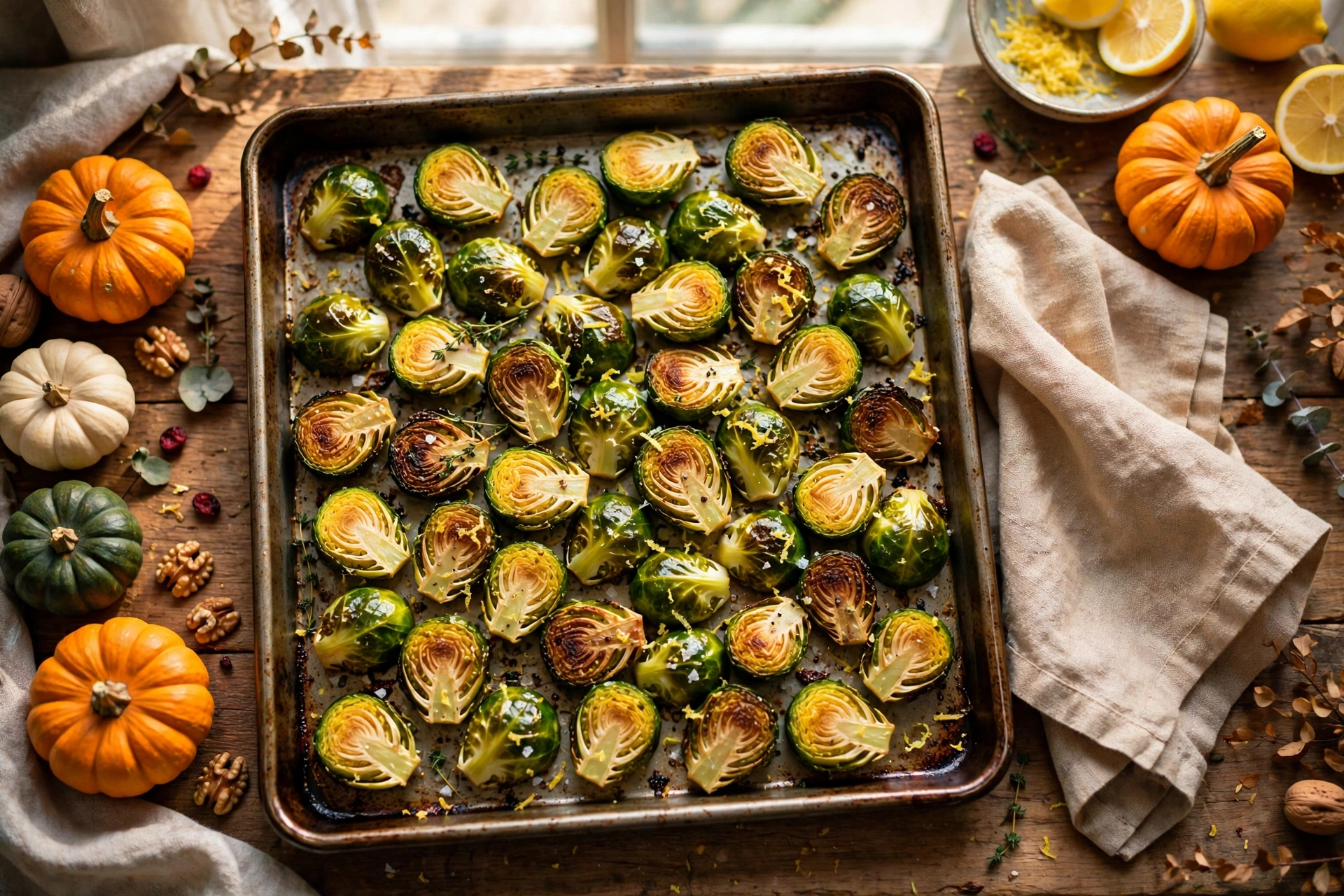
Placement looks fussy and matters completely. Each half goes cut side down, flat against the metal, with a whisper of space around it. The flat face is where the sugars concentrate, and full contact is what turns it amber and sweet.
Crowding is the quiet saboteur. Two pounds spread over one large pan roast beautifully; the same two pounds squeezed onto a small pan trap steam between the sprouts and come out soft and pale. When in doubt, use two pans and rotate them halfway.
The sprouts stay untouched for the first fifteen minutes. Turning them early tears the crust before it sets. Once the faces are deeply golden, a spatula can loosen them for a final five minutes so the rounded backs take a little color too.
Size sorting helps the whole pan finish together. Halve the small and medium sprouts, quarter the very large ones, and pull off any yellowed outer leaves before roasting. Loose leaves that fall during trimming can go on the pan as they are; they crisp into the cook’s snack.
A word about the trim itself: slice only a thin shaving from the stem end. Cutting too deep loosens the layers, and the half falls apart into separate leaves that scorch before the core cooks. A shallow trim keeps the sprout intact while removing the one woody bite nobody enjoys.
The Side Dish Math: 110 Against 220
The classic holiday version of this dish roasts the sprouts in rendered fat, finishes them with crisped cured meat and lands near 220 calories a serving before the maple glaze some recipes add. This lighter build keeps the caramelization and drops the freight: about 110 calories, 5 grams of protein and 5 grams of fiber a serving.
The vegetable itself does most of the work. Brussels sprouts are naturally dense in vitamin C, vitamin K and folate for very few calories, a profile worth checking in the USDA FoodData Central database if you like your numbers sourced. Roasting concentrates their sweetness instead of leaching it into boiling water.
On the table, the math becomes strategy. A light, bright side lets the rest of the meal stay traditional without apology. Set the dish beside healthy herb roasted turkey breast and healthy green bean almondine, and the plate reads abundant rather than heavy.
The lemon and parmesan finish is calibrated, not decorative. Acid lifts roasted vegetables the way salt lifts everything, and two tablespoons of finely grated parmesan across six servings deliver savor for about seven calories a plate. Flavor per calorie is the whole game on this site.
Ingredients for Healthy Roasted Brussels Sprouts
- 2 pounds Brussels sprouts, trimmed and halved
- 2 tablespoons olive oil
- 3 garlic cloves, minced
- 1 teaspoon lemon zest
- 3/4 teaspoon fine sea salt
- 1/2 teaspoon black pepper
- 1/4 teaspoon smoked paprika
- 2 tablespoons finely grated Parmesan
- 1 tablespoon fresh lemon juice
Choose sprouts that feel heavy and tight, with bright green leaves and no black spots on the cut stem. Small to medium sprouts, about an inch across, roast sweetest. Very large ones can carry a sharper bite and are better quartered so their centers tenderize in time.
The smoked paprika is subtle, a background warmth rather than a barbecue note, and it deepens the color of the crust. Fresh lemon matters here; bottled juice tastes flat against roasted flavors. The parmesan should be finely grated so it melts into a lacy coating instead of sitting in clumps.
Trim, Toss, Roast: Thirty Minutes to the Table
- Place a large rimmed sheet pan in the oven and preheat to 425°F (220°C). Trim the stem ends of the sprouts, halve them, and dry the cut faces thoroughly on a clean towel for at least 15 minutes.
- In a large bowl, toss the sprouts with the olive oil, garlic, lemon zest, salt, pepper and smoked paprika until every cut face carries a thin film of oil.
- Carefully remove the hot pan and arrange the sprouts cut side down in a single layer with space around each half. Return the pan to the oven.
- Roast undisturbed for 15 minutes, until the cut faces are deeply golden. Loosen with a spatula and roast 8 to 10 minutes more, until the centers are tender when pierced.
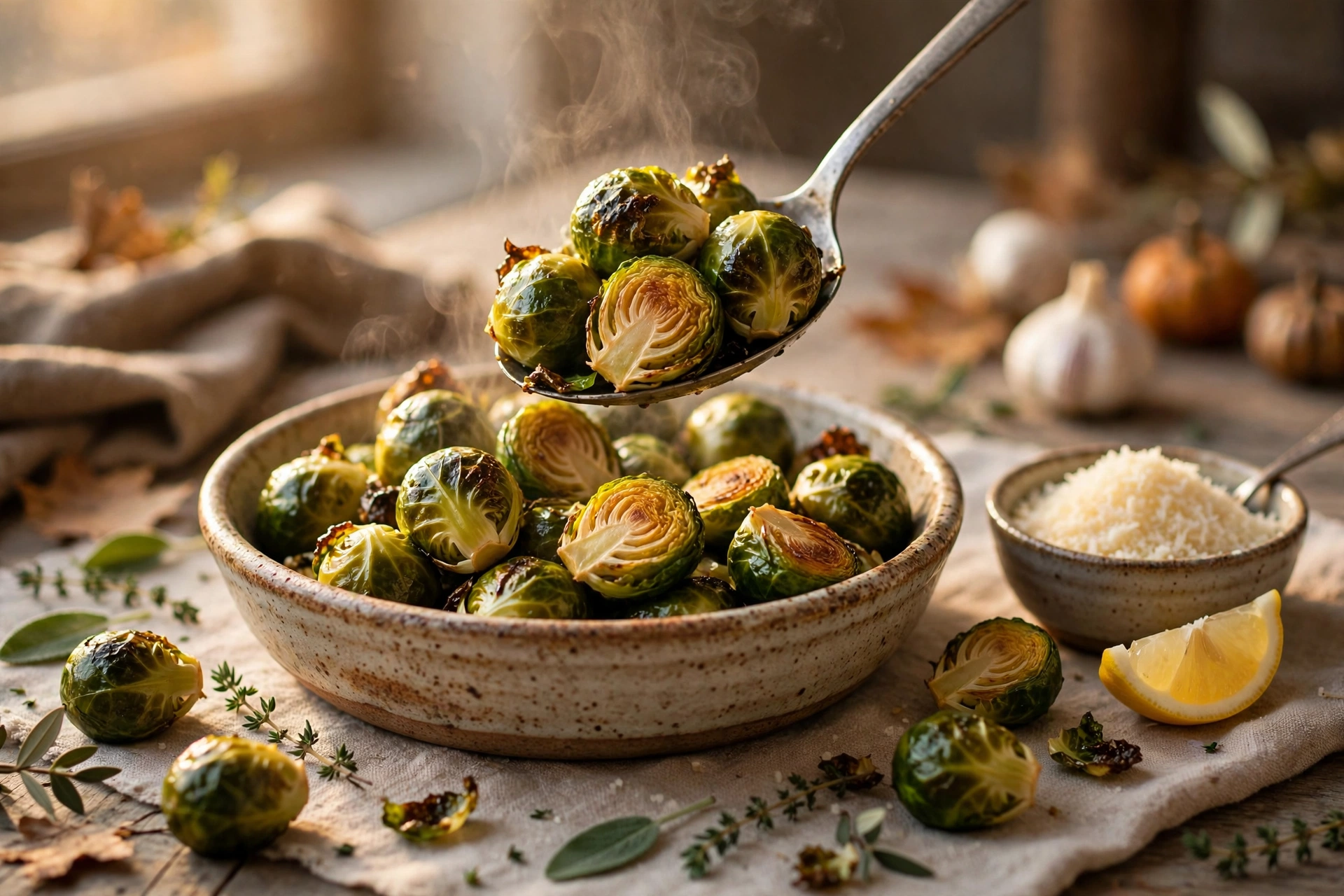
- Transfer to a warm serving dish. Shower with the parmesan, drizzle with the lemon juice, toss once and serve right away while the loose leaves are still crisp.
A Thanksgiving Plan That Saves the Oven
Oven space is the real currency on Thanksgiving, and this dish is built to spend as little of it as possible. The sprouts can be trimmed, halved and dried the day before, then held in a towel lined container in the refrigerator, ready for oil and heat.
Two schedules work on the day. Roast them first, while the turkey rests, and hold them in a low oven; or roast them in the morning, undercook them by five minutes, and bring them back at 425 degrees for six to eight minutes just before serving. The second pass restores the crisp edges completely.
Timing around the bird gets easier with a partner dish that asks nothing of the oven. A bright bowl of healthy cranberry sauce, made days ahead, and a stovetop pot of healthy mashed potatoes leave the racks free for exactly one pan of sprouts at the critical moment.
Leftovers hold their own the next day. Refrigerated in a sealed container, the sprouts keep three to four days and reheat best in a dry skillet or a hot oven, never the microwave. Chopped cold, they also fold beautifully into a grain bowl with leftover turkey.
Serving temperature matters more than cooks expect. Roasted sprouts taste sweetest in the first fifteen minutes, while the contrast between the hot crisp edges and the tender center is at its peak. If the rest of dinner runs late, hold them in the cooling oven rather than on the counter, and add the lemon at the very last moment so its brightness does not fade into the steam.
Soggy, Bitter, Burnt Leaves: the Three Fixes
Soggy sprouts almost always trace back to water or crowding. Wet cut faces, a pan loaded past a single layer, or an oven running cool will each produce the same soft result. Dry thoroughly, give them room, and trust the hot pan to do its work.
Bitterness comes from two places: old sprouts and overcooking. Sprouts stored too long develop a sharp edge that no seasoning hides, so buy them within a few days of roasting. In the oven, pull them when the centers are just tender; long past that point, the sulfur notes take over.
Burnt outer leaves with raw centers mean the sprouts were mismatched in size or the oven runs hot at the back. Quarter the large ones, rotate the pan once at the fifteen minute mark, and let the loose leaf chips darken; they are supposed to be nearly burnt, and they are the best part.
One more quiet failure deserves naming: seasoning added after roasting slides off. Salt and spices belong in the oil before the pan, where they cling, toast and season every layer instead of dusting the outside of a finished dish.
Air Fryer, Parmesan Free and Three Flavor Turns
The air fryer handles a half batch beautifully. Roast at 400 degrees for twelve to fifteen minutes, shaking the basket twice, and expect even crisper leaf chips than the oven gives. Work in two batches rather than filling the basket; the same no crowding rule applies.
For a dairy free plate, drop the parmesan and finish with a teaspoon of nutritional yeast or a handful of toasted chopped walnuts. The walnuts add crunch and richness for a modest calorie increase, and they suit the Thanksgiving table particularly well.
Flavor turns stay inside the same light frame. A teaspoon of balsamic vinegar whisked into the lemon juice leans sweet and dark. A pinch of chili flakes and a drizzle of honey leans warm and bright. Orange zest in place of lemon, with a few pomegranate seeds at serving, leans festive without touching the numbers much.
In another season entirely, the same method carries the sprouts to a weeknight bowl with a fried egg and a spoonful of chili crisp. The technique is the recipe; the holiday dressing is only one of its outfits.
Shaved raw is the warm weather cousin worth knowing. The same sprouts, sliced paper thin and dressed with the same lemon, oil and parmesan, become a slaw with real crunch and none of the cooking. It will not replace the roasted pan at Thanksgiving, but it proves the point: the flavors in this recipe were never the heavy part.
The Green Dish That Gets Eaten First
Healthy roasted Brussels sprouts succeed at Thanksgiving because they refuse to taste like a compromise. Crisp faces, tender centers, lemon over everything, and a calorie count that leaves room for pie: the dish behaves like an indulgence and reads like a relief.
Make them once with the drying step done properly and the pan left uncrowded, and the method becomes reflex. Next year, nobody will ask whether the sprouts are the healthy version. They will ask whether there are more.
Questions Cooks Ask About Roasted Brussels Sprouts
Can I roast frozen Brussels sprouts the same way?
Not quite. Frozen sprouts carry too much surface water to crisp, so thaw them fully, halve them, and press them dry between towels before oiling. Expect softer centers and lighter browning than fresh, and add five minutes to the roasting time.
How do I keep Brussels sprouts from tasting bitter?
Buy fresh, tight sprouts and roast them hot and fast rather than low and long. The deep caramelization at 425 degrees converts their sharp edge into sweetness, and the lemon finish at the end balances whatever bite remains.
Can I roast the sprouts ahead and reheat them for Thanksgiving?
Yes. Roast them in the morning and stop five minutes early, then cool them uncovered. Six to eight minutes at 425 degrees before serving brings back the crisp faces and warms the centers through.
Should sprouts roast cut side up or down?
Down, always. The flat cut face in direct contact with the hot pan is where the sugars caramelize into the deep golden crust. The rounded backs steam gently from above and stay tender.
How long do leftover roasted Brussels sprouts keep?
Three to four days in a sealed container in the refrigerator. Reheat them in a dry skillet or a 425 degree oven for five minutes to restore the edges; the microwave makes them soft.