Healthy Hasselback Butternut Squash with Sage, Garlic and Light Parmesan, Crisp Edged at About 115 Calories a Serving
In this article:
- Why This Healthy Hasselback Butternut Squash Works
- Caramel Edges, Soft Centers and Crispy Sage
- A Showpiece That Fits the Thanksgiving Timeline
- Light by Design, With the Numbers Up Front
- Ingredients for the Healthy Hasselback Butternut Squash
- How to Make the Healthy Hasselback Butternut Squash
- The Two Chopsticks Rule and Other Slicing Wisdom
- Acorn Squash, Delicata and Other Easy Turns
- Storage, Reheating and Next Day Bowls
- FAQ
Healthy hasselback butternut squash is the side dish that makes the whole Thanksgiving table lean in: two golden fans of squash, edges crisped, sage crackling on top, and a smell of garlic and warm spice that reaches the door.
Each serving lands at about 115 calories. The classic versions drown the squash in brown butter and climb past 350 calories before the topping. This one keeps the drama and trades the butter for olive oil and a measured snowfall of parmesan.
The method is calmer than it looks. The squash roasts briefly before slicing, so the knife work is easy and safe, and the fans finish in the oven while the turkey rests and the gravy comes together.
Why This Healthy Hasselback Butternut Squash Works
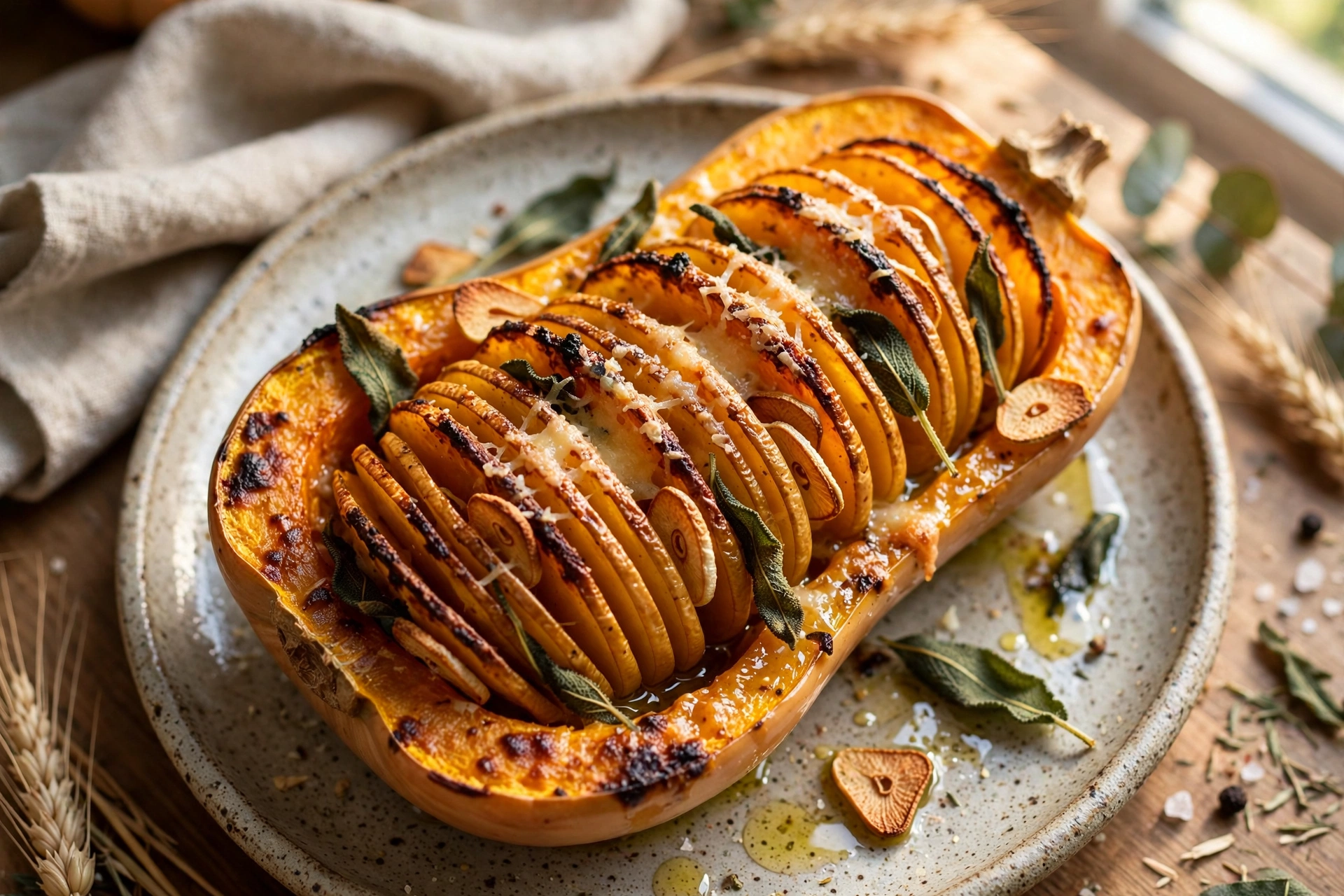
Healthy hasselback butternut squash works because the thin cuts do three jobs at once. They multiply the edges that can caramelize, they open channels for the seasoned oil to run deep, and they cook the dense flesh evenly without drying it out.
A short first roast is the quiet trick. Fifteen minutes in the oven softens the squash just enough that the slices cut cleanly and stay even, which is where most home attempts fall apart on a rock hard raw squash.
Olive oil replaces the usual half cup of butter without losing the point of the dish. The oil carries the garlic and sage into every cut, crisps the edges, and keeps the finish glossy instead of greasy.
The parmesan is measured, not handfuls. A quarter cup over the whole squash melts into a salty, lacy crust that seasons each bite, the same role it plays in our healthy roasted parsnips, where a little goes a long way.
A final brush of maple and vinegar wakes everything up. One tablespoon of maple across eight servings adds gloss and a whisper of sweetness, and the vinegar keeps that sweetness from sitting heavy on the plate.
Caramel Edges, Soft Centers and Crispy Sage
The pleasure of this dish is contrast. The top edges of each slice turn deep amber and almost shatter, while the center of the fan stays soft and spoon tender, sweet as roasted chestnut.
Garlic sliced thin goes sweet in the heat instead of sharp. Tucked between the slices, it perfumes the flesh around it, and the pieces that peek out at the top toast into mild, golden chips.
Sage arrives twice. Leaves tucked inside soften and turn silky, giving the deep herbal note of a holiday roast. Leaves fried at the end stay crisp, so every forkful has one shattering green bite.
The parmesan crust ties it together. It melts into the cuts, browns at the tips, and adds the savory depth that makes a vegetable side taste like the main event, much like the cheese pull on a gratin.
Served on a warm platter, the two fans hold their shape and slice at the table with a spoon. It looks like the hardest dish on the table. It is one of the simplest, which is a fine trick to keep.
A Showpiece That Fits the Thanksgiving Timeline
This squash respects the busiest oven of the year. It roasts at 425 degrees, the same temperature most sides want, and it can share the rack with healthy sweet potato casserole without a temperature fight.
The work splits into calm stages. Peel and start the squash in the morning, slice and season after the first roast, then hold the pan at room temperature for up to an hour before the final roast.
That final roast takes about forty minutes, which matches the resting time of a turkey almost exactly. While the bird rests and the gravy simmers, the fans caramelize and the sage fries in one small pan.
If the oven is crowded, the squash also finishes beautifully ahead of time. Roast it fully two hours early, keep it covered, and give it eight minutes in the hot oven just before serving to wake the edges.
For the cook, the best part is the serving. There is no carving, no sauce to keep warm, no last second mashing. The platter goes from oven to table and portions itself, one fan slice at a time.
Light by Design, With the Numbers Up Front
The numbers are the point of this version, so here they are plainly. A serving of this squash, one quarter of a half fan with its topping, comes to about 115 calories, with 4 grams of fat and 3 grams of fiber.
Compare the classics. Published versions built on brown butter run from about 356 to 442 calories a serving, most of that from a half cup of butter poured over at the end. The squash itself was never the problem.
Butternut brings real substance to those low numbers. According to USDA FoodData Central, the flesh is rich in fiber, potassium and vitamin A, which is why a modest portion still eats like a full side dish.
Nothing here is a diet trick. There is no sweetener swap and no missing topping, just olive oil measured in tablespoons, cheese measured in grams, and the natural sweetness of the squash doing the heavy lifting.
On a table with healthy roasted Brussels sprouts and a light gravy, this plate leaves everyone fed and still ready for pie, which is exactly the job of a holiday side.
Ingredients for the Healthy Hasselback Butternut Squash
- 1 large butternut squash, about 3 pounds (1.4 kg), a long neck gives the neatest slices
- 2 tablespoons olive oil (30 ml), plus 1 teaspoon for frying the sage
- 3/4 teaspoon fine sea salt (4.5 g)
- 1/2 teaspoon black pepper (1 g)
- 3 garlic cloves (9 g), thinly sliced
- 16 fresh sage leaves (about 8 g), divided
- 1 tablespoon maple syrup (15 ml)
- 1 teaspoon apple cider vinegar (5 ml)
- 1/4 cup finely grated parmesan (25 g)
How to Make the Healthy Hasselback Butternut Squash
- Heat the oven to 425 degrees F (220 degrees C). Line a rimmed baking sheet with parchment. Trim the ends of the squash, halve it lengthwise, scoop out the seeds, and peel until only orange flesh shows.
- Set the halves cut side down on the sheet and roast for 15 minutes, until the flesh gives slightly when pressed. This short roast makes the slicing safe and even.
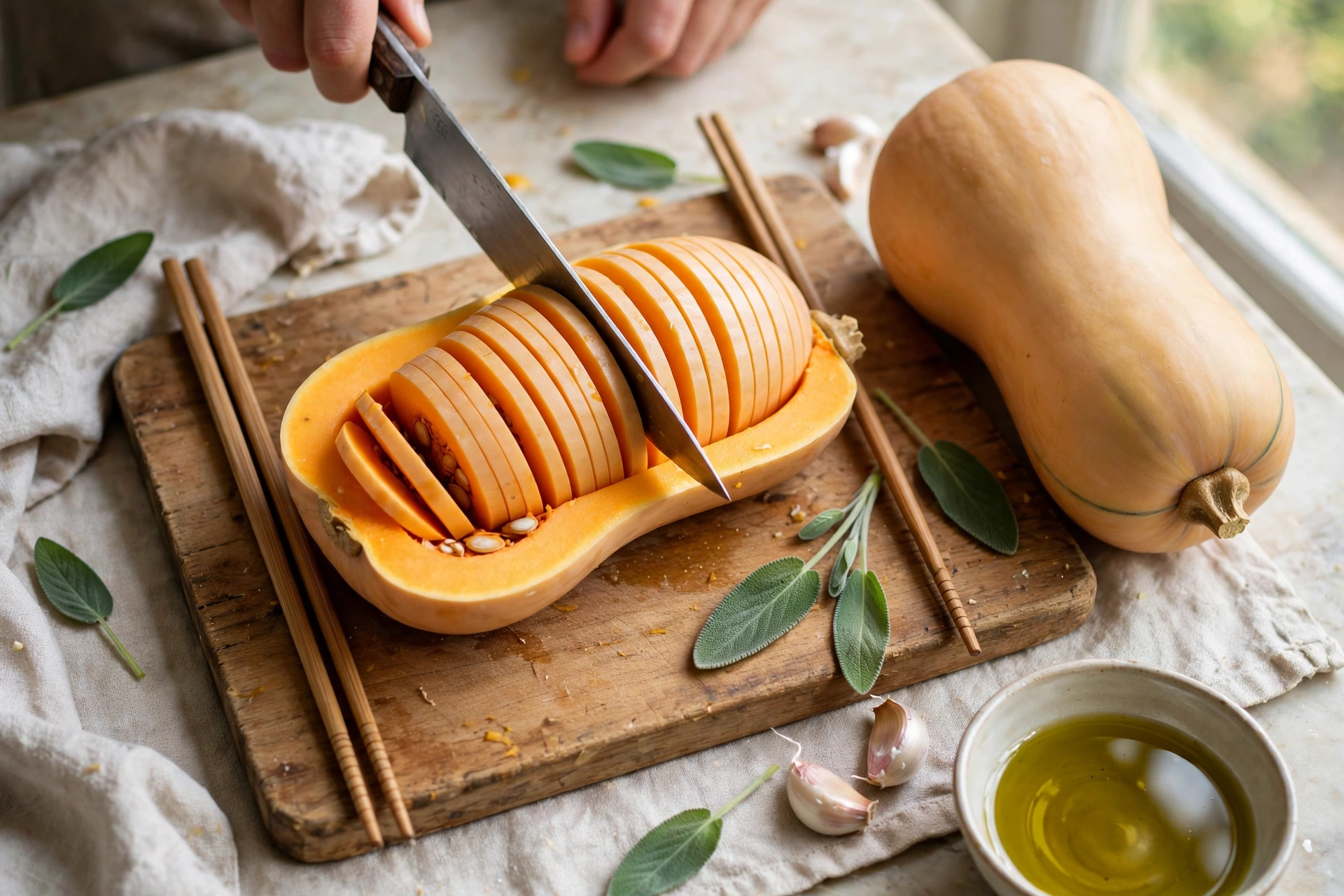
- Move the halves to a cutting board, cut side down. Lay a chopstick along each long side and slice across every 1/4 inch (6 mm), stopping at the chopsticks so the base stays whole.
- Return the halves to the sheet, cut side up. Brush with half the olive oil (15 ml), working it into the cuts, and season with the salt (4.5 g) and pepper (1 g).
- Tuck the garlic slices and half the sage leaves down between the slices, spacing them along the whole fan.
- Roast for 25 minutes, until the slices open like a fan and the edges begin to color.
- Whisk the maple syrup (15 ml) and vinegar (5 ml) into the remaining olive oil. Brush over the squash, coating the tops and letting it run into the cuts.
- Roast 15 to 20 minutes more, until the flesh is tender at the base and the edges are deep amber and crisp.
- While the squash finishes, heat the last teaspoon of olive oil in a small skillet and fry the remaining sage leaves for about 30 seconds, until crisp. Drain on a paper towel.
- Scatter the parmesan (25 g) over the hot squash and return to the oven for 2 minutes, just until it melts into the cuts. Rest 5 minutes, top with the crispy sage, and serve on a warm platter.
The Two Chopsticks Rule and Other Slicing Wisdom
Choose the right squash first. A long, thick neck with a small seed bulb gives you the longest run of clean slices. Avoid any squash with soft spots or a cracked stem, which roast unevenly.
Never slice a fully raw squash if you can help it. The fifteen minute head start in the oven is the difference between calm, even cuts and a wrestling match that ends with a broken fan.
The chopsticks are not a gimmick. They set a floor for the knife, so every cut stops at the same depth and the base holds. Wooden spoons with flat handles work the same way.
Keep the slices honest at about 1/4 inch (6 mm). Thinner slices dry out and fuse together, thicker ones stay firm in the middle while the edges scorch. A ruler check on the first three cuts sets the rhythm.
If a slice does break free, do not panic and do not discard it. Tuck it back into the fan before the final roast. Once the parmesan melts over the top, nobody will ever know, including you.
Acorn Squash, Delicata and Other Easy Turns
The same method flatters other winter squash. Delicata needs no peeling at all and roasts faster, about thirty minutes total, which makes it the weeknight version of this healthy hasselback butternut squash idea.
Acorn squash works in wedges rather than fans. Slice each half into connected arcs, season the same way, and shorten the final roast by about ten minutes, since the flesh is thinner.
For a warmer spice profile, whisk 1/2 teaspoon of smoked paprika (1 g) and a pinch of cinnamon into the maple brush. The squash turns deeper in color and leans gently toward the flavors of the stuffing.
To make it fully dairy free, skip the parmesan and finish with 2 tablespoons of toasted pumpkin seeds (18 g) for crunch and a final pinch of flaky salt. The edges and sage still carry the dish.
Leftovers have a second life. Chop the cold fans and fold them through cooked grains with a soft egg, or blend them into the base of our healthy roasted parsnip soup for a deeper, sweeter pot.
Storage, Reheating and Next Day Bowls
Leftovers keep well for up to 4 days in the fridge, stored in a shallow covered container. The sage topping softens, so fry a few fresh leaves at serving time if you want the crunch back.
Reheat in a 375 degree F (190 degree C) oven for 12 to 15 minutes, uncovered, until the edges sizzle again. The microwave works for a quick lunch but steams the edges soft, so the oven is worth it for guests.
Freezing is possible for up to 2 months, though the fan shape relaxes as it thaws. Freeze the portions flat on a tray first, then bag them, and reheat from frozen at 375 degrees for about 25 minutes.
The day after Thanksgiving, this squash earns its keep a second time. Serve the reheated fans beside the sliced turkey, and keep our guide to healthy leftover turkey recipes nearby for the rest of the bird.
However it returns to the table, it returns with its color and its edges intact, which is more than most holiday sides can promise. Make it once for the feast, and it will quietly become the dish people ask about first.
FAQ
My butternut squash is too hard to slice. What am I doing wrong?
You are probably slicing it raw. Roast the peeled halves for 15 minutes first, until the flesh gives slightly when pressed. The knife then glides, the slices stay even, and the fan holds together far better.
Can I use dried sage instead of fresh leaves in hasselback squash?
For the seasoning, yes: rub 1 teaspoon of dried sage (1 g) into the cuts with the salt. For the crispy topping, no, dried sage turns dusty. Fry a few fresh leaves if you have them, or finish with toasted pumpkin seeds instead.
Can I make healthy hasselback butternut squash the day before Thanksgiving?
Yes. Roast it fully, cool, cover and refrigerate. The next day, reheat uncovered at 375 degrees F (190 degrees C) for 15 to 18 minutes, then add the parmesan for the last 2 minutes and fry fresh sage to serve.
What can I use instead of parmesan on this squash?
Aged pecorino works gram for gram with a sharper bite. For a dairy free finish, skip the cheese and scatter 2 tablespoons of toasted pumpkin seeds (18 g) and a pinch of flaky salt over the hot fans.
Why did my squash slices fuse together while roasting?
The slices were likely cut too thin, under 1/4 inch, or the squash was not brushed with oil between the cuts. Oil each fan well, keep the cuts near 1/4 inch (6 mm), and fan the slices apart gently with the knife before the final roast.
Healthy Hasselback Butternut Squash with Sage, Garlic and Light Parmesan, Crisp Edged at About 115 Calories a Serving
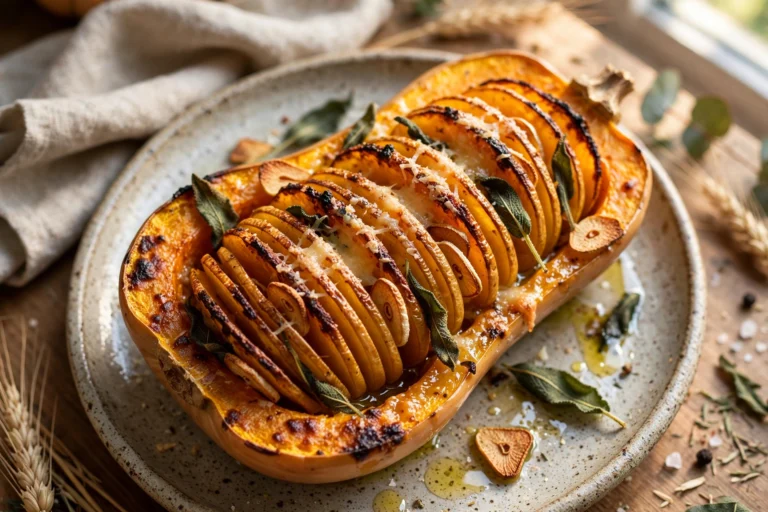
Butternut squash halves roasted briefly, sliced into thin fans, then finished with olive oil, garlic and sage tucked between the slices, a light maple brush and a measured snowfall of parmesan. About 115 calories a serving, against 356 to 442 for the classic brown butter versions.
- Total Time: 1 hour 15 minutes
- Yield: 8 servings 1x
Ingredients
1 large butternut squash, about 3 pounds (1.4 kg), a long neck gives the neatest slices
2 tablespoons olive oil (30 ml), plus 1 teaspoon for frying the sage
3/4 teaspoon fine sea salt (4.5 g)
1/2 teaspoon black pepper (1 g)
3 garlic cloves (9 g), thinly sliced
16 fresh sage leaves (about 8 g), divided
1 tablespoon maple syrup (15 ml)
1 teaspoon apple cider vinegar (5 ml)
1/4 cup finely grated parmesan (25 g)
Instructions
Heat the oven to 425 degrees F (220 degrees C). Line a rimmed baking sheet with parchment. Trim the ends of the squash, halve it lengthwise, scoop out the seeds, and peel until only orange flesh shows.
Set the halves cut side down on the sheet and roast for 15 minutes, until the flesh gives slightly when pressed. This short roast makes the slicing safe and even.
Move the halves to a cutting board, cut side down. Lay a chopstick along each long side and slice across every 1/4 inch (6 mm), stopping at the chopsticks so the base stays whole.
Return the halves to the sheet, cut side up. Brush with half the olive oil (15 ml), working it into the cuts, and season with the salt (4.5 g) and pepper (1 g).
Tuck the garlic slices and half the sage leaves down between the slices, spacing them along the whole fan.
Roast for 25 minutes, until the slices open like a fan and the edges begin to color.
Whisk the maple syrup (15 ml) and vinegar (5 ml) into the remaining olive oil. Brush over the squash, coating the tops and letting it run into the cuts.
Roast 15 to 20 minutes more, until the flesh is tender at the base and the edges are deep amber and crisp.
While the squash finishes, heat the last teaspoon of olive oil in a small skillet and fry the remaining sage leaves for about 30 seconds, until crisp. Drain on a paper towel.
Scatter the parmesan (25 g) over the hot squash and return to the oven for 2 minutes, just until it melts into the cuts. Rest 5 minutes, top with the crispy sage, and serve on a warm platter.
- Prep Time: 20 minutes
- Cook Time: 55 minutes
Nutrition
- Calories: 115
- Sugar: 5
- Sodium: 220
- Fat: 4
- Saturated Fat: 1
- Trans Fat: 0
- Carbohydrates: 18
- Fiber: 3
- Protein: 3
- Cholesterol: 3