Healthy Roasted Butternut Squash, Deep Gold and Tender at About 115 Calories a Cup
Healthy Roasted Butternut Squash, Deep Gold and Tender at About 115 Calories a Cup
In this article:
- The Squash Is Already Sweet: Why This Pan Needs No Glaze
- Cutting a Butternut Without a Fight: Flat Base, Neck First
- The Calorie Math: About 115 Against About 210
- Ingredients for Healthy Roasted Butternut Squash
- Season, Spread, Roast: the Pan in Three Moves
- Thanksgiving Timing: Roasting Around a Turkey That Owns the Oven
- Pale, Steamed or Scorched at the Corners: Three Squash Failures, Fixed
- Maple Heat, Garlic Herb, or Tomorrow’s Soup Pot
- Five Days in the Fridge, Three Months in the Freezer
- The Quiet Side That Balances the Table
- Questions Cooks Ask About Healthy Roasted Butternut Squash
Healthy roasted butternut squash should taste like autumn itself: deep gold at the edges, soft and sweet at the center, with no glaze of butter and brown sugar standing between you and the vegetable.
The cubes come off the pan with caramelized corners and creamy middles. A little smoke from the paprika, a whisper of cinnamon, and sage crisped in the final minutes give them the holiday register the table expects.
The method is plain on purpose. One squash, one hot pan, a measured spoon of oil, and room for every cube to roast instead of steam.
At about 115 calories a cup, against roughly 210 for the glazed classic, this is the Thanksgiving side that lets the rest of the plate stay generous. It also happens to be the bowl that empties first.
The Squash Is Already Sweet: Why This Pan Needs No Glaze
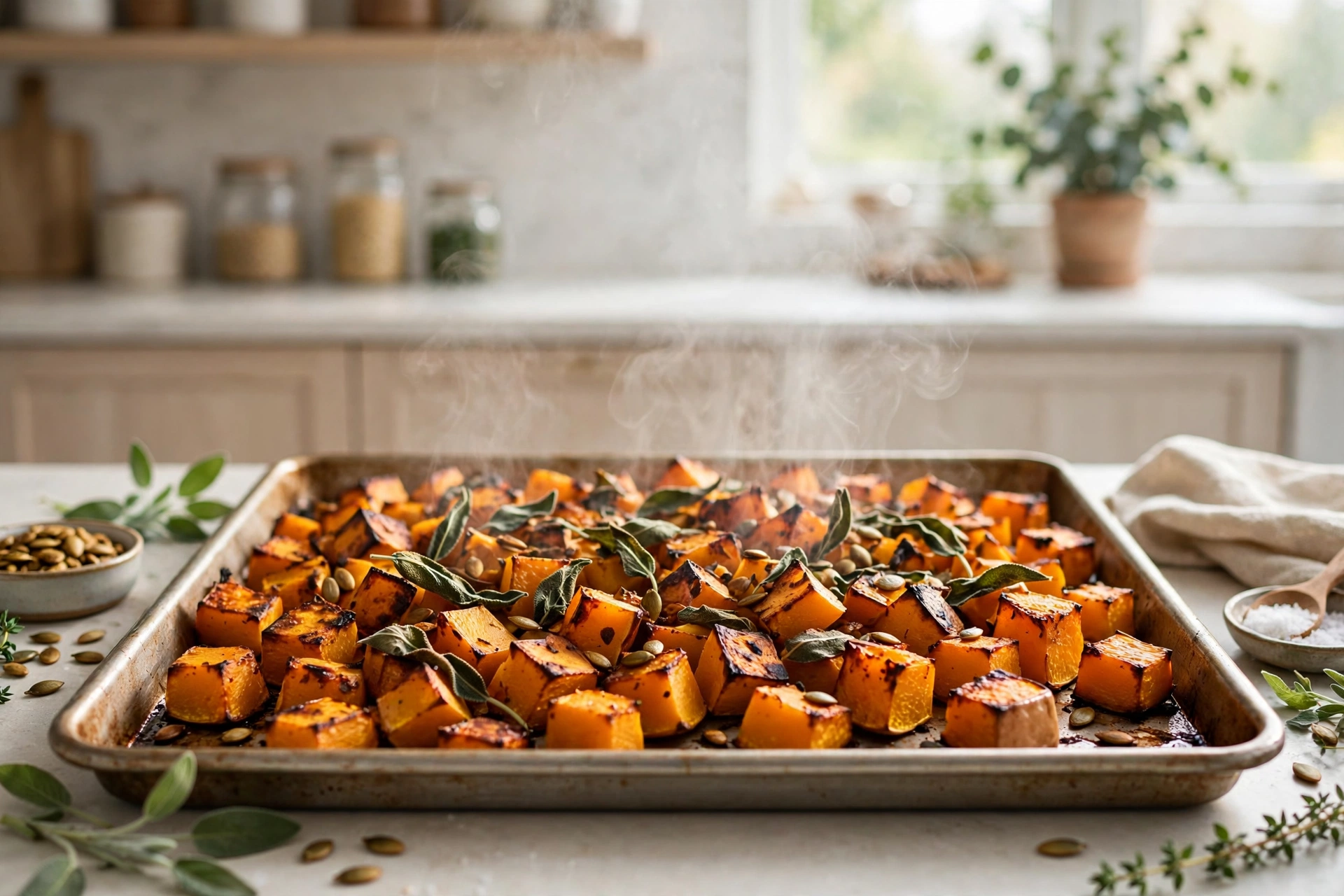
Healthy roasted butternut squash works because the vegetable brings its own sugar to the oven. A ripe butternut carries enough natural sweetness that dry, high heat alone will bronze it deeply, no coating required.
The classic glaze works against that browning. Brown sugar melts into syrup, the syrup steams, and the cubes simmer in sweetness before they ever roast, which is why glazed squash so often arrives soft and pale.
Smoked paprika and cinnamon supply the depth a glaze only pretends to give. Paprika reads as warmth and wood smoke, cinnamon echoes the sweetness already present, and a little garlic keeps the pan firmly on the savory side.
High heat does the rest. At 425 degrees F on a preheated pan, the surfaces dry and brown before the centers collapse, so each cube keeps a tender bite instead of slumping into mash.
The finish is freshness rather than more fat. Crisped sage, toasted pumpkin seeds, and a teaspoon of cider vinegar wake the pan up at the end, the way a squeeze of lemon wakes a rich soup.
Ripeness is the quiet ingredient underneath all of this. A squash with deep tan, matte skin and a dry, woody stem sugars far better in the oven than a pale one, and its cubes need nothing the recipe does not already give them.
Cutting a Butternut Without a Fight: Flat Base, Neck First
More cooks abandon this vegetable at the cutting board than at the oven. A butternut is dense, round, and slick under its peel, and a knife that skids on that curved skin is a genuine hazard.
Two minutes in the microwave changes the job. Poke the whole squash with a fork, heat it briefly, and the skin softens just enough for a sturdy peeler to bite instead of slip.
Cut off both ends first and stand the squash on its flat base. A vegetable that cannot roll cannot surprise you, and every cut after that one becomes a straight, calm push.
Work the neck before the body. Slice it into rounds one inch thick, then cut the rounds into cubes; the neck is solid flesh, with no seeds to slow the knife down.
Halve the round body, scrape out the seeds and the stringy web around them, and cube what remains. Rinsed, dried, and roasted, those seeds season exactly like purchased pumpkin seeds.
Even cubes are a cooking instruction, not a tidy habit. A one inch cube browns at the corners in the same thirty five minutes that turn its center tender, while mixed sizes give you burnt tips beside hard cores.
The Calorie Math: About 115 Against About 210
The numbers are worth showing, because recipes for this dish claim everything from 64 to 214 calories for the same cup of squash. Here is the arithmetic for this pan, line by line.
Cooked butternut squash itself runs about 82 calories a cup, with 22 grams of carbohydrate and nearly 7 grams of fiber. It is exactly the kind of vegetable the USDA MyPlate vegetable guidance has in mind for half the plate.
Two tablespoons of olive oil spread over eight cups of cubes add about 30 calories a cup. The sage, seeds, and spices add roughly 10 more, which lands the serving at about 115 calories, all of it accounted for.
The glazed classic spends very differently. Butter and brown sugar over the same squash add close to 100 calories a cup and about 12 grams of added sugar, which is how a humble vegetable reaches 210.
What the lighter pan keeps is everything that made the squash worth serving: the fiber, the potassium, and a deep orange color that announces vitamin A before anyone reads a label.
Ingredients for Healthy Roasted Butternut Squash
The list is one vegetable, one oil, four seasonings, and a finish that goes on after the roasting. Nothing on it is decorative; everything earns its place on the pan.
- 1 butternut squash, about 3 pounds, peeled, seeded and cut into 1 inch cubes (about 8 cups)
- 2 tablespoons olive oil
- 1 teaspoon smoked paprika
- 1/2 teaspoon ground cinnamon
- 1/2 teaspoon garlic powder
- 3/4 teaspoon fine sea salt
- 1/4 teaspoon black pepper
- 12 fresh sage leaves
- 2 tablespoons toasted pumpkin seeds
- 1 teaspoon apple cider vinegar
Season, Spread, Roast: the Pan in Three Moves
The work sits in the cutting and the seasoning. Once the pan is in the oven, the recipe asks for a single flip and nothing else.
- Poke the whole squash 8 to 10 times with a fork and microwave it for 2 minutes. The skin softens just enough to make peeling and cutting safer.
- Heat the oven to 425 degrees F with a large rimmed sheet pan, 18 by 13 inches, inside on the middle rack.
- Cut off both ends of the squash so it stands flat. Peel it with a sturdy peeler, cut the neck into 1 inch rounds and then into cubes, then halve the body, scrape out the seeds and strings, and cube the rest.
- Toss the cubes in a large bowl with the olive oil, smoked paprika, cinnamon, garlic powder, salt, and pepper until every cube is glossy.
- Spread the cubes on the hot pan in a single layer with space between them. Eight cups is the maximum for one large pan; use two pans rather than a deeper layer.
- Roast undisturbed for 20 minutes, until the bottoms are deep golden and the cubes release from the pan with a thin spatula.
- Flip the cubes in sections. Scatter the sage leaves over the pan and roast 12 to 15 minutes more, until the edges are dark gold at the corners and a knife slides into the largest cube without resistance.
- Slide the pan onto a rack. Drizzle the cider vinegar over the hot cubes and toss once, then scatter the toasted pumpkin seeds and the crisped sage over the top and serve hot.
Thanksgiving Timing: Roasting Around a Turkey That Owns the Oven
On Thanksgiving, the oven belongs to the turkey, and the turkey roasts at a gentle 325 or 350 degrees while this squash wants 425. The trick is sequencing, not compromise.
Roast the squash while the turkey rests. The bird needs thirty to forty five minutes under foil before carving, and a rested bird carves better, so the pan loses nothing by taking that window at full heat.
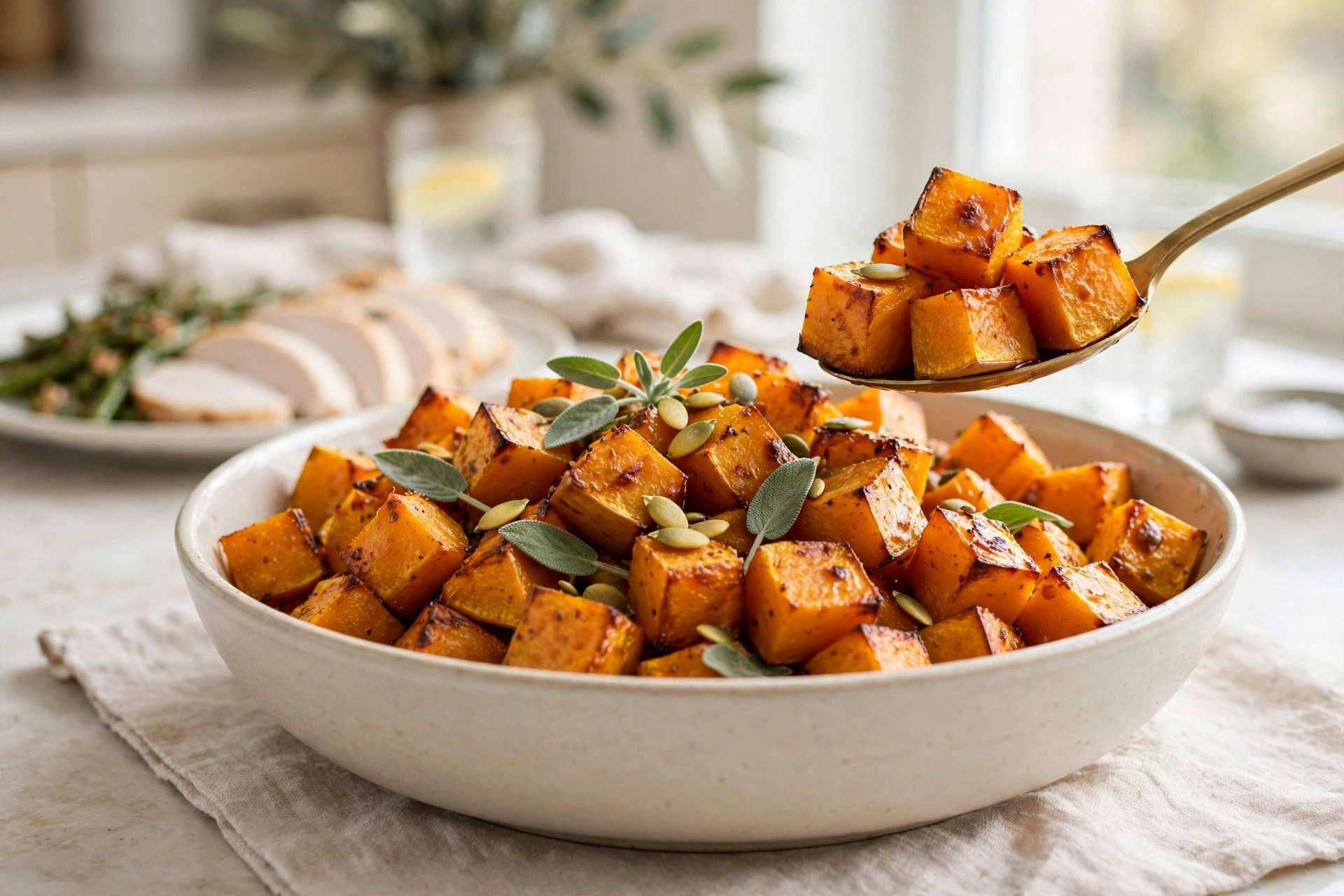
Set the bowl beside our healthy herb roasted turkey breast and pass our healthy turkey gravy at the table; a spoonful of gravy over the caramel edges is the richest bite on the plate, and it costs almost nothing.
If the pan must share the oven, slide it in for the turkey’s final stretch at 350 degrees and give the cubes 45 to 50 minutes. They come out softer and paler, still good, and five solo minutes at 425 while the bird rests restore the edges.
Made an hour ahead, the cubes hold loosely covered in the turned off oven. Five minutes at 425 degrees F just before the meal brings back the crisp corners that holding softens.
For twelve or more, scale by the pan and never by the pile: two pans of eight cups each, on two racks, swapped top to bottom at the flip. Our healthy roasted sweet potatoes run the same temperature on the same schedule, so the two orange sides can share the resting window.
Pale, Steamed or Scorched at the Corners: Three Squash Failures, Fixed
Pale, steamed cubes mean the pan was crowded or the cubes went in wet from a rinse at the board. Eight cups is the ceiling for one large pan, and the cubes should be patted dry before they meet the oil.
Scorched corners beside hard centers mean mixed sizes or a cold pan. Cut to one inch, let the pan heat with the oven, and surfaces and centers finish at the same moment.
Cubes that tear when flipped were moved too early. Browning releases them on its own schedule: at twenty minutes a thin spatula slides under a finished cube, while at ten minutes it rips the crust away.
A fourth, quieter failure is seasoning that lands in patches. Toss the cubes in a bowl, never on the pan, and give them a full thirty seconds of turning; the oil is the vehicle, and every cube has to look glossy before the heat starts.
Maple Heat, Garlic Herb, or Tomorrow’s Soup Pot
For a spicier pan, add a quarter teaspoon of chili flakes to the seasoning and whisk a teaspoon of maple syrup into the vinegar at the end. The sweetness stays a finishing note, measured in drops, never a glaze.
For a savory register, drop the cinnamon, double the garlic, and finish with chopped rosemary and parsley instead of sage. That version leans toward a weeknight chicken dinner rather than the holiday table.
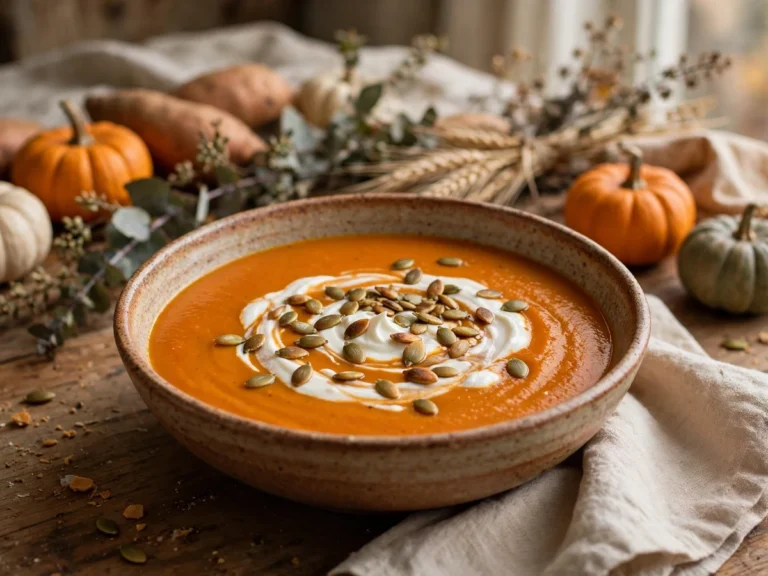
Leftovers have a second life already waiting on this site: blend two cups of cold cubes with warm broth and you are most of the way to our healthy butternut squash soup, the roasted edges doing the work that cream usually does.
Cold cubes also hold their shape in a grain bowl or over greens with a sharp dressing. The caramel edges turn slightly chewy in the cold, which reads as texture against crisp leaves, not as failure.
Five Days in the Fridge, Three Months in the Freezer
Cool the cubes to room temperature within two hours, the window the FoodSafety.gov leftovers guidance sets for cooked holiday food, then refrigerate them in a shallow covered container.
They keep five days in the refrigerator and reheat best the way they cooked: a single layer on a hot pan at 425 degrees F for eight to ten minutes. The microwave works, but it hands them back soft.
To freeze, spread the cooled cubes on a tray until solid, then bag them flat. Three months in the freezer costs them a little edge definition and nothing more, and they reheat from frozen at 425 for about fifteen minutes.
The Quiet Side That Balances the Table
Healthy roasted butternut squash earns its place by being exactly what the Thanksgiving table is short on: color, fiber, and a sweet vegetable that tastes of itself.
No glaze, no marshmallow, no apology. Just a hot pan, a measured spoon of oil, and a squash allowed to brown in peace.
Make it once for the holiday and it will quietly join the weeknight rotation, as happy beside a January roast chicken as beside the November turkey. That is the real test of a lighter recipe, and this pan passes it.
Questions Cooks Ask About Healthy Roasted Butternut Squash
Can I roast the squash at 350 degrees F next to the turkey instead?
Yes, and the recipe is written for that trade. At 350 degrees F the cubes need 45 to 50 minutes instead of 35, and they come out softer and paler. If the turkey then rests, five minutes alone at 425 degrees F brings the caramel edges back.
Do I have to peel the squash, or can the cubes roast with the skin on?
Peel it. Healthy roasted butternut squash needs every face of the cube exposed to the hot pan, and the skin shields one face while staying chewy itself. Peeled cubes caramelize all over, which is the entire point of the pan.
Why did my cubes steam instead of browning?
Moisture and crowding, in that order. Cubes rinsed or cut from a wet board carry water into the pan, and more than 8 cups on one large sheet traps steam between the pieces. Pat the cubes dry, cap the pan at 8 cups, and leave space between them.
Can I cut the squash a day ahead for Thanksgiving?
Yes. Cube the squash up to 24 hours ahead, spread the cubes on a paper towel lined tray or in a sealed container with a towel on top, and refrigerate. Roast them straight from the fridge; cold cubes may need 3 to 4 extra minutes.
How do I pick a butternut that roasts sweet instead of watery?
Choose one that feels heavy for its size, with matte, unblemished tan skin and a long, thick neck, since the neck is pure flesh. A squash with a large bulbous base gives you more seeds and strings and fewer cubes for the same money.