Healthy Ambrosia Salad, Fluffy and Bright at About 148 Calories a Cup
Healthy Ambrosia Salad, Fluffy and Bright at About 148 Calories a Cup
In this article:
- No Marshmallows, No Whipped Topping: What Holds This Ambrosia Together
- The 20 Minute Drain: How This Ambrosia Stays Fluffy, Not Soupy
- Fresh Pineapple, Clementines, and Cherries Without the Dye
- Ingredients for Healthy Ambrosia Salad
- Drain, Whisk, Fold, Chill: Healthy Ambrosia Salad in Four Moves
- On the Christmas Table, Between the Turkey and the Pies
- The Ambrosia Math: About 148 Against About 320
- Pomegranate Jewels, a Ginger Kick, or the Dairy Free Bowl
- The 4 to 12 Hour Window: Make Ahead and Storage Rules
- The Bowl That Comes Back Empty
- Questions Cooks Ask About Healthy Ambrosia Salad
Healthy ambrosia salad should taste like the Christmas table remembers it: cool, creamy, and jewel bright, with pineapple and mandarin shining through a soft white dressing. This version keeps every bit of that pleasure and rebuilds the dressing underneath it.
There are no marshmallows and no whipped topping in the bowl. In their place, strained Greek yogurt whisked with orange zest and vanilla folds around fresh fruit, and the fluff everyone expects arrives on schedule.
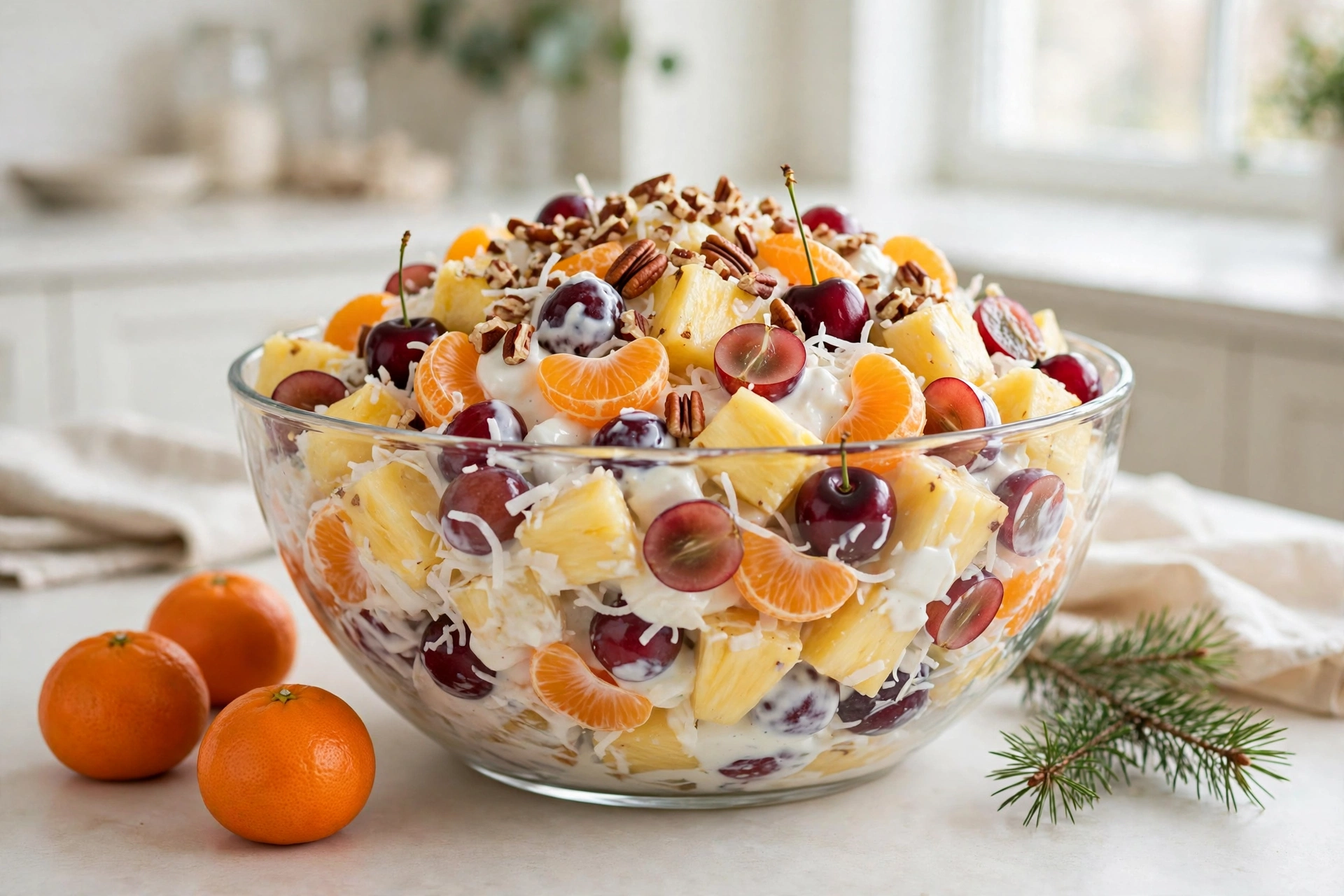
The colors do the decorating. Deep red cherries, orange clementine segments, and golden pineapple chunks sit in the pale dressing like ornaments, and a snowfall of coconut and crunchy pecans finishes the top.
It is a fifteen minute assembly with one honest rule attached: the fruit drains before it dresses. Respect that single step and the salad stays fluffy for hours on the holiday buffet.
No Marshmallows, No Whipped Topping: What Holds This Ambrosia Together
Healthy ambrosia salad usually keeps one foot in the classic recipe, and that foot is a cup of mini marshmallows. They bring the fluff, but they also bring most of the added sugar, and after an hour they dissolve into a sweetness that flattens every fruit it touches.
This bowl takes the other path. The body of the dressing is Greek yogurt strained for twenty minutes, which thickens it to a soft, spoon coating consistency that behaves almost like softly whipped cream.
One tablespoon of honey takes the edge off the yogurt tang, and it is the only added sweetener in the recipe. The fruit, chosen ripe and fresh, does the rest of the sweetening itself.
Vanilla and orange zest are the quiet flavor team. Zest whisked into the dressing echoes the clementines in the bowl, and vanilla gives the whole salad the rounded, dessert like finish people associate with the whipped topping version.
Unsweetened shredded coconut folds through the salad rather than sitting on top. It drinks a little of the fruit juice as the salad rests, softens into the dressing, and returns a gentle chew in every spoonful.
The result reads as ambrosia at first bite: cool, creamy, fruity, sweet. What is missing is only the sugar haze, and most guests notice its absence as brightness rather than loss.
The 20 Minute Drain: How This Ambrosia Stays Fluffy, Not Soupy
Every failed ambrosia fails the same way: a puddle of pale juice gathers at the bottom of the bowl while the dressing slides off the fruit. The cause is never the dressing. It is fruit that went in wet.
Fresh pineapple is the biggest contributor. Cut it, salt it with nothing, and let it sit in a colander for a full twenty minutes; you will be surprised at the half cup of juice that leaves, juice that would otherwise thin the whole salad.
Clementine segments need a shorter rest, about ten minutes on a clean towel after peeling and separating. Their membranes hold most of their juice, but the surface moisture from peeling is enough to matter in a bowl this size.
Frozen cherries, thawed, are the third drain. Thaw them in the colander itself, over the sink, for thirty minutes, and pat them dry; thawed cherries release more liquid than any other fruit here.
The yogurt gets the same treatment in miniature. Twenty minutes in a fine mesh strainer over a bowl drops two or three tablespoons of whey, and that small loss is exactly the difference between a dressing that clings and one that pools.
Assemble with dry fruit and thick yogurt and the salad holds its shape for a full buffet evening. It is the entire technical secret of the recipe, and it costs nothing but a colander and a little patience.
Fresh Pineapple, Clementines, and Cherries Without the Dye
The classic bowl was built on cans, because it was invented in an era when fresh pineapple was a luxury. Winter is now full of good fresh fruit, and this healthy ambrosia salad is written for it, with the canned versions kept as a workable backup.
Fresh pineapple brings acidity that canned in juice cannot match, and that acidity is what keeps a creamy salad tasting bright after hours in the refrigerator. Choose a fruit that smells sweet at the base and gives slightly at the sides.
Clementines replace the traditional mandarin segments for two reasons: they peel cleanly with no bitter pith, and their membranes are tender enough to eat without the canned softness. In December they are at their peak and priced for buying by the bag.
The cherries are dark sweet cherries, fresh when the market allows and frozen the rest of the year. They are never the jarred maraschino kind, which are bleached, dyed, and soaked in syrup, and which turn the dressing an apologetic pink.
Red grapes, halved, are the supporting fruit. They add a snap that the softer fruits lack, and their skins keep their juice politely inside until the moment they are bitten.
If fresh fruit is out of reach, canned pineapple and mandarins packed in juice, drained for the same twenty minutes, make a respectable bowl. Add a squeeze of lemon over the top to replace the brightness the cans leave behind.
Ingredients for Healthy Ambrosia Salad
The list is a fruit bowl plus a dressing: fresh pineapple, clementines, dark cherries and grapes, strained Greek yogurt, unsweetened coconut, and pecans that go on at the last minute so they stay crunchy.
- 2 cups fresh pineapple chunks (about half a medium pineapple)
- 4 clementines, peeled and separated into segments (about 1 1/2 cups)
- 1 cup dark sweet cherries, pitted and halved (fresh, or frozen and thawed)
- 1 cup red seedless grapes, halved
- 1 1/2 cups plain low fat (2 percent) Greek yogurt, strained 20 minutes
- 1 tablespoon honey
- 1 teaspoon vanilla extract
- 1 teaspoon finely grated orange zest
- 1/2 cup unsweetened shredded coconut
- 1/3 cup chopped pecans, for serving
Drain, Whisk, Fold, Chill: Healthy Ambrosia Salad in Four Moves
The method is mostly waiting, arranged in the right order. Start the drains first and the whole recipe unfolds in about fifteen minutes of actual work, with the refrigerator doing the last and longest shift.
- Drain the fruit. Set the pineapple chunks in a colander for 20 minutes. Rest the clementine segments on a clean towel for 10 minutes. Thaw frozen cherries in a colander for 30 minutes and pat dry; halve and pit fresh cherries.
- Strain the yogurt. Line a fine mesh strainer with a coffee filter or cheesecloth, set it over a bowl, and let the yogurt drain 20 minutes, until it holds soft peaks on a spoon.
- Whisk the dressing. In a large serving bowl, whisk the strained yogurt with the honey, vanilla, and orange zest until smooth and glossy.
- Fold the coconut into the dressing first, so it begins softening, then add the pineapple, clementines, cherries, and grapes. Fold gently with a large spatula, lifting from the bottom, until every piece is coated and nothing is crushed.
- Cover and refrigerate at least 1 hour and up to 12 hours, so the flavors marry and the coconut softens into the dressing.
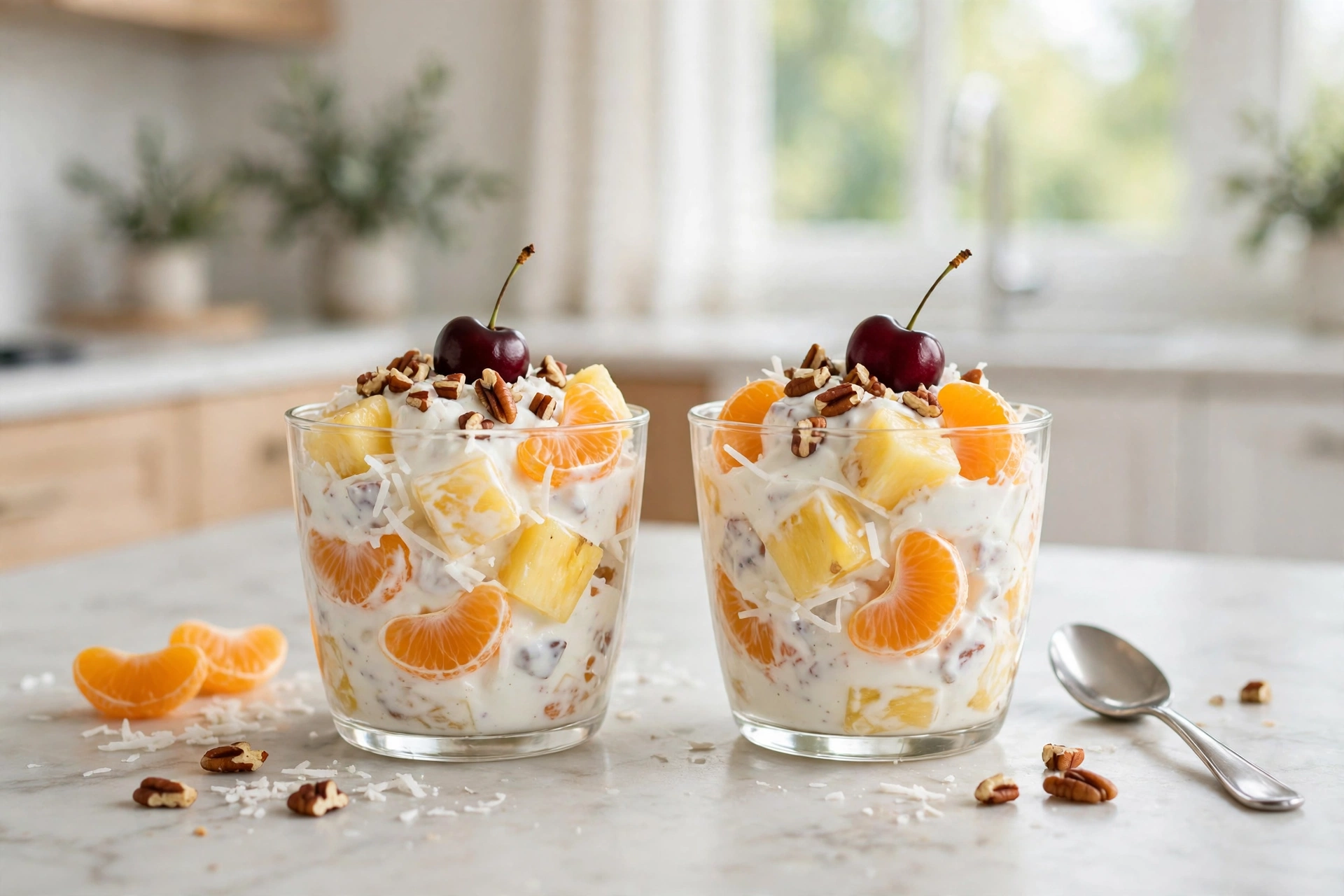
- Scatter the chopped pecans over the top just before serving. Serve cold, in the bowl or spooned into small glass cups.
On the Christmas Table, Between the Turkey and the Pies
Ambrosia holds an old and honorable place on the Southern Christmas table, where it sits in the borderland between side dish and dessert and is claimed by both courses. This lighter bowl keeps the seat and behaves better in it.
Its coolness is the point. A table of roasts, gratins, and gravy needs one cold, bright spoonful, and ambrosia has played that role for a century for good reason: it rests the palate between rich bites.
Serve it in a clear glass bowl if you have one. The layered colors of cherry, clementine, and pineapple through the white dressing are the decoration, and beside our healthy Christmas salad, the table gets its red and green twice, in two very different keys.
Pour our healthy Christmas punch alongside and the fruit theme doubles down in the best way. For the end of the meal, the bowl shares dessert duty gracefully with our healthy eggnog chia pudding, one fresh and one spiced.
Portion planning is gentle here. As a side among many, this recipe serves eight; as the only dessert, spooned into cups, it serves six generously. The bowl empties either way, which is the reliable history of ambrosia.
The Ambrosia Math: About 148 Against About 320
A classic ambrosia, built on whipped topping, sweetened coconut, marshmallows, and fruit in syrup, lands near 320 calories a cup, with added sugar doing much of the work and close to 30 grams of sugar in the serving.
This version lands near 148 calories a cup, and the savings are structural. Greek yogurt replaces whipped topping and adds about 6 grams of protein, unsweetened coconut replaces the sweetened kind, and the marshmallows simply leave, taking their sugar with them.
Sugar drops to about 17 grams a cup, and nearly all of it arrives inside whole fruit, with the fiber of that fruit still attached. The single tablespoon of honey across eight servings is the entire added sugar budget of the recipe.
That pattern is exactly what the USDA MyPlate guidance asks for when it says to focus on whole fruits: sweetness carried by the fruit itself, in the company of its own fiber and water.
Fat stays honest at about 6 grams a cup, from the coconut and pecans, and sodium is nearly nothing, under 30 milligrams. Against the classic, the light bowl is not a compromise position; it is the same dish with its proportions repaired.
Pomegranate Jewels, a Ginger Kick, or the Dairy Free Bowl
The pomegranate version scatters a third of a cup of pomegranate arils over the top with the pecans. The look is pure Christmas, red jewels on white, and each aril pops with a tart juice that wakes up the creamy dressing.
A ginger version whisks a half teaspoon of finely grated fresh ginger into the dressing and swaps the grapes for diced crisp apple. It leans the bowl toward a waldorf brightness and pairs beautifully with roasted meats.
For a dairy free bowl, strain a thick coconut based yogurt the same way and keep every other measure identical. The coconut in the dressing meets the coconut in the salad, and the result tastes deliberate rather than substituted.
A tropical variation trades the cherries for mango cubes and the pecans for macadamias. It leaves Christmas behind and becomes a January bowl, which is a fine second life for a recipe built on draining and folding.
For children, finely diced fruit and an extra spoon of honey in the dressing make the bowl friendlier to small spoons. The structure does not change; only the cut does.
The 4 to 12 Hour Window: Make Ahead and Storage Rules
Ambrosia has a prime window, and knowing it is the difference between a fluffy salad and a tired one. The bowl is at its best between 4 and 12 hours after assembly, when the coconut has softened and the flavors have married but the fruit still holds its edges.
One hour of chilling is the minimum before serving; less than that and the dressing tastes like yogurt next to fruit instead of ambrosia. More than 24 hours and even well drained fruit begins to weep, softening the whole bowl.
Leftovers keep two days in the refrigerator, covered, and they remain pleasant, if softer, eating. Stir gently before serving and add a fresh scatter of pecans to restore the crunch the fridge took.
Do not freeze this salad. Yogurt based dressings separate on thawing and the fruit collapses; the recipe is quick enough that a fresh half batch is always the better answer.
On the buffet table, mind the clock. FoodSafety.gov advises keeping perishable food out of the temperature danger zone, no more than two hours at room temperature, so nest the bowl in a larger bowl of ice and return leftovers to the refrigerator promptly after the meal.
The Bowl That Comes Back Empty
Healthy ambrosia salad asks for a colander, a strainer, and the restraint to leave the marshmallows in the pantry. What returns is the bowl the holiday table has always loved, cool and creamy and bright, with its sweetness carried by the fruit itself.
At about 148 calories a cup, it takes its old seat between the turkey and the pies without asking anyone to make room in their conscience. Make it in the morning, and let Christmas dinner be the easy part of the day.
Questions Cooks Ask About Healthy Ambrosia Salad
Can I make healthy ambrosia salad the night before Christmas?
Yes, and the timing is nearly ideal. Assemble it the evening before and it will be inside its best window, 4 to 12 hours of chilling, when dinner arrives. Keep the pecans separate and scatter them at serving so they stay crunchy, and give the bowl one gentle fold before it goes to the table.
Why did my ambrosia salad turn watery?
Wet fruit is almost always the cause. Pineapple needs a full 20 minutes in a colander, thawed cherries need 30, and the yogurt itself should be strained for 20 minutes to drop its whey. Assemble with drained fruit and thick yogurt and the dressing clings instead of pooling at the bottom of the bowl.
What can replace the marshmallows in ambrosia salad?
In this recipe, nothing needs to: strained Greek yogurt supplies the fluffy body and unsweetened coconut supplies the gentle chew, so the bowl holds its texture without them. If you miss their soft sweetness, fold in an extra half cup of finely diced ripe pineapple; it sweetens each spoonful and stays in the spirit of the recipe.
Can I use canned fruit for healthy ambrosia salad?
Yes. Choose pineapple and mandarin oranges packed in juice, never in syrup, and drain them for the full 20 minutes, because canned fruit carries more surface liquid than fresh. A squeeze of lemon juice over the finished bowl replaces the brightness that canning takes away.
How long can ambrosia salad sit out at a holiday buffet?
Two hours at room temperature is the limit for a yogurt dressed salad. Nest the serving bowl inside a larger bowl of ice to stretch its table life safely, and refrigerate leftovers promptly; they keep two days, covered, and want a fresh scatter of pecans before serving again.