
Healthy Eggnog: Silky, Spiced and Gently Sweet
In this article:
- Why This Healthy Eggnog Still Tastes Like Christmas
- The Honest Numbers: 140 Calories Against 340
- Cooked Gently to 170 Degrees, Never Boiled
- Fresh Nutmeg, Grated at the Last Second
- Ingredients for the Healthy Eggnog
- How to Make Healthy Eggnog on the Stove
- Thin, Curdled or Bland: Eggnog Fixes
- Dairy Free, Chai Spiced and the Eggnog Latte
- Make It Ahead, Serve It All Week
- A Glass of Christmas That Leaves Room for Pie
- Questions Home Cooks Ask About This Eggnog
This healthy eggnog is the December classic poured at about 140 calories a serving, against roughly 340 for the rich homemade cup built on cream and a heavy hand with the sugar bowl. The custard body, the warmth of the spice and the slow, silky pour all survive the lightening.
Nothing here is a substitute product wearing a costume. The base is real milk and real egg yolks, cooked gently on the stove the way eggnog was always made, then sweetened with a measured quarter cup of maple syrup instead of a drift of white sugar.
It takes fifteen minutes of cooking and a few hours of chilling, and the chilling is not optional filler. Cold is what turns a warm custard into eggnog: the flavors marry, the texture settles, and the nutmeg blooms across the top when you grate it at the table.
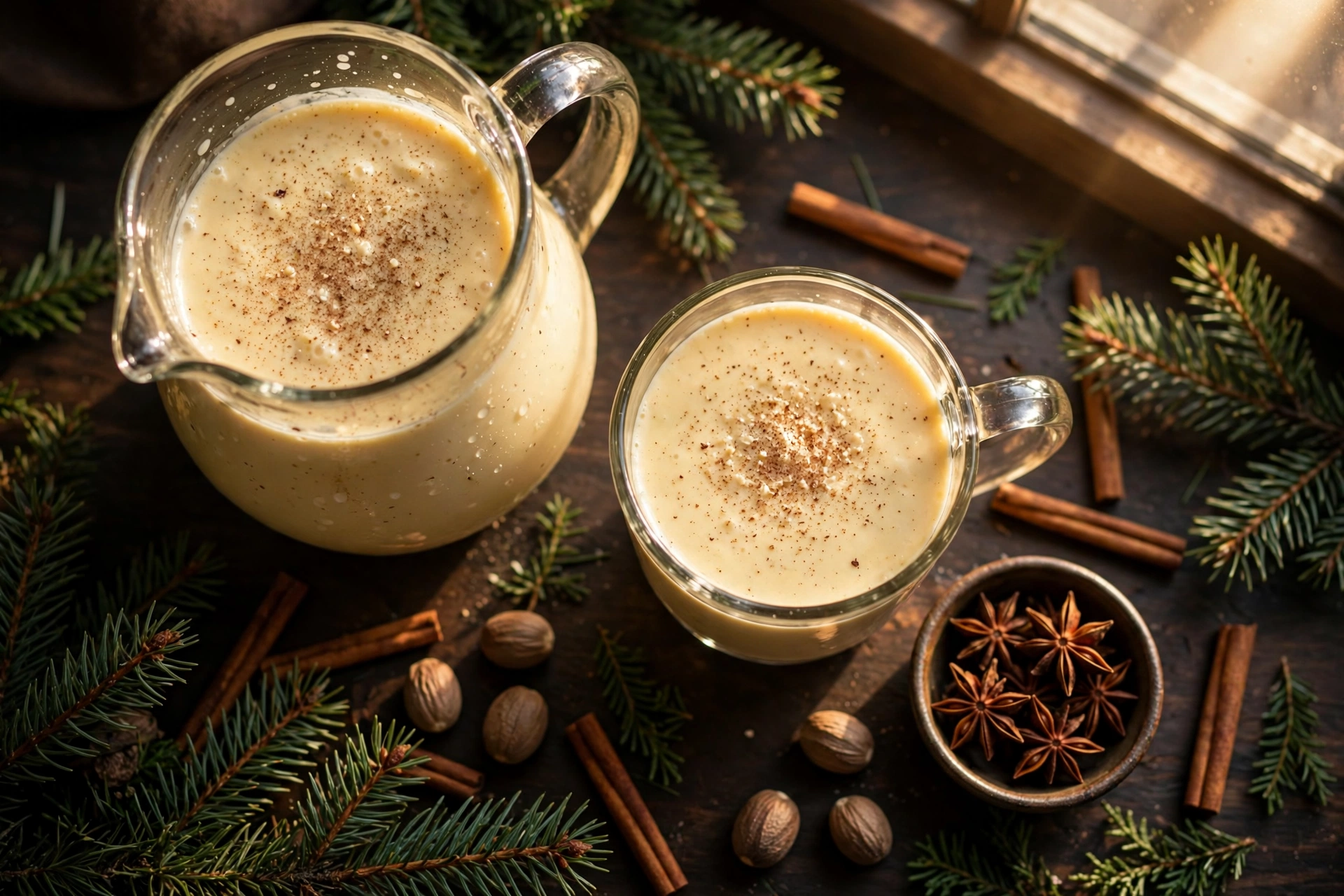
Why This Healthy Eggnog Still Tastes Like Christmas
Healthy eggnog works because eggnog was never really about the cream. It is about a thin custard, yolks whisked with milk until the mixture coats a spoon, carrying vanilla and nutmeg in suspension. Get that base right and the drink reads as indulgent at a fraction of the weight.
The yolks do double duty. They bring the golden color everyone expects, and they emulsify the milk into something that feels richer than it is, so three yolks across the whole batch taste like six when the cooking is patient and the whisk never stops moving.
Maple syrup is the sweetener with a flavor of its own, which means less of it satisfies. A quarter cup across six servings registers as warmth and wood smoke under the spice, instead of the flat sweetness that white sugar leaves behind in a cold drink.
The cinnamon stick steeps in the warm milk rather than being stirred in as powder. Infused spice tastes woven through the drink instead of dusty on top of it, and the stick comes out before the yolks go in, so nothing gritty ever reaches the glass.
Finally, the cold finish. A cup of the milk is held back and stirred in off the heat, which stops the cooking at the exact silky point and drops the temperature fast. It is a small step borrowed from pastry kitchens, and it rescues more batches than any other.
The Honest Numbers: 140 Calories Against 340
A classic homemade eggnog, built on whole milk, heavy cream, six yolks and three quarters of a cup of sugar, lands near 340 calories a cup, and the commercial cartons are no kinder at about 190 calories for a small half cup pour. This version serves at about 140 calories for a generous three quarter cup.
The math is mostly the milk. Two percent milk carries the flavor of whole milk at roughly thirty fewer calories a cup, and skipping the cream entirely removes the single largest line in the classic recipe without touching the custard structure that the yolks provide.
Protein holds up surprisingly well. Between the milk and the yolks, each serving keeps about 7 grams of protein, which is why a glass of this eggnog at four in the afternoon carries you to dinner instead of sending you back to the cookie tin.
Sugar sits near 15 grams a serving, and most of it is accounted for: the natural lactose in the milk plus the maple you can taste. Fat lands near 5 grams, a figure in line with the USDA data for two percent milk, instead of the twenty plus grams hiding in the cream based classic.
If your household likes a sweeter glass, add one more tablespoon of maple syrup to the batch. It costs about 9 extra calories a serving and buys real sweetness, which is always a better trade than a second helping poured to chase flavor the first glass lacked.
Cooked Gently to 170 Degrees, Never Boiled
The base cooks to 170 degrees Fahrenheit, 77 degrees Celsius, and that number is the whole technique. At 170 the yolks thicken into a sauce that coats the spoon, past the point food safety guidance sets for egg mixtures; at 185 the proteins seize and the smoothest whisking in the world will not unscramble them.
A thermometer removes the drama. Clip it to the side of the pan, stir in slow figure eights that reach the corners, and pull the pan off the heat the moment the reading touches 170. The temperature will coast a degree or two higher on its own.
No thermometer is a workable situation, not a dead end. The old test still holds: dip a spoon, run a finger across the back, and when the line stays clean and the custard does not flood back, the base is done. Work over gentle heat and test early rather than late.
The tempering step protects everything that follows. Hot milk meets the whisked yolks a ladle at a time, so the eggs warm gradually instead of shocking into sweet scrambled eggs. Rush this and no amount of straining fully hides the evidence.
Strain the finished base anyway, into a clean pitcher, through the finest sieve you own. It catches the chalazae, any stray fleck of cooked egg and the cinnamon stick fragments, and it is the difference between a smooth pour and a glass that needs chewing.
Fresh Nutmeg, Grated at the Last Second
Nutmeg is the voice of this drink, and it fades faster than any other spice in the cupboard. A whole nutmeg grated over the finished glass perfumes the first sip in a way that powder from a jar opened last December simply cannot, because the aromatic oils evaporate within minutes of grating.
The dose is smaller than instinct suggests. A quarter teaspoon of freshly grated nutmeg across the whole batch equals roughly half a teaspoon of the pre ground spice, and doubling it pushes the drink toward medicinal. Eggnog should whisper its spice, never announce it.
Keep a dedicated fine grater or a rasp with the nutmegs, stored in a small jar away from light. Whole nutmegs keep their strength for a year or more, which makes the small bag from the spice shop one of the better December investments a kitchen can make.
Cinnamon plays support, not lead. The stick in the base gives warmth without the woody dustiness that ground cinnamon leaves in a cold drink, and a bare pinch of ground cinnamon over the top of each glass is garnish, a picture, not a flavoring strategy.
Ingredients for the Healthy Eggnog
- 4 cups (960 ml) 2 percent milk, divided
- 3 large egg yolks
- 1/4 cup (60 ml) maple syrup, plus 1 more tablespoon to taste
- 1 teaspoon cornstarch
- 1 cinnamon stick, or 1/2 teaspoon ground cinnamon
- 1 small pinch of fine sea salt
- 1 teaspoon pure vanilla extract
- 1/4 teaspoon freshly grated nutmeg, plus more for the glasses
Every ingredient here earns its place in a healthy eggnog, and the list stays short on purpose. The cornstarch is a single teaspoon of insurance: it steadies the yolks at temperature and gives the chilled drink a touch more body, then disappears completely into the texture.
Readers who keep a well stocked holiday drinks shelf will find the same measured approach in our healthy hot chocolate, which blooms its cocoa the same patient way.
How to Make Healthy Eggnog on the Stove
- Pour 3 cups (720 ml) of the milk into a medium saucepan and add the cinnamon stick. Warm over medium heat until the milk steams and small bubbles gather at the edges, 4 to 5 minutes. Do not let it boil.
- While the milk warms, whisk the egg yolks, maple syrup, cornstarch and salt in a heatproof bowl until the mixture turns pale and falls off the whisk in ribbons, about 1 minute of steady whisking.
- Fish the cinnamon stick out of the milk. Ladle about 1 cup of the hot milk into the yolk mixture, whisking constantly, then add a second ladle the same way. This is the tempering that keeps the yolks smooth.
- Pour the tempered yolks back into the saucepan. Set over medium low heat and cook, stirring constantly in slow figure eights, until the mixture reaches 170 degrees Fahrenheit (77 degrees Celsius) and coats the back of a spoon, 5 to 7 minutes.
- Take the pan off the heat at once. Stir in the remaining 1 cup (240 ml) of cold milk, the vanilla and the grated nutmeg. The cold milk stops the cooking and keeps the custard silky.
- Strain the eggnog through a fine mesh sieve into a pitcher. Press a piece of plastic wrap directly onto the surface so no skin forms.
- Chill for at least 4 hours, ideally overnight. The eggnog thickens a little more as it cools and the spices settle into the base.
- Whisk briefly before serving, pour into small glasses, and grate fresh nutmeg over each one at the table.
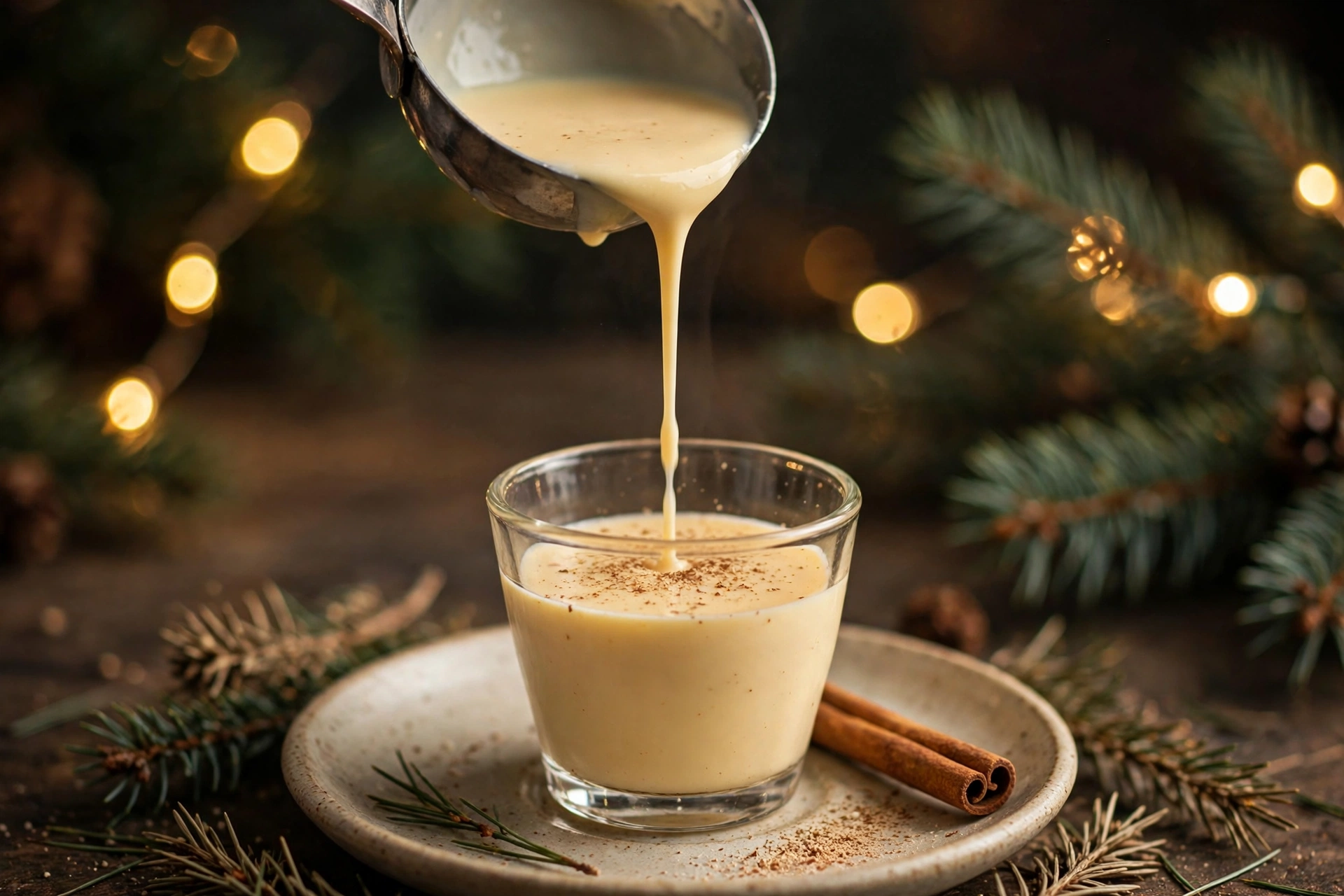
Thin, Curdled or Bland: Eggnog Fixes
Thin eggnog almost always means the base stopped short of temperature. If it pours like milk after chilling, return it to the pan and bring it gently to 170 degrees again, stirring without pause, then chill it a second time. The yolks will finish the job they started.
Curdling has one cause: the heat ran ahead of the whisk. A batch that has just begun to grain can often be saved by an immediate plunge into an ice bath and thirty seconds with an immersion blender, followed by careful straining. It will not be the silkiest glass of the season, but it will not be wasted either.
Bland eggnog is usually under salted rather than under spiced. The pinch of salt in the base reads as sweetness and depth once the drink is cold, and cold dulls every flavor, so season the warm base until it tastes very slightly too sweet and too warm. Chilling will balance it.
A skin on top means the surface dried in the fridge. The plastic wrap pressed directly onto the surface prevents it, and if a skin has formed anyway, whisk the eggnog hard for twenty seconds and strain it once more before pouring.
Dairy Free, Chai Spiced and the Eggnog Latte
For a dairy free batch, barista style oat milk is the substitute that behaves. It cooks to the same temperature without splitting, its natural sweetness lets you trim the maple to 3 tablespoons, and the finished glass lands near 130 calories. Almond milk works but pours thinner, so keep the cornstarch and add a second teaspoon if you like.
The chai spiced variation swaps the cinnamon stick for two crushed cardamom pods, a strip of fresh ginger and two cloves steeped in the warm milk. Strain them out with the same care, and the eggnog takes on a warmer, more perfumed character that suits a January evening as much as a December one.
For an eggnog latte, steam or gently warm a half cup of the chilled eggnog and pour it over a shot of espresso or a half cup of strong coffee. It is the quiet cousin of our healthy peppermint mocha, same December mood, no mint, and it turns a batch in the fridge into two different drinks.
And for the household that loves the flavor in every form, the spoonable sibling already lives on the site: our healthy eggnog chia pudding sets the same spiced base into a make ahead dessert. When the party bowl needs filling instead, the healthy christmas punch carries the crowd while this pitcher stays by the stove for slow refills.
Make It Ahead, Serve It All Week
Eggnog is one of the rare holiday recipes that improves with a head start. Made on a Sunday, the flavors are rounder by Tuesday, the spice fully settled into the custard, and the pitcher waits in the fridge for whoever comes home cold and in need of something festive.
The batch keeps for 4 days refrigerated, stored in a covered pitcher and whisked before each pour. Because the base is fully cooked, there is none of the day two anxiety that hangs over raw egg versions, and the flavor actually peaks around the second day.
For a party, the recipe doubles cleanly in a larger pan; give the bigger batch a few extra minutes to reach temperature and stir with extra patience at the corners. Set the pitcher in a bowl of ice on the table and it will hold its chill and its texture through a whole evening.
Freezing works better than most people expect. Freeze leftover eggnog in ice cube trays, then blend the cubes with a splash of milk for a January smoothie that tastes like the holidays remembered kindly. Whole pitchers do not freeze gracefully, but cubes are a small gift to your future self.
A Glass of Christmas That Leaves Room for Pie
Healthy eggnog asks for no apologies and offers no lectures: it is a cooked custard, properly spiced, poured cold under fresh nutmeg, that happens to land at half the calories of the classic. Make it once this December and the pitcher will earn its place in the fridge door. From our kitchen to yours, merry Christmas. Nora Ellis
Questions Home Cooks Ask About This Eggnog
Is this healthy eggnog safe to drink, since it contains egg yolks?
Yes. The yolks are tempered and then cooked with the milk to 170 degrees Fahrenheit, which is above the temperature food safety agencies recommend for cooked egg mixtures. Nothing raw is served, and the finished eggnog keeps safely for 4 days in the fridge.
Why did my eggnog turn out thin instead of creamy?
The base almost certainly stopped below 170 degrees, so the yolks never fully thickened. Return the chilled eggnog to the pan, warm it gently to 170 degrees while stirring constantly, then chill it again. The single teaspoon of cornstarch in the recipe also helps the texture set.
Can I make this eggnog with skim milk or almond milk?
Skim milk works and drops each serving to about 125 calories, though the pour is a little less rich; keep the cornstarch in that case. Almond milk is the thinnest option, so add a second teaspoon of cornstarch. Barista style oat milk gives the closest result to the 2 percent version.
How long does homemade healthy eggnog keep in the fridge?
Four days, covered, in a clean pitcher. Whisk it before pouring because the spice settles as it stands. If you want to keep it longer, freeze it in ice cube trays for up to a month and blend the cubes with a splash of milk for a smoothie style drink.
Can children drink this eggnog?
Yes. The recipe contains no alcohol at any point, and the eggs are fully cooked, so it is simply a spiced custard drink. If nutmeg is a new flavor for your children, grate half the amount over their glasses; its warmth reads as cinnamon like to young palates.
Healthy Eggnog
The Christmas classic rebuilt the light way: a gently cooked custard of 2 percent milk and real egg yolks, sweetened with a measured quarter cup of maple syrup and finished with freshly grated nutmeg. About 140 calories a serving against roughly 340 for the classic cream version, with no alcohol and nothing raw. Total time includes the 4 hours of chilling that turn the warm custard into true eggnog.
- Total Time: 4 hours 25 minutes
- Yield: 6 servings 1x
Ingredients
- 4 cups (960 ml) 2 percent milk, divided
- 3 large egg yolks
- 1/4 cup (60 ml) maple syrup, plus 1 more tablespoon to taste
- 1 teaspoon cornstarch
- 1 cinnamon stick, or 1/2 teaspoon ground cinnamon
- 1 small pinch of fine sea salt
- 1 teaspoon pure vanilla extract
- 1/4 teaspoon freshly grated nutmeg, plus more for the glasses
Instructions
- Pour 3 cups (720 ml) of the milk into a medium saucepan, add the cinnamon stick, and warm over medium heat until steaming with small bubbles at the edges, 4 to 5 minutes. Do not let it boil.
- Whisk the egg yolks, maple syrup, cornstarch and salt in a heatproof bowl until pale and ribbony, about 1 minute.
- Remove the cinnamon stick. Ladle about 1 cup of the hot milk into the yolk mixture, whisking constantly, then add a second ladle the same way to temper the yolks.
- Pour the tempered yolks back into the saucepan. Cook over medium low heat, stirring constantly in slow figure eights, until the mixture reaches 170 degrees Fahrenheit (77 degrees Celsius) and coats the back of a spoon, 5 to 7 minutes.
- Remove from the heat and stir in the remaining 1 cup (240 ml) of cold milk, the vanilla and the grated nutmeg.
- Strain the eggnog through a fine mesh sieve into a pitcher and press plastic wrap directly onto the surface.
- Chill for at least 4 hours, ideally overnight, until cold and lightly thickened.
- Whisk briefly, pour into small glasses, and grate fresh nutmeg over each serving.
- Prep Time: 10 minutes
- Cook Time: 15 minutes




4 Comments
Comments are closed.