Healthy Waldorf Salad, Crisp, Creamy and Light at About 140 Calories a Cup
Healthy Waldorf Salad, Crisp, Creamy and Light at About 140 Calories a Cup
In this article:
- All Yogurt, No Mayo: the Dressing That Lightens the Waldorf
- The Waldorf Math: 140 Against 320
- Apples, Grapes and Celery: Cutting for Crunch
- Ingredients for Healthy Waldorf Salad
- Toast, Whisk, Fold: the Salad in Twenty Five Minutes
- On the Thanksgiving Table: Where a Fresh Salad Earns Its Place
- Watery, Brown or Bland: the Three Waldorf Fixes
- With Chicken, With Pecans, or Dairy Free
- The Fresh Bowl at a Heavy Table
- Questions Cooks Ask About Healthy Waldorf Salad
Healthy Waldorf salad is the bowl that refreshes a heavy table, and it has never needed its mayonnaise to do it. In the classic version, the fruit and celery disappear under a thick white coat, and the crunch you came for turns soft within the hour.
This version builds the dressing on Greek yogurt alone, sharpened with lemon and Dijon and softened with one measured tablespoon of honey. The coat stays creamy and bright, and the apples stay recognizably apples.
The numbers land where a salad should. One cup comes in at about 140 calories, against roughly 320 for the classic full mayonnaise version, and the yogurt quietly adds protein the original never had.
It is also built for real holiday logistics. The walnuts toast in five minutes, the dressing waits in the refrigerator overnight, and the fruit goes in close to serving, so the bowl arrives crisp while everything else is resting and reheating.
There is a small elegance in it too. Red grapes, green celery, ruby cranberries and pale gold apple in one bowl is the prettiest color story on the Thanksgiving table, and nobody at either end of it feels weighed down.
All Yogurt, No Mayo: the Dressing That Lightens the Waldorf
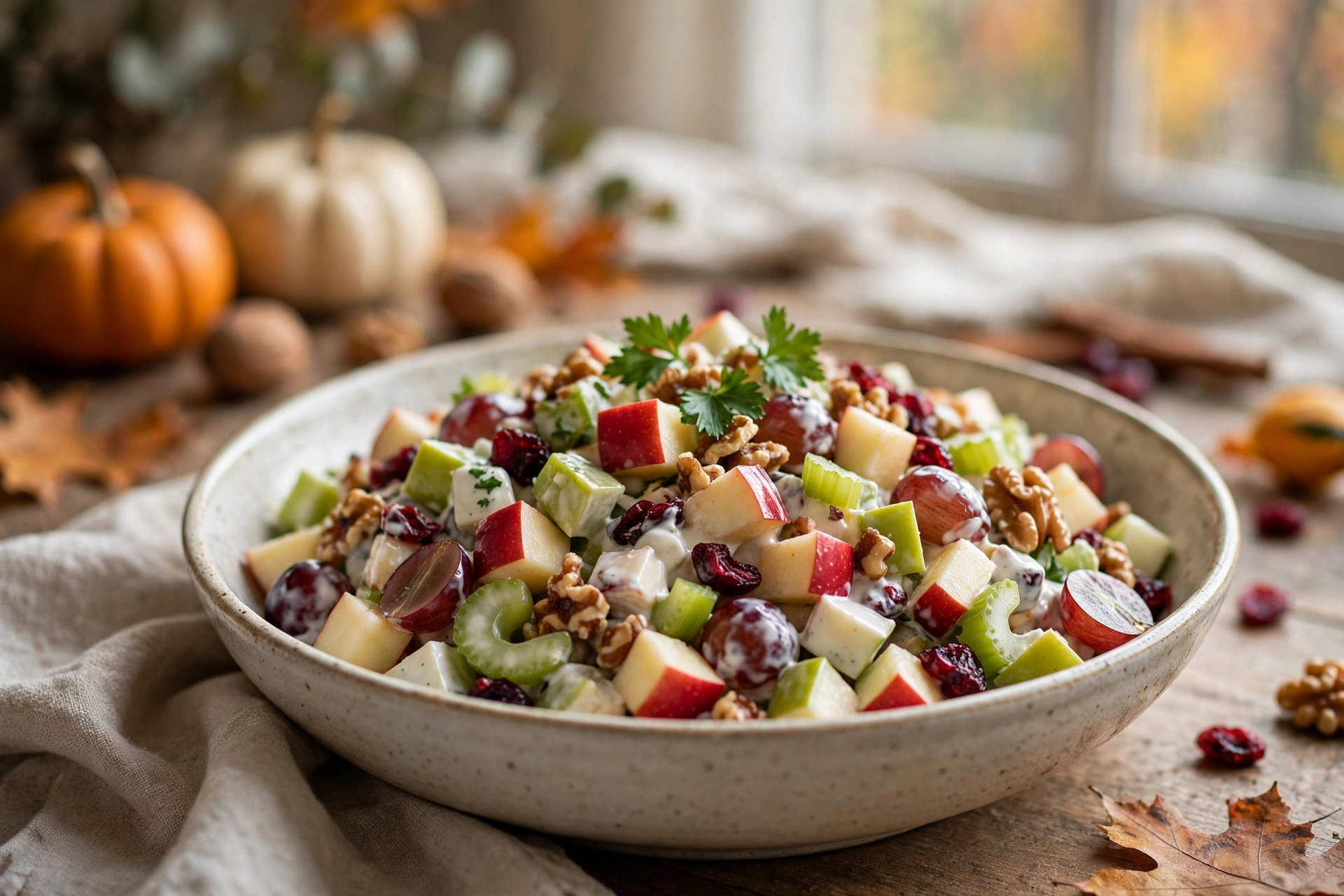
Healthy Waldorf salad stands or falls on its dressing, and this one is a straight swap with a few reinforcements. Nonfat Greek yogurt brings the body and the tang, lemon juice brings the brightness that keeps fruit awake, and Dijon mustard gives the mixture a savory spine so it tastes like a dressing and not like breakfast.
The honey is measured, not poured: one tablespoon across eight servings, just enough to round the yogurt’s edge. Salt is a full half teaspoon, because cold salads eat blander than they taste in the bowl, and black pepper goes in early so it blooms in the acid.
Texture is the honest difference. Mayonnaise coats heavily and sits; yogurt coats thinly and clings. Every piece of fruit stays distinct under a glossy film instead of sinking into a white mass, which is why this salad still crunches at the end of a long meal.
Parsley is the quiet finish. Folded through the dressing it reads as freshness rather than garnish, and a little more scattered at serving makes the bowl look newly made even when it was assembled hours earlier.
One ratio is worth memorizing: one cup of yogurt to two tablespoons of lemon. More lemon and the dressing thins and turns sharp; less and the apples dull by dinnertime. At that ratio, the dressing holds its body and protects the fruit at the same time.
A word on where this salad comes from, because it explains the dressing. The original was served in the 1890s at the Waldorf hotel in New York, and it held only apples, celery and mayonnaise. Grapes and walnuts arrived later, and the bowl has been getting richer ever since. This version simply walks the recipe back toward its first, fresher idea, with better tools than a nineteenth century kitchen had.
Greek yogurt is that better tool. It did not exist on American grocery shelves when the classic took shape, so mayonnaise carried the dressing by default for a hundred years. Now that the swap is available, the lighter construction is not a compromise on the original. It is closer to the point of the dish: fruit and celery, cold and crisp, in a coat that sharpens rather than buries them.
The Waldorf Math: 140 Against 320
The classic Waldorf earns its roughly 320 calories almost entirely in the dressing. Three quarters of a cup of mayonnaise carries more than 700 calories before a single apple is cut, and most recipes use at least that much for a bowl this size.
This version replaces that cup of fat with a cup of nonfat Greek yogurt, about 100 calories for the whole recipe, and moves the richness to a half cup of walnuts where it also brings texture. The salad stops being a vehicle for dressing and goes back to being fruit, celery and nuts in a light coat.
What you keep is everything people actually notice: the snap of celery, the burst of grapes, the toasted depth of walnuts. You also keep about 4 grams of protein and 3 grams of fiber per cup, numbers that reflect what walnuts and apples genuinely contain, as the listings at USDA FoodData Central show for both.
Portion honesty is part of the design here too. The serving is a full cup, a real scoop beside the turkey and not a garnish spoonful, so the comparison with the classic is scoop against scoop. A second helping, the true Thanksgiving unit, still lands under the classic’s first.
Apples, Grapes and Celery: Cutting for Crunch
Use two kinds of apple on purpose. A sweet red apple gives the base note and the color, and one tart green apple keeps the bowl from reading as dessert. Leave the skin on both: it is where the color lives, it slows browning at the edges, and it keeps each cube distinct in the dressing.
Cut everything to one size, roughly half inch pieces. Waldorf fails when the celery is confetti and the apples are boulders, because every spoonful then tastes like a different salad. Even pieces mean the dressing coats evenly and each bite gets fruit, crunch and nut together.
Grapes go in halved, always. A whole grape is a slippery surprise in a dressed salad; a halved one sits still, releases a little juice into the dressing and shows its pale interior, which lightens the whole bowl visually.
The celery deserves crisp ribs from the center of the bunch, sliced thin on a slight diagonal. Outer ribs can be stringy and bitter; the pale inner ribs are sweet and mild. If the celery has gone limp in the drawer, twenty minutes in ice water brings back most of its snap.
Dried cranberries are the Thanksgiving accent: a third of a cup, folded through for color and chew. They are sweet, so they replace any extra honey rather than adding to it, and their ruby flecks make the bowl look dressed for the holiday.
Serve it in a wide, shallow bowl rather than a deep one. The dressing is pale and the fruit is jewel colored, and a wide bowl shows the mix instead of hiding it in layers. A final scatter of parsley and the reserved walnuts across the top, done at the table, makes the salad look freshly tossed even when it was assembled right after breakfast.
Ingredients for Healthy Waldorf Salad
The list splits into a five minute dressing and a bowl of raw crunch, which is the whole charm of the dish. Everything is a supermarket staple in November, and the only cooking in the recipe is toasting the walnuts.
- 1 cup plain nonfat Greek yogurt
- 2 tablespoons fresh lemon juice
- 1 tablespoon honey
- 1 teaspoon Dijon mustard
- 1/2 teaspoon fine sea salt
- 1/4 teaspoon black pepper
- 2 tablespoons chopped fresh parsley, plus more for serving
- 3 large apples (2 sweet red and 1 tart green), cored and diced (about 4 cups)
- 1 1/2 cups red seedless grapes, halved
- 1 1/2 cups celery, thinly sliced (about 4 ribs)
- 1/2 cup walnuts, toasted and roughly chopped, divided
- 1/3 cup dried cranberries
Toast, Whisk, Fold: the Salad in Twenty Five Minutes
The order matters more than the clock here. Dressing first, walnuts cooling, apples cut last and dressed the second they are cut: follow that sequence and the salad protects itself.
- Toast the walnuts in a dry skillet over medium heat for 4 to 5 minutes, shaking the pan often, until fragrant and a shade darker. Tip them onto a plate to cool completely; warm nuts steam the dressing and lose their crunch.
- In a large bowl, whisk the Greek yogurt, lemon juice, honey, Dijon mustard, salt, pepper and parsley until smooth and glossy. This is the whole dressing: no mayonnaise, nothing else hiding in it.
- Dice the apples last, leaving the skin on, and fold them into the dressing the moment they are cut. Coating every cut surface in the lemon yogurt dressing right away is what keeps the apples white for hours.
- Add the grapes, celery, dried cranberries and half the walnuts. Fold gently with a wide spatula until everything is evenly coated and glossy.
- Rest the salad in the refrigerator for 30 minutes so the flavors settle and the celery stays crisp. It can wait up to 4 hours; stir once before serving.
- Spoon into a serving bowl and finish with the remaining walnuts and a little extra parsley, so the crunch lands fresh on top instead of softening in the dressing.
On the Thanksgiving Table: Where a Fresh Salad Earns Its Place
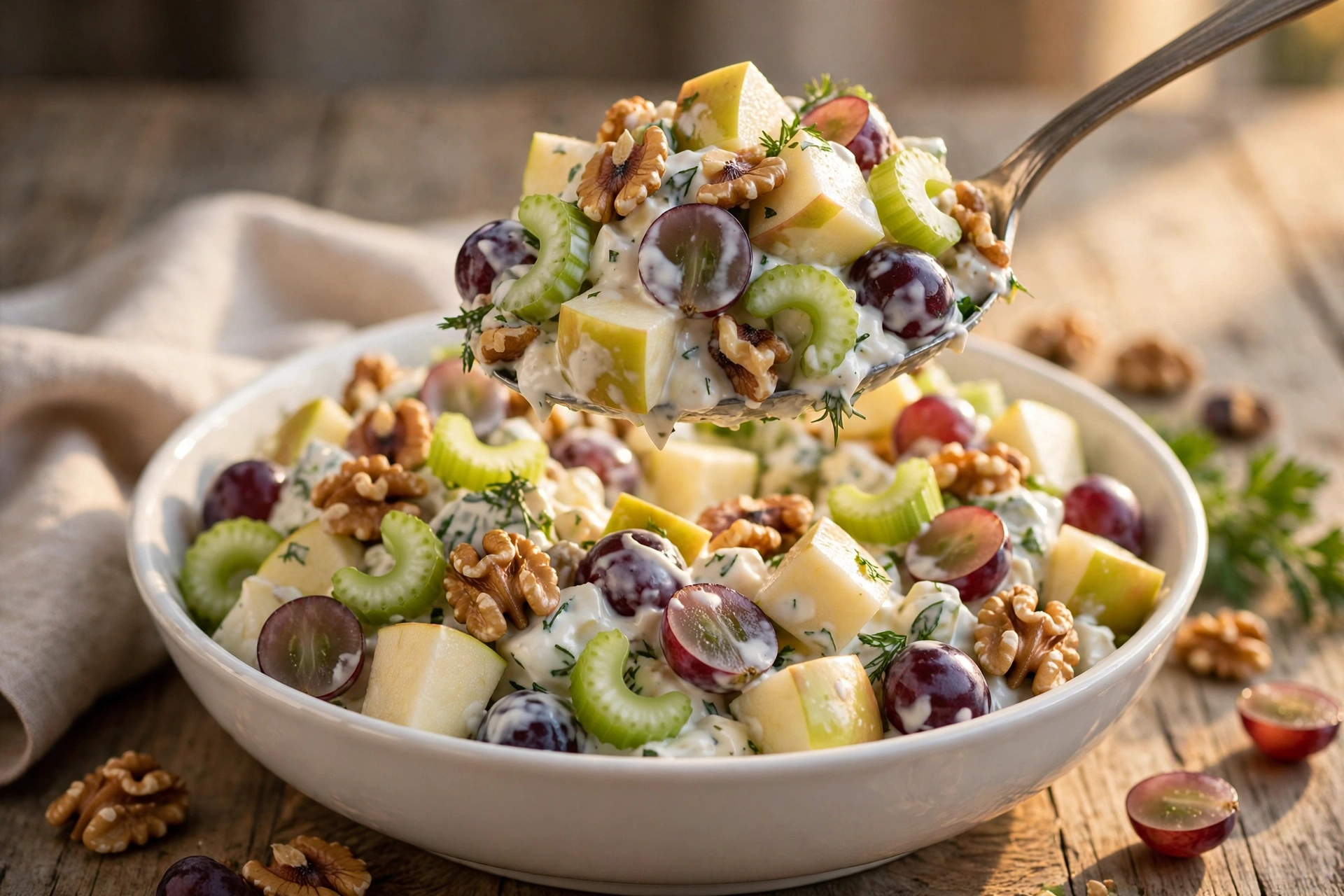
Thanksgiving plates run brown and beige by default, and a cold, bright salad is the relief valve. Set the Waldorf between the rich dishes and it will be revisited more than any of them, because it is the bite that resets the palate between stuffing and gravy.
It also fills the menu’s awkward gap. Beside our healthy mushroom herb stuffing and a bowl of healthy creamed corn, the table has something fresh, something earthy and something sweet, and no two of them compete.
Timing is gentle. The dressing and the toasted walnuts are day before work, ten quiet minutes. The fruit is cut and folded at most four hours before the meal, while the turkey roasts, and the finishing walnuts go on as the bowl is carried out.
For a bigger table, the recipe doubles without any ratio changes, and it holds its crunch better than a dressed green salad ever could next to healthy mashed potatoes and the rest of the hot sides. Serve it cold, straight from the refrigerator, for maximum contrast.
Watery, Brown or Bland: the Three Waldorf Fixes
A watery bowl almost always means the fruit went in wet or the salad sat too long. Pat the grapes dry after halving, dress the apples within minutes of cutting, and if liquid has pooled after chilling, lift the salad out with a slotted spoon into a fresh bowl and leave the puddle behind.
Brown apples are a timing problem, not a lost cause. The lemon in the dressing protects cut surfaces, but only the surfaces it touches, so fold thoroughly. A bowl that has already dulled brightens again with a fresh squeeze of lemon and a spoonful of yogurt whisked and folded through.
Blandness comes from cold. Chilled salads mute salt and acid, so season the dressing slightly bolder than tastes right at room temperature, then taste once more after the rest and adjust. A pinch more salt at the end usually does more than any extra honey.
Soft walnuts are the last quiet failure. They were either added warm or folded in hours ahead. The fix is the recipe’s own habit: half in the salad for flavor, half kept dry in a small bowl and scattered at the table, where they stay toasted and loud.
With Chicken, With Pecans, or Dairy Free
For the days after the holiday, fold in two cups of diced leftover turkey or rotisserie chicken and the salad becomes lunch outright: the same dressing, the same crunch, and enough protein to count as a meal. It packs well and travels to work without complaint.
Pecans swap in for walnuts at a one to one ratio and push the bowl sweeter and more Southern; toast them the same way and watch them closely, because their higher sugar content darkens them fast in a dry pan.
For a dairy free table, use a plain unsweetened coconut or almond yogurt and add one extra teaspoon of lemon juice. The dressing runs slightly softer, so fold gently and serve the salad a little colder than usual to keep its definition.
A lighter still direction: replace half the grapes with diced pear in December, when pears are at their best, and add a pinch of cinnamon to the dressing. The bowl turns wintry without changing its structure or its numbers in any meaningful way.
The Fresh Bowl at a Heavy Table
Healthy Waldorf salad asks for almost nothing: five minutes of toasting, one bowl of whisking, and the discipline to cut the apples last. What it returns is the freshest bite of the holiday, creamy without weight and crunchy to the final spoonful.
Make it for Thanksgiving and it will reappear all winter, beside roast chicken on Sundays and in lunch bowls on Mondays. Some classics survive because they are rich. This one survives because it is awake.
Questions Cooks Ask About Healthy Waldorf Salad
How far ahead can I make healthy Waldorf salad before the apples turn brown?
Assemble it at most 4 hours before serving. The lemon juice in the yogurt dressing protects the cut apples, as long as every piece is folded through and coated. Keep the finishing walnuts separate and add them at the table so they stay crunchy.
Can I make the dressing without any mayonnaise and still have it taste creamy?
Yes, that is the design of this recipe. Nonfat Greek yogurt gives the body, Dijon mustard adds the savory depth mayonnaise usually provides, and one tablespoon of honey rounds the tang. The coat is thinner than mayo but clings well and lets the fruit stay distinct.
What apples work best in a Waldorf salad?
A mix is best: two sweet red apples such as Honeycrisp or Fuji for the base and one tart green apple such as Granny Smith for contrast. Leave the skin on for color and structure, and dice everything to about half an inch so each spoonful is balanced.
My Waldorf salad went watery in the refrigerator. What went wrong?
Usually the grapes went in wet or the salad sat past its best window. Halve and pat the grapes dry, dress the apples right after cutting, and serve within 4 hours. If liquid has pooled, lift the salad into a fresh bowl with a slotted spoon and leave the liquid behind.
Can I turn this Waldorf salad into a main dish?
Fold in about 2 cups of diced cooked chicken or leftover Thanksgiving turkey and it becomes a complete lunch with roughly 12 grams of protein per cup. Add the meat at serving time rather than ahead, so the dressing stays bright and the celery stays crisp.