Healthy Coconut Macaroons, Chewy Centers, Golden Edges and Real Honey
Healthy Coconut Macaroons, Chewy Centers, Golden Edges and Real Honey
In this article:
- The Whipped Whites Do the Lightening
- Real Honey, Measured in Tablespoons
- Ingredients for Healthy Coconut Macaroons
- Whip, Fold, Scoop: Golden in Eighteen Minutes
- Spread, Weep or Scorch: Reading the Tray
- Built for the Christmas Cookie Box
- Orange, Peppermint and Chocolate Bottoms
- The Cookie That Tastes Like the Bakery Case
- Questions Bakers Ask About Coconut Macaroons
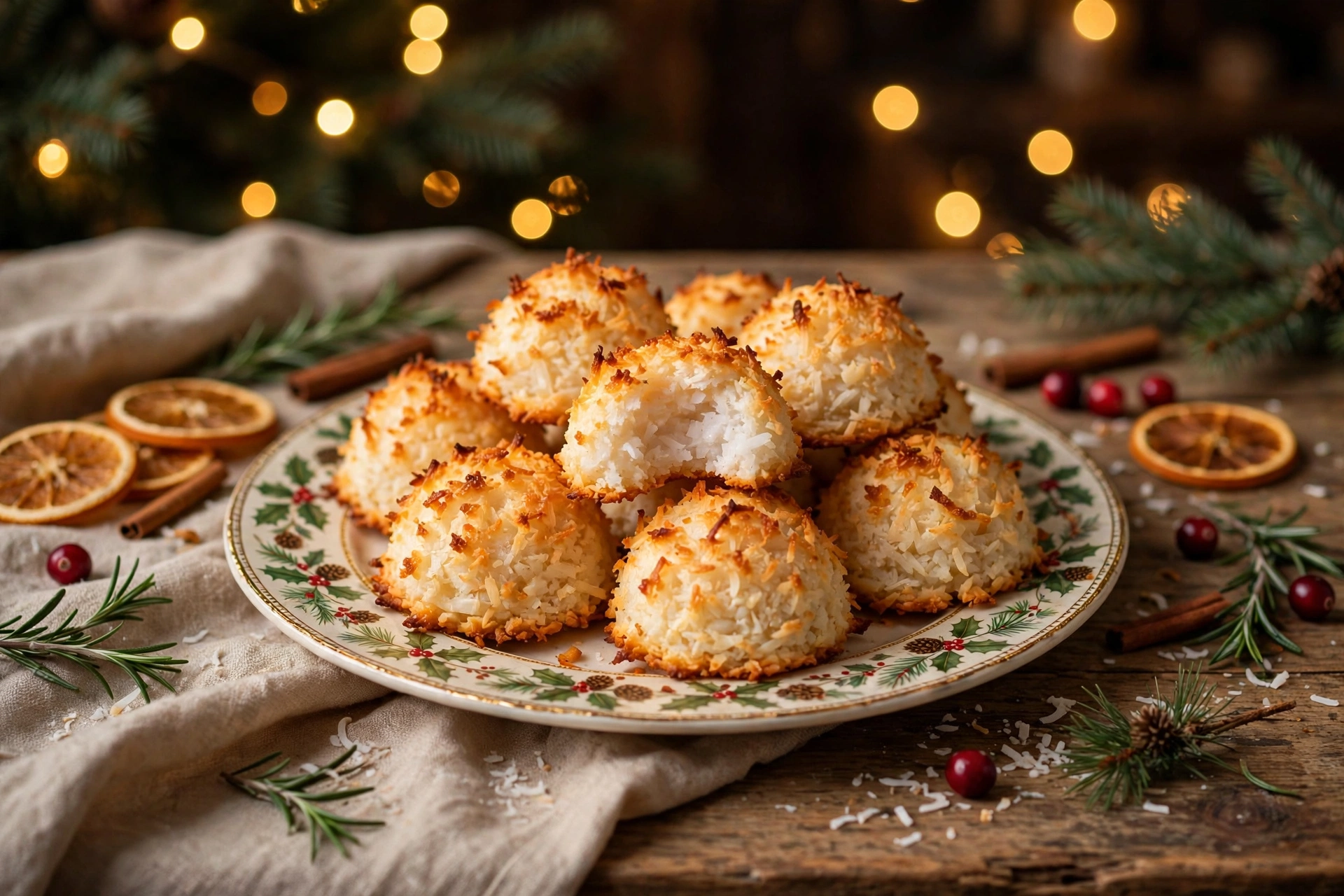
Every Christmas cookie plate has a soft spot, and it is usually the macaroon: a shaggy golden mound, crisp at the edges, chewy as taffy in the middle, gone in two bites.
The classic version earns that chew with a full can of sweetened condensed milk, which is also why it lands near 160 calories a cookie. These healthy coconut macaroons keep the texture and cut the freight to about 95 calories each, with no sweetener blends, no condensed milk and nothing that tastes like a substitute.
The trick is structural rather than chemical. Egg whites whipped to soft peaks do the lifting that sugar syrup usually does, and a measured third of a cup of honey carries the sweetness for the whole batch of twenty four.
They also happen to be the fastest cookie in the December rotation. No butter to soften, no dough to chill, no rolling or cutting: one bowl of foam, one bowl of coconut, a scoop and a short bake. From craving to warm cookie in about thirty five minutes flat, with a sink that holds exactly two bowls and one spatula.
The Whipped Whites Do the Lightening
Healthy coconut macaroons stand on a bowl of foam. Most recipes stir raw egg whites into coconut and lean on sugar for structure, which is why lighter versions so often bake up flat, wet or grainy. Whipping changes the physics of the cookie entirely.
Beaten to soft, glossy peaks, the whites trap thousands of tiny air pockets. Folded through the coconut, that foam holds the mounds tall in the oven, sets into a delicate scaffold, and leaves the center moist instead of dense. The cookie reads rich because it is airy, not because it is heavy.
Room temperature whites whip faster and higher than cold ones, so the eggs should sit out for thirty minutes before baking. The bowl must be scrupulously clean; a trace of yolk or grease can keep the foam from forming at all.
Soft peaks, not stiff, are the target. A foam whipped too far turns dry and clumpy, and it folds into the coconut in streaks instead of a smooth batter. Stop when the peaks curl over at the tip when the whisk lifts.
A stand mixer makes the whipping effortless, but a hand mixer reaches the same place about a minute later, and a strong arm with a balloon whisk gets there too, with more character. What matters is not the tool but the stopping point, and the discipline to fold rather than stir once the coconut goes in.
Folding deserves its own thirty seconds of attention, because it is where this recipe is won or lost. Add the coconut in two additions, not one, and cut down through the center of the bowl with a flexible spatula, then sweep along the bottom and lift the batter up and over. Turn the bowl a quarter turn and repeat. The motion feels slow, almost lazy, and that is correct: eight to ten patient folds keep the air, while twenty brisk stirs would pour it away.
Real Honey, Measured in Tablespoons
The first page of light macaroon recipes runs on monk fruit, stevia and sugar free syrups, and each carries its own aftertaste or cooling effect. This recipe declines the trade. Real honey, a third of a cup across twenty four cookies, works out to roughly two teaspoons of sugar per cookie.
Honey also behaves better in the oven than granulated sugar here. It dissolves into the foam without graininess, helps the edges caramelize to a deep gold, and its floral note sits naturally beside toasted coconut. A mild clover or orange blossom honey keeps the flavor clean.
The unsweetened coconut is the other half of the equation. Sweetened shredded coconut, the bag most classic recipes assume, carries about fifty grams of added sugar per cup before anything else joins the bowl. The unsweetened kind lets the honey be the only sweetener, counted and deliberate.
Unsweetened coconut is naturally rich in fiber and minerals for a cookie ingredient, a profile documented in the USDA FoodData Central database. None of that makes a macaroon a health food. It makes it an honest one, which is the standard this kitchen keeps.
Maple syrup can stand in for the honey at the same measure, for bakers who keep it on hand or cook for someone avoiding honey. The flavor leans warmer and slightly darker, and the edges color a shade deeper. Agave works as well but tastes flatter; honey remains the first choice for both flavor and browning.
Ingredients for Healthy Coconut Macaroons
- 3 cups unsweetened shredded coconut
- 1/4 cup almond flour
- 1/4 teaspoon fine sea salt
- 3 large egg whites, at room temperature
- 1/3 cup honey
- 1 teaspoon pure vanilla extract
- 1/4 teaspoon almond extract, optional
- 1 ounce dark chocolate, melted, for a light drizzle, optional
The coconut should be shredded, not flaked and not desiccated. Long shreds give the macaroon its shaggy edges and chewy pull; very fine desiccated coconut bakes up dry and sandy. If the bag feels stale or papery, a fresh bag is worth it.
Almond flour is the quiet binder, two tablespoons more than a whisper, and it catches the honey that would otherwise pool under the cookies. The almond extract is optional but lovely, a bakery note behind the vanilla. The chocolate is a drizzle, not a dip, and it is counted separately in the notes below.
Whip, Fold, Scoop: Golden in Eighteen Minutes
- Heat the oven to 325°F (165°C) and line a large baking sheet with parchment. In a bowl, stir the coconut, almond flour and salt together.
- In a clean, dry bowl, whip the egg whites to soft, glossy peaks, about 2 to 3 minutes with an electric mixer.
- Drizzle in the honey, vanilla and almond extract, and whip 15 seconds more, just until the foam turns satiny.
- Fold the coconut mixture into the foam in two additions, turning the bowl and lifting from the bottom, until no dry coconut remains and the batter holds soft mounds.
- Scoop 24 mounds of about 2 tablespoons each onto the sheet, spacing them an inch apart, and tidy any stray shreds with damp fingers.
- Bake 16 to 18 minutes, rotating the pan once, until the edges and tips are deep golden and the centers still look slightly pale.
- Cool on the pan for 10 minutes, then move to a rack. Drizzle with the melted dark chocolate if you like, and let it set before boxing.
Spread, Weep or Scorch: Reading the Tray
Macaroons that spread into puddles were folded too hard or scooped from a foam that had already fallen. The air is the structure; treat the batter like a soufflé base, fold gently, and get the tray into the oven within a few minutes of mixing.
A sticky syrup weeping from the bottoms means the honey pooled instead of dispersing. Warm honey that has crystallized so it pours in a thin stream, drizzle it slowly over the whipping whites, and make sure the almond flour is evenly stirred through the coconut before folding.
Scorched tips with pale sides point to an oven running hot or a dark pan. Macaroons color fast because of the honey, so check at fourteen minutes the first time you bake them. A light colored pan and the middle rack keep the browning even.
Cookies that crumble when lifted were underbaked or moved too soon. The bases should feel set and release from the parchment with a thin spatula after the ten minute rest. A macaroon that bends slightly rather than snapping is exactly right.
Uneven mounds bake unevenly, which is why a small cookie scoop earns its drawer space here. Two level tablespoons, packed lightly, give cookies that finish at the same moment and box in tidy rows. If the last scoop of batter looks sparse, redistribute rather than baking one thin, sad cookie that browns before the rest.
Built for the Christmas Cookie Box
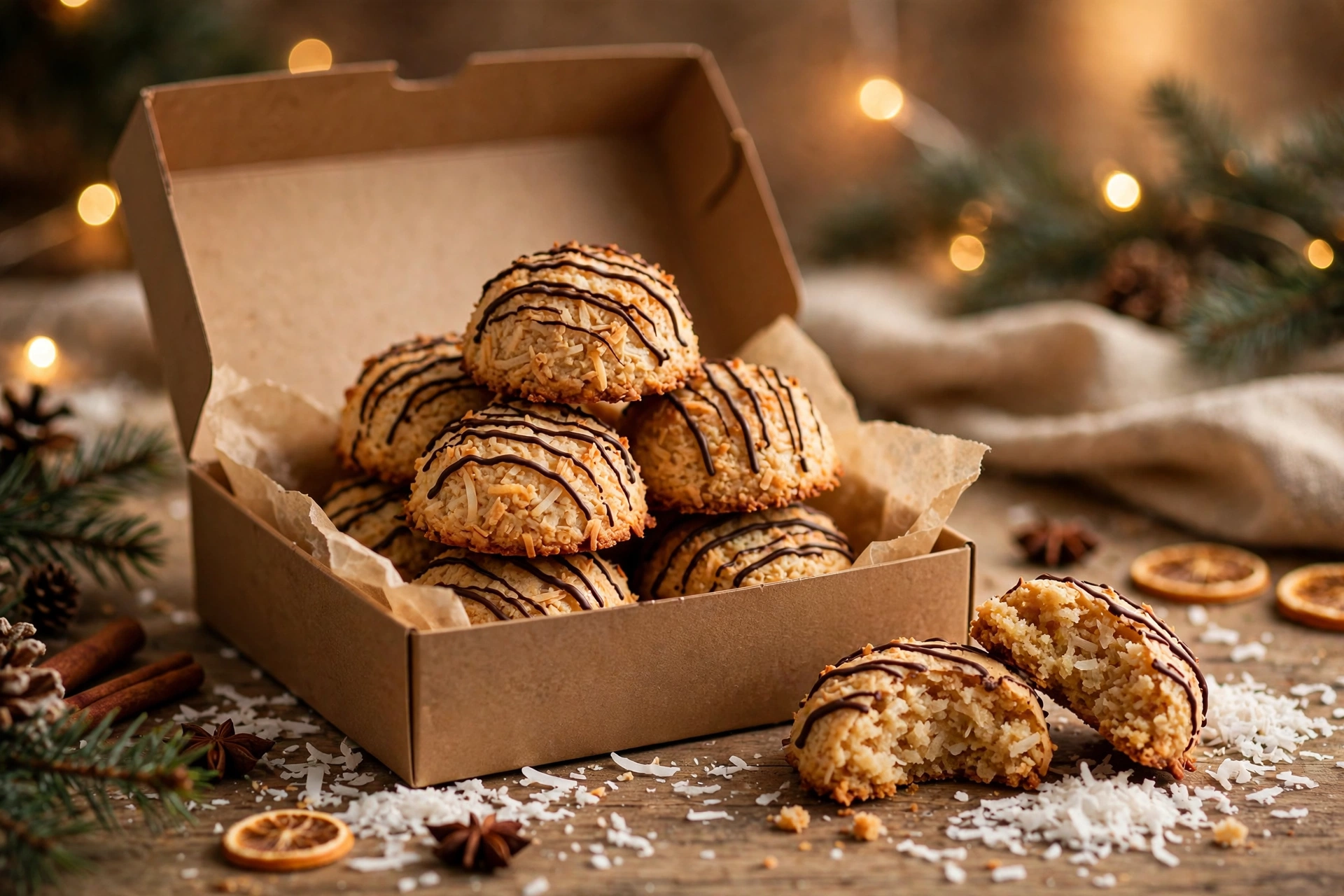
Cookie boxes punish delicate baking, and macaroons are the rare cookie that travels like a champion. They are sturdy, they stack without crushing, and their flavor deepens on the second day as the centers settle into chew. On a mixed plate beside healthy almond snowball cookies and healthy peppermint truffles, they are usually the first compartment to empty.
The make ahead math is friendly. Baked macaroons freeze for up to two months in a sealed container, layered between parchment, and they thaw at room temperature in under an hour. Baking a double batch in early December removes one whole job from the busy final week.
For gifting, box them the day after baking rather than the hour they cool; the texture is at its best once the centers have set overnight. Keep them in their own compartment or parchment sleeve, since coconut politely perfumes anything stored against it, including the healthy thumbprint cookies in the next row.
At room temperature in a sealed tin, the cookies keep five to six days and stay chewy. If they firm up in a dry kitchen, ten seconds in the microwave or a slice of bread in the tin overnight restores the soft center.
One more box virtue deserves a line: these cookies are naturally gluten free, with no special flour blend and no gritty substitute texture. On a plate where a few guests always scan for something they can eat, the macaroons quietly solve the problem while tasting like the cookie everyone reaches for anyway.
Orange, Peppermint and Chocolate Bottoms
Orange zest is the smallest change with the largest effect. A teaspoon folded into the coconut turns the whole batch toward a holiday creamsicle note, and it pairs naturally with the dark chocolate drizzle. Candied zest on top is decoration the calories can afford.
For a peppermint turn, swap the almond extract for a quarter teaspoon of peppermint extract and press a few crushed candy cane crumbs onto the tops before baking. Set beside healthy chocolate fudge, the plate reads unmistakably like December.
Chocolate bottoms, dipped rather than drizzled, add about fifteen calories a cookie and a satisfying snap. Dip the cooled bases in melted dark chocolate, set them chocolate side down on parchment, and chill ten minutes. Choose the drizzle for everyday batches and the dip for the gift boxes.
A cocoa version folds a tablespoon of unsweetened cocoa powder in with the almond flour and skips the drizzle. The result is darker, less sweet tasting and excellent with coffee, though the mounds will look less golden.
A lemon version, zest of one lemon folded in and the almond extract left out, belongs to the spring plate more than the Christmas one, but it is worth knowing in December too: the brightness cuts through a box of otherwise rich cookies, and lemon with coconut is a pairing that never needs explaining.
The Cookie That Tastes Like the Bakery Case
Healthy coconut macaroons prove the point this site keeps making: the light version wins when it is built on technique instead of substitutes. Whipped whites for structure, real honey in a measured amount, coconut doing what coconut does best.
Bake them once and watch the plate. Nobody at the cookie exchange will file them under diet food. They will ask for the recipe, which is the only review a Christmas cookie has ever needed, and the kindest thing one baker can hand another in December.
Questions Bakers Ask About Coconut Macaroons
Can I use sweetened shredded coconut instead?
You can, but the cookies will be far sweeter and the honey should drop to 3 tablespoons. Expect about 25 extra calories a cookie and a softer set, since sweetened coconut carries added moisture and sugar.
Why do my macaroons fall apart after baking?
Usually the foam was underwhipped or the cookies moved before setting. Whip to soft glossy peaks, fold gently, and give the tray the full 10 minute rest so the bases firm up before lifting.
Do the egg whites really need to be room temperature?
It helps more than any other small step. Room temperature whites whip faster and reach a higher, more stable volume, which is the structure of this cookie. Thirty minutes on the counter is enough.
Can I freeze coconut macaroons for a cookie box?
Yes, they freeze beautifully for up to two months, layered between parchment in a sealed container. Thaw at room temperature for about an hour and add the chocolate drizzle after thawing for the cleanest finish.
Why did the bottoms brown faster than the tops?
Dark pans and a low rack concentrate heat on the bases, and honey caramelizes quickly. Use a light colored pan on the middle rack, and check the tray at 14 minutes the first time you bake the recipe.